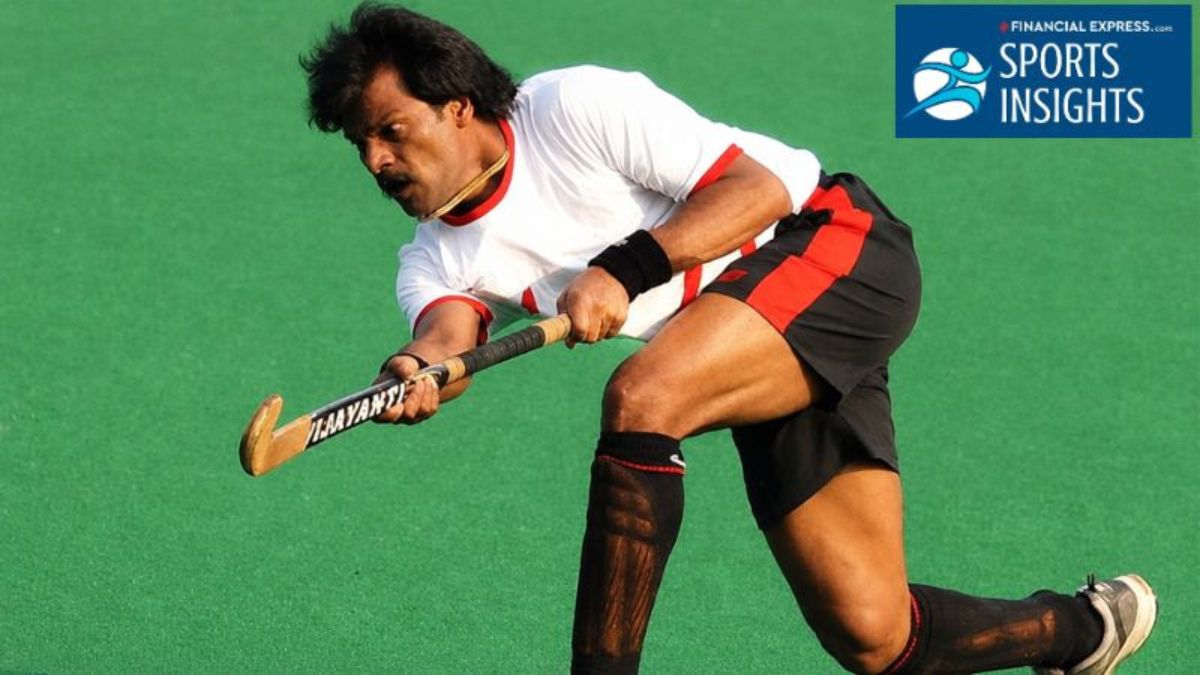
While cricket made Sachin a crorepati, India’s Hockey legend relied on a meagre allowance
For 15 years Dhanraj Pillay was the face of Indian hockey. His family named him hoping he would end their poverty. The story of what he earned shows what it costs to be great at a sport India loves but does not pay for.
In the late 1990s, when Sachin Tendulkar was signing deals worth crores and the Board of Control for Cricket in India (BCCI) was learning to count television money, the best hockey player in the country was surviving on a meagre allowance of $20. Sometimes less, depending on which official was feeling generous that week. Pillay did not complain much. He could not afford to. He was the fourth son of a groundsman at the Ordnance Factory in Khadki, a garrison town outside Pune.
His father Nagalingam swept and patched the factory grounds. His mother Andalamma raised five boys in staff quarters so small that privacy was a luxury they never had. When young Dhanraj wanted to play hockey, there was no money for a proper stick. So he picked up broken ones thrown away by older players, tied the splinters together with gunny-sack string and resin glue, and ran barefoot on mud that cut his feet.
That boy went on to play 339 matches for India. Score around 170 goals. Become the only field hockey player on the planet to appear in 4 Olympics, 4 World Cups, 4 Champions Trophies and 4 Asian Games. He captained India to its first Asian Games hockey gold in 32 years in Bangkok in 1998, finished as the tournament's top scorer with 11 goals, and carried the national flag at the opening ceremony. For this, the system gave him a job at Indian Airlines.
A flat in Powai, arranged in 48 hours by Bal Thackeray. And years later, when he tried to give back through his own academy, he ended up collecting empty printer cartridges from Mumbai offices to keep the lights on. This is not a sad story. It is a business story. One that tells you exactly how Indian sport worked before the IPL taught everyone what an athlete is worth. 6 seconds. With a hockey ball on his stick.
That is not a statistic. That is the entire story. No Indian forward before or since has combined that raw pace with that level of ball control at full sprint. It made him "Toofan," the Tornado, to fans in Chennai who called him "Enga Veettu Pillay," our home boy. It made him the most feared striker in Asia. And it made him, according to the market's own valuation, worth approximately nothing. Here is the bargain bin framing that defines his entire career.
In 1985, when his elder brother Ramesh, himself an India international, brought 17-year-old Dhanraj from Khadki to Mumbai's cutthroat hockey league, the boy had no equipment, no academy training, no sponsor. He had speed. Former Indian defender Joaquim Carvalho recruited him to Mahindra & Mahindra's corporate team, where Pillay earned his first stable income as a Junior Assistant. The market said he was a utility player.
The truth was that India had just signed its greatest forward of the modern era for the price of a junior clerical salary. (Photo: Express Archive) The PSU Salary Behind the National Jersey Walk into Air India office and you might still find him. Deputy General Manager. Joint Secretary of the Air India Sports Promotion Board. The titles are real, the pension is real, the healthcare benefits are real.
Pillay spent his entire playing career as a public sector employee who happened to be the fastest man on a hockey pitch. This was the deal Indian hockey offered its stars in the 1990s. No central contracts. No guaranteed annual retainers. No broadcast money trickling down. The Indian Hockey Federation under KPS Gill ran a tight ship, and the players were the cargo. Daily allowances on foreign tours could be as low as $20 a day.
Match fees were promises, not payments. So the Public Sector Undertaking stepped in. Air India, Indian Airlines, Bharat Petroleum, Indian Oil, the Railways. They recruited elite athletes under sports quotas, gave them salaries, housing allowances, job security. It was not glamour. It was survival. And for Pillay, it was the only reason he could keep playing. While cricket players were becoming equity holders in the new economy of Indian sport, hockey players were becoming clerks.
Good clerks. Pensionable clerks. But clerks. The foreign clubs paid better. HC Lyon in France. HTC Stuttgart Kickers in Germany, where he was playing when his mother accepted the Khel Ratna on his behalf from President K.R. Narayanan because he could not fly back. Telekom Malaysia. Selangor. Abahani in Dhaka. Khalsa in Hong Kong. They paid in Deutsche Marks, Euros, Pounds, Ringgit. Hard currency that actually meant something when converted to rupees.
Those stipends, plus housing and bonuses, were his real hockey income. The Indian jersey came with applause. The European contracts came with money. The 1998 Gold That Changed Nothing, Then Everything For 32 years, Indian hockey did not win an Asian Games gold medal. Children were born, finished school, married, and had children of their own between 1966 and 1998. Generations of Indian forwards tried and failed to break that drought.
Then, in December 1998, a 30-year-old forward from a Tamil migrant family carried the Indian flag into Bangkok's National Stadium. Pillay led India to the Asian Games final against South Korea. The match went to a penalty shootout. India won 4-2. The gold medal ended a 32-year wait. Pillay scored 11 goals in the tournament, the most by anyone. What nobody knew was that the man who broke the drought had spent his childhood playing barefoot on mud, holding his hockey stick together with gunny-sack string and adhesive because his family could not afford a new one.
Back home, the Shiv Sena government in Maharashtra announced rewards. Bal Thackeray, the party chief, personally intervened. Pillay had spoken about not owning a house in Mumbai. Thackeray summoned him to Shiv Sena Bhavan and promised government housing. Within 48 hours, Pillay had the keys to a flat in Powai. A real estate asset in one of the city's fastest growing suburbs. That flat is still the most concrete return he ever got from Indian hockey.
Then came the axe. Pillay and five other senior teammates publicly criticised the IHF over poor receptions, unpaid fees and those $20 daily allowances. The federation responded by dropping all of them. Officially, the players were being rested. Everyone knew it was punishment. The outrage forced a recall, but the message landed. Ask for money and you are replaceable. Pillay kept asking. For the rest of his career, and after it.
The Awards and the Real Earnings The Arjuna Award came in 1995. The Rajiv Gandhi Khel Ratna for 1999-2000 made him the first hockey player to receive India's highest sporting honour. The Padma Shri followed. When Pillay was selected for the Khel Ratna, he was overseas on a European club contract. He asked the Ministry of Youth Affairs and Sports to let his mother receive the award from the President at Rashtrapati Bhavan on his behalf.
Andalamma, who had struggled through extreme poverty to fund his early hockey days, stood in for her son. Pillay later said watching that video meant more than any trophy he had personally lifted. The cash prize that came with the Khel Ratna was modest. The award's purse was raised from ₹1 lakh to ₹3 lakh around 2000, and it would not reach ₹25 lakh until 2020. By the standards of the IPL era that would arrive eight years later, it was a fraction of what even a fringe Indian cricketer might earn for a single season of warming benches.
Each award carried a cash prize. Incremental. Symbolic. Nothing that compared to what a single IPL season would later pay a squad player. (Photo: Express Archive) The Cartridge King of Mumbai Hockey Pillay opened the Dhanraj Pillay Hockey Academy in Mumbai. Free coaching. Free equipment. Free nutrition. For kids from families like his, the ones who could not afford sticks, let alone astroturf time.
He was the founder, the managing trustee, the chief fundraiser and the mentor for all kids. The academy ran for about 10 years. It never made money because it was never supposed to. It was supposed to find the next Pillay. But the Mumbai Hockey Association refused regular access to its astroturf facilities for his trainees. Sponsorships were promises that died in boardrooms. Corporate India loved putting his face on a poster.
Writing a cheque was different. So Pillay got creative. He launched a collection drive across Mumbai corporate offices. Empty plastic printer ink cartridges. He gathered them by the bagful, shipped them to a European recycling firm, and used the proceeds to pay for kits, travel and food for his academy players. The Tornado of Indian Hockey, the man who once dribbled past entire defences, was now negotiating the scrap value of toner cartridges.
It worked for a while. Then it did not. Around 2016, the academy closed. Funding had dried up. The facility problem never went away. Hundreds of kids lost their free training ground. Pillay lost a decade of his life and a large chunk of his savings. He then partnered with the Gujarat government to direct the SAG Hockey Academy, using state capital to build modern training pipelines. His mentorship produced national-level players, including goalkeeper Bansari Solanki.
The man whom Mumbai's hockey establishment would not give a turf to became the architect of Gujarat's hockey infrastructure. The Antitrust Rebel In 2011, Hockey India threatened to ban any player who signed with the unsanctioned World Series Hockey league. The WSH was offering retainers between ₹5 lakh and ₹25 lakh per season for top Indian players. Real money. Finally. Pillay and fellow Olympians filed a case before the Competition Commission of India.
Case No. 73 of 2011. They argued that a federation could not stop athletes from earning a living. The CCI eventually ruled that Hockey India had not abused its dominant position, but the proceedings forced the establishment to separate regulatory governance from commercial leagues. That separation paved the way for the Hockey India League and for every player-friendly contract that followed. Pillay played in the WSH himself in 2012, for the Karnataka Lions.
He was 43. He scored 2 goals. He had played in the Premier Hockey League before that, spending two seasons with the Maratha Warriors (2006-2008). Neither league survived. The money was not enough to build a pension, but it was enough to prove a point. Hockey players were worth something. Someone had to say it out loud in a courtroom. The Business of Being Dhanraj Pillay Celebrity net worth websites claim Pillay is worth around ₹15-16 crore.
Financial Express has not verified these numbers independently. There is no documentation for this. No corporate filings. No tax records. No directorships in listed companies. The real portfolio is simpler. A Powai flat. The Bopodi flat in Pune he bought for his mother. An Air India pension. Fees from leagues that no longer exist. A Gujarat government contract that paid him as Technical Director and High Performance Director of the state hockey academy from around 2014 to 2019.
Post-retirement, Pillay built a portfolio that reflects his origins: no inherited wealth, no corporate backing, only public sector stability and foreign currency earned the hard way. Air India, his employer since his playing days, promoted him to Deputy General Manager in Mumbai. As Joint Secretary of the Air India Sports Promotion Board, he managed sports quota recruitments and athlete welfare, giving young players the institutional support he never had.
His foreign club contracts with HC Lyon in France, HTC Stuttgart Kickers in Germany, Telekom Malaysia, and Abahani Limited in Dhaka provided the capital for his first major asset: a modest 2-BHK apartment on Bhau Patil Road in Bopodi, Pune, bought in 1994 for his mother. In 1999, Mahindra & Mahindra gifted him his first vehicle, a second-hand Mahindra Armada. In 2000, he bought his first new car, a Ford Ikon, with a ₹5 lakh bank loan he repaid in monthly installments.
After the 1998 Asian Games gold, Shiv Sena chief Bal Thackeray facilitated a state government flat in Powai, Mumbai, a property Pillay has repeatedly said he could never have afforded on his playing income alone. His net worth today derives from his Air India executive salary, government sports pensions, his directorship at the Sports Authority of Gujarat hockey academy, real estate appreciation in Mumbai and Pune, and the Khel Ratna corpus.
It is a financial blueprint built on patience, not endorsements. In February 2014, Pillay briefly joined the Aam Aadmi Party, drawn to its anti-corruption platform, before stepping back to focus on sports administration. In April 2020, he donated ₹5 lakh from his personal savings to the PM-CARES Fund during the COVID-19 pandemic. Throughout his post-retirement life, he has quietly funded hockey sticks, equipment, and travel for players from poor families, ensuring that talent is not lost to poverty as his own nearly was.
His second act is worth Rs 178 crore The Boy From Khadki Is Still Barefoot Somewhere Pillay is in his late fifties now. The DGM cabin at Air India is his office. The Powai flat is his home. The medals are in a cupboard. The 339 matches exist in record books and memory, because the IHF never kept proper logs. The 170 goals are an estimate. Even his statistics are unofficial, the way his entire career was unofficial in the eyes of the money men.
But go to any muddy ground in any factory colony in India. You will find a kid with taped shoes and a second-hand stick who has never heard of central contracts or franchise auctions. That kid is the real legacy. Pillay proved that such a kid could carry the flag at the Asian Games. He also proved that the system would make that kid fight for every rupee, every facility, every ounce of respect. He fought.
He is still fighting. The cartridges are gone, but the anger is not. And somewhere in Khadki, on the same rough ground where a groundsman's son once played barefoot, another boy is tying two broken sticks together with string. He does not know it yet, but he is already worth more than the system will ever pay him. Pillay knows. He has always known. That is why he kept the string. Editorial Note: This is an independent profile.
Dhanraj Pillay and their representatives were contacted but did not respond prior to the time of publication. In the absence of direct comment, this article was reported using publicly available records and regulatory filings, where applicable. This content was produced in accordance with FinancialExpress.com’s editorial guidelines.