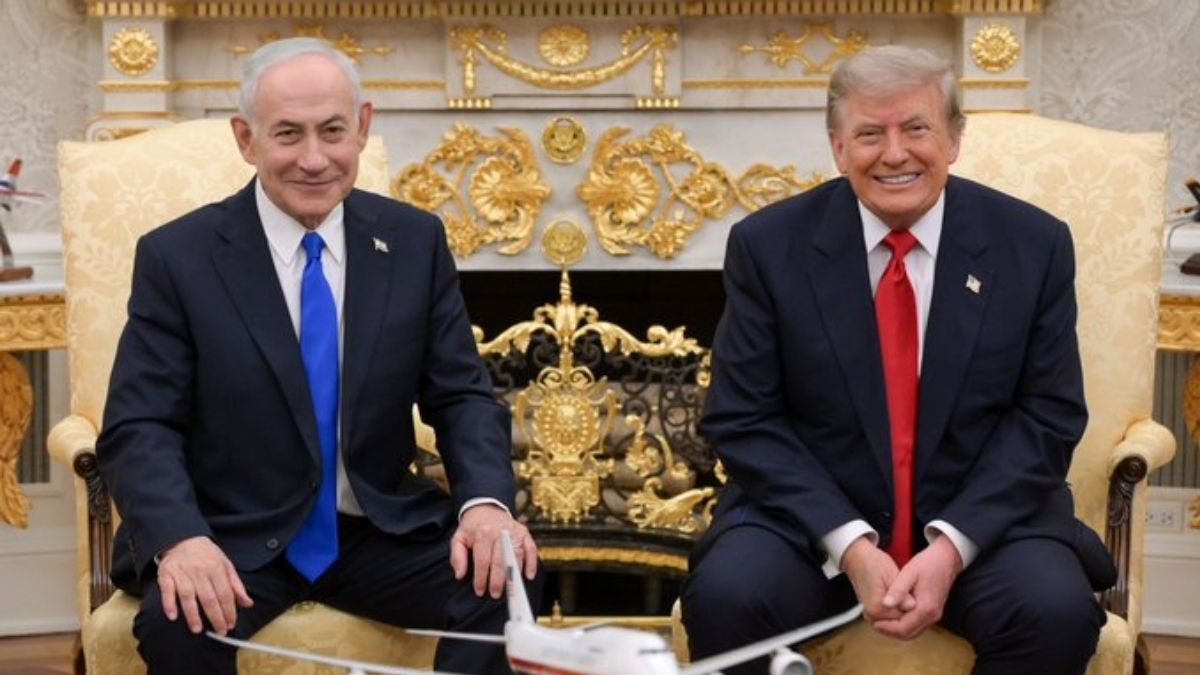
‘Israel doesn’t need it’: Trump says US will stop $4 billion annual funding by year-end
Read how Trump says the US will end $4B in annual Israel funding by late 2026 after a Netanyahu deal, with aid pact details unclear.
US President Donald Trump on Tuesday said the United States would stop providing $4 billion in annual funding to Israel after the end of 2026. He said he had reached an agreement with Israeli Prime Minister Benjamin Netanyahu to end the financial support. Trump said the decision had been discussed with Netanyahu months ago on Fox News. He added Washington would continue to help Israel if the country needed support in the future.
"Now, as far as paying Israel, Bibi Netanyahu and I have made a deal that we give Israel $4 billion a year, and we made a deal months ago that we're stopping," Trump told Fox News "We've already agreed that by the end of this year we won't be paying Israel. Now we'll help Israel if they need it," he said. Trump said Israel was now financially strong enough to manage without American funding. He also added that the annual payment had become a political issue in the United States, with some Democrats and left-wing politicians using it to criticise Republicans.
"The left uses the $4 billion payment that everybody knows about, well it's no secret, as a signal of unfairness, and we can't allow that to happen," Trump said. "We were giving them 4 billion, we are, but it gets cut off at the end of the year," he added. It is not immediately clear which specific funding programme Trump was referring to or how the proposed change would be carried out. The United States currently provides Israel with around $3.8 billion in annual military assistance under a 10-year agreement signed in 2016.
The agreement covers the period from 2019 to 2028. The arrangement includes $3.3 billion in Foreign Military Financing and $500 million for missile defence programmes. Most of the military assistance is used by Israel to purchase weapons and military equipment manufactured in the United States. The current agreement is due to expire in 2028. Discussions have been taking place between the two countries on how American military assistance to Israel could change after the agreement ends.
Trump's announcement, however, points to a possible end to the annual funding much earlier, by the end of 2026. He did not explain whether the existing agreement would be changed or whether the announcement referred to a different funding arrangement. Trump also indicated that Israel would still be able to purchase American weapons even after the financial assistance ends. "They can buy whatever they want.
They can buy whatever they want. So can Europe. We make the greatest weapons in the world," Trump said. This indicates that Washington could continue its defence trade with Israel even if it stops providing direct financial assistance. In a May interview with CBS, the Israeli prime minister said he hoped to gradually reduce the country's reliance on US military support over the next decade. In a June letter to a US congressman, Netanyahu said the time had come for Israel "to move from aid recipient to partner."
Trump's statement indicates that the two leaders have discussed ending the financial arrangement. However, Netanyahu's earlier statements pointed to a gradual reduction in aid over several years rather than an immediate end to the funding. US funding to Israel becomes a political issue American financial and military support for Israel has faced growing criticism in the United States since the Gaza war began in 2023.
The issue has become particularly sensitive among Democratic voters. Several Democratic lawmakers and candidates have become increasingly critical of Washington's support for Israel. Candidates opposing continued military assistance have also gained support in Democratic primary elections. The issue has also created divisions within the US Congress. In July, the House of Representatives rejected an amendment seeking to cut off aid to Israel.
The proposal, introduced by outgoing Republican Representative Thomas Massie of Kentucky as part of a State Department spending bill, was defeated by 314 votes to 104. Trump's announcement came as voting began in the 2026 US midterm elections, in which Republicans are facing a major political test. He said the annual funding had become a talking point for politicians criticising the Republican Party.