What triggered fresh clashes in Paris, Marseille despite heavy security?
Hundreds of thousands protested across France against rising living costs and inequality, with clashes erupting in Paris and Marseille despite heavy security. Demonstrations also spread to other European cities.
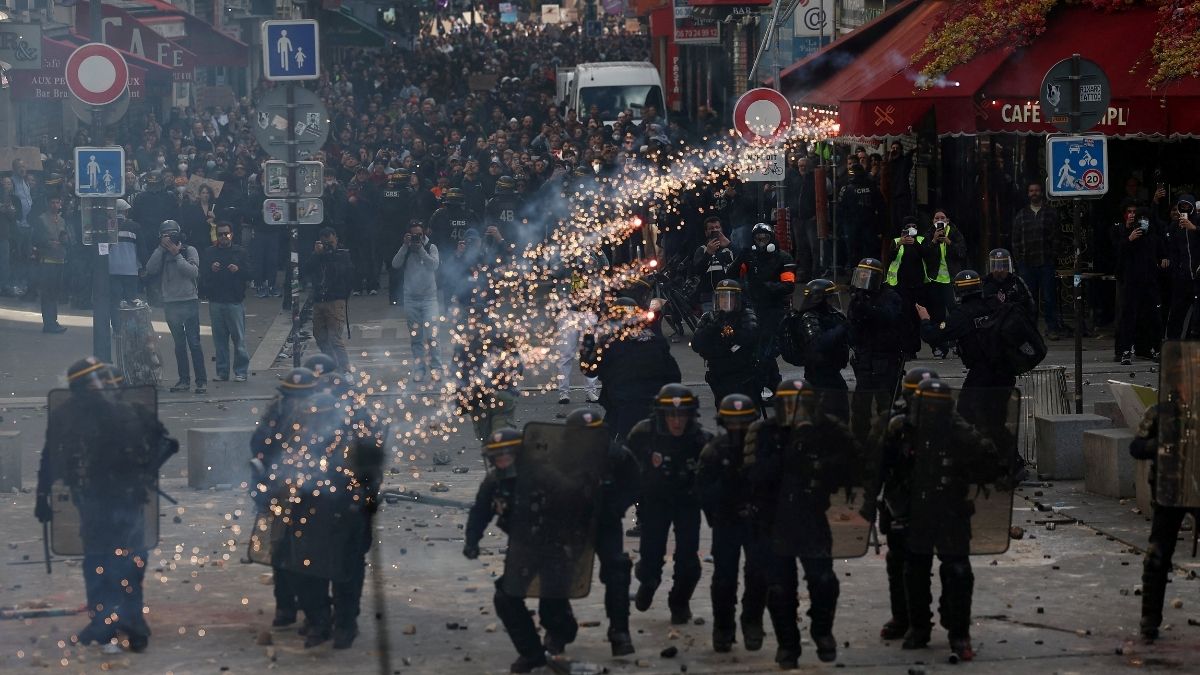
Hundreds of thousands of people took to the streets across France on Saturday to protest against rising living costs and growing inequality. Most rallies remained peaceful during the day, but clashes broke out in Paris and Marseille as night fell, despite a massive security operation to prevent a repeat of last week's violence. France's Interior Ministry said 410,000 people had joined the protests across the country.
Unions, however, put the number at twice that figure. The biggest demonstration took place on the southeastern outskirts of Paris, where at least 110,000 people gathered to protest, Reuters reported. Clashes break out in Paris and Marseille The situation in Paris worsened after the main rally ended. Riot police fired tear gas and used water cannon against a group of around 500 hooded youths. The group eventually dispersed as cold and rainy weather set in.
In Marseille, France's second-largest city, young protesters set fire to rubbish bins to block roads and threw stones and bottles at security forces. Police said several shops were ransacked, including two jewellery stores. Clashes were also reported in Lyon, Bordeaux, Grenoble, Clermont-Ferrand, Lille, Rennes, Nantes and Toulouse. Interior Minister Laurent Nunez said groups looking to cause trouble had broken away from the main demonstrations.
"In almost every march we saw the formation of these high-risk groups. They broke away from the main body and sought to commit acts of violence," Nunez said. He accused far-left activists and criminal gangs of trying to trigger violence during the protests. Paris sees heavy security deployment Authorities deployed 70,000 police officers and gendarmes across France, 10,000 more than a week earlier.
The move came after officials admitted they had underestimated the scale of the violence on October 17. Nunez said the clashes on Saturday were less severe than those seen the previous week, when looters and vandals damaged shops and other property. "What changed was anticipation," he said. The minister also said far-right activists had tried to provoke confrontations with left-wing groups in the southern cities of Nice and Montpellier, raising fears that the unrest could spread further.
Central Paris looked almost like a city under lockdown. Shopkeepers boarded up their storefronts, museums shut their doors and more than 20 metro stations were closed as a precaution. Business groups urged retailers to keep their shops closed after thousands of businesses and stores were damaged or looted across France last weekend. "There are hardly any customers, so it's not really worth staying open," said Oskar, manager of a Kiton boutique in Paris.
Some of the capital's best-known cultural attractions, including the Louvre, the Musee d'Orsay and the Paris Opera, also closed for the day to avoid possible trouble. The closures left many tourists confused and disappointed. "Everything's boarded up and we're not quite sure where we should be," said Xavier Dolliole, a tourist from New Orleans in the United States. Protests spread to other European countries The unrest began last month with small student demonstrations in the suburbs of Paris over conditions in schools.
It soon grew into a wider movement against the government's economic policies and spread to neighbouring countries. In Brussels, Belgian police used tear gas and pepper spray during clashes with anti-government protesters on Saturday. Demonstrations also took place in several Italian cities for the second weekend in a row, as well as in Albania. Jean-Luc Mélenchon, the hard-left leader who joined the Paris rally, said the protests would continue until President Emmanuel Macron addressed the country's growing social and economic problems.
Macron's presidential mandate ends next year. "Given the current situation, I think he will come to understand that this will happen again every week. There is still time for (Macron) to give in. After that, the only thing left to him will be the exit door," Melenchon told reporters. Far-right party holds congress amid tensions The first authorised march of the day passed peacefully in Orléans, around 120 km (75 miles) south of Paris.
Protesters gathered there to oppose Marine Le Pen's far-right National Rally party, which was holding its party congress in the city. Tensions had already risen after a shooting west of Paris on Friday. A gunman suspected of acting out of Islamophobic hatred killed one person and wounded four others, including a 12-year-old girl. Bally Bagayoko, the mayor of Saint-Denis and a member of Melenchon's France Unbowed party, said the protesters wanted to send a message to the far right. "We have come to tell the far right, face-to-face, that we are not afraid," he said.