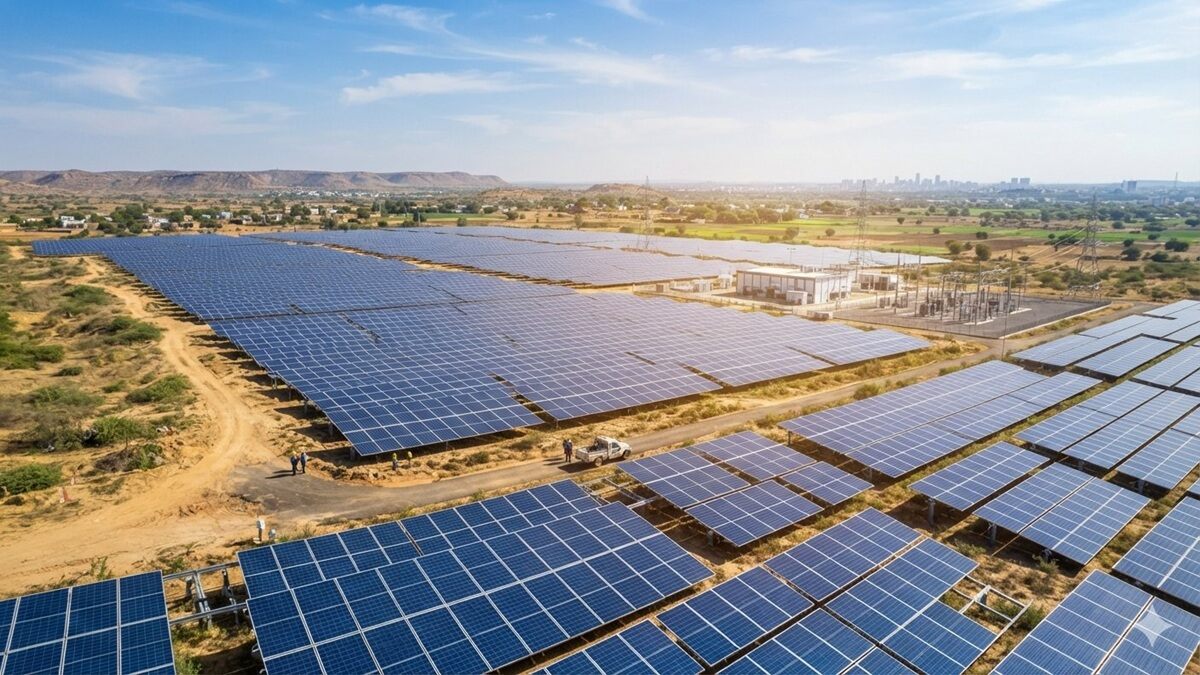
India’s solar supply chain reality check: Modules are ready, cells are not
India’s solar module capacity is surging, but cell shortages and China reliance threaten 2030 clean-energy goals—read how bottlenecks may ease.
India is in the midst of a solar manufacturing boom — with approximately 170 GW capacity and a 500 GW clean energy target by 2030. Generation rose 39% year-on-year during the September quarter as renewable generation excluding large hydro crossed 100 billion units for the first time. But the country remains heavily reliant on China for solar cell imports and replacement has become an arduous challenge for manufacturers.
The Indian government has strongly pushed domestic manufacturing this year — pursuing several policy changes to increase solar capacity. However, unavailability remains a key hurdle — with factories shut as the wait time for domestic components to replace Chinese imports stretched up to eight months. According to a Reuters report in late July, the disruptions threatened thousands of jobs and nearly $4 billion in investment within weeks.
Delays can also threaten India’s push to establish 500 gigawatts of non-fossil fuel capacity by 2030 — coming amidst record electricity demand. Any slowdown in solar deployment will also have to be offset by greater use of fossil fuel-based generation, primarily coal, delaying the switch to cleaner energy. Is India’s solar boom still powered by China? According to industry estimates cited by Reuters, India has relied on China for about 95% of its solar cell imports.
Such imports reportedly rose 37% in the last fiscal year to about $1.86 billion. At the same time, New Delhi added a record-breaking 44.61 GW of solar capacity in FY26 — nearly double the 23.83 GW added the previous year. 86 lakh cr fix the grid? Infrastructure lag threatens India’s 2030 renewable goals A PIB press release added in early August that the sector had expanded more than fiftyfold since 2014 to reach 162.15 GW by the end of June 2026.
Large solar projects now contribute 118.79 GW of installed capacity while rooftop solar systems connected to the electricity grid contribute another 27.88 GW. And solar module manufacturing capacity had increased from 2.3 GW in 2014 to about 172 GW by the end of March 2026. Industry sources cited by Reuters also noted that China monitors technology exports to India and curbs equipment sales. Any export restrictions would in turn delay setting up cell manufacturing plants.
Cosimo Ries, analyst at policy consultancy Trivium China, told the publication in July that China was likely trying to preserve its dominance of the solar industry in the longer term — especially considering its already strong grip on most manufacturing segments. From 13 GW to 38 GW: India’s Solar Cell Industry Scales Fast — But Not Fast Enough According to the Indian Solar Manufacturers Association, solar cell capacity has risen rapidly from 13 GW in July 2025 to the current figure of 38 GW.
Production has increased in tandem — reaching about 19.3 GW so far this year with a peak of nearly 2.9 GW in August as per the NISE DCR portal. “We expect demand for domestic cells to touch 25 to 30 GW in 2027, and the industry is scaling up to meet it, with capacity set to reach 60 GW by December 2026 and cross 100 GW by mid-2027,” Secretary General Amit Manohar told Financial Express. But he stressed the need for deeper localisation — noting that India had imported about 61 GW of cells in FY26 and another 26.3 GW between April and July 2026.
Manohar reiterated that “each of those gigawatts is value, jobs and technology that India could build at home”. This suggests that, in aggregate, module assembly capacity is not the immediate constraint when compared with India's recent annual installation rate,” said Anish Mandal, Partner at Deloitte India. He explained that the scenario became “materially different as we go upstream from module to cell, wafers, ingots and polysilicon”.
The New Energy and Energy Transition expert also reiterated that domestic manufacturing capacity across these segments has not expanded uniformly. “The supply chain is dominated by Chinese manufacturers upstream of solar cells in the wafer -> polysilicon and silica (quartz) value chain, thus increasing the reliance, volatility, and uncertainty for downstream manufacturers," Mandal said. Manufacturing bottlenecks and factory disruptions India presently has a solar panel manufacturing capacity of about 260 GW while being able to produce only about 38 GW of solar cells.
The gap yawns wider in practice — with effective operating cell manufacturing capacity falling significantly lower. Rajan Kalsotra, senior consultant at EUPD Research, told Reuters in July that it would “likely take three to five years” to close the steep cell supply deficit. Another factor to consider is the difference between ‘nameplate capacity’ and availability to the domestic market. Mandal noted that a significant capacity of cells and modules had buyers in western geographies — with the true domestic levels perhaps “significantly lower than these nameplate capacities”.
US trade actions and duties imposed over the past two years can "potentially free capacities for availability in the domestic market”. The government has taken several steps to address this imbalance — issuing a mandate in December 2024 that required solar projects (such as government-backed, open-access, and net-metering schemes) to use locally made cells. Manufacturers were given 18 months for adaptation before the rules came into effect at the beginning of June.
86 lakh cr Green Corridor scheme: 3 stocks riding the transmission boom Rapid scaling of local cell production has remained a massive challenge for MSMEs (which make up 60% of manufacturing capacity). Multiple solar module makers told Reuters in late July that they had temporarily halted production or significantly cut capacity due to a lack of domestically made cells. "It is impossible to start producing cells with 18 months' notice due to complicated technology, manufacturing needs like land and sourcing raw materials," Chetan Shah, chairman of solar panel producer Solex Energy, had told Reuters.
Manohar took a slightly different stance on the matter — telling Financial Express that the cell mandate had come with clear timelines and given the Industry time to prepare. “Schemes like PM-KUSUM and PM Surya Ghar run fully on Indian-made modules and keep growing, which shows domestic manufacturing can meet domestic demand. With cell capacity set to cross 100 GW by mid-2027, India is on track, and wafers are the next frontier,” he said.
Mandal added that India was “placed well to meet the solar deployment requirement for modules and cells”. He warned that the industry may face some near-term shortages but “stands secured for the long term” — while stressing the need for the power sector to “continue investing in transmission and evacuation infrastructure and enforce resource adequacy to states”. Is rooftop solar next? Recent reports suggest India is considering a mandate for locally made inverters and a minimum share of domestic components in batteries under the next phase of its flagship rooftop solar scheme.
“The intent is sound. Rooftop solar is now a market of genuine scale, with 33.40 GW installed, of which 18.21 GW has come under PM Surya Ghar, benefiting over 60 lakh households. Demand of that depth can anchor a domestic inverter and battery industry. Localizing these components would extend the gains of solar manufacturing beyond modules and cells, deepen domestic supply chains, create skilled jobs and reduce import dependence across the rooftop value chain.
A clear, phased roadmap with adequate lead time would give manufacturers the confidence to invest and scale capacity in step with demand,” said Manohar. The change would cover domestic manufacturers of solar photovoltaic ingots and wafers — completing the 3-tier regulatory chain. “Once a verified supply demand baseline is established, the MNRE can reassess the readiness of the ALMM List-III applicability and accordingly decide on next steps.
In parallel, an assessment of the supply chain ecosystem needs to be undertaken to understand and develop an action plan to support the upstream manufacturers,” Mandal told FE.