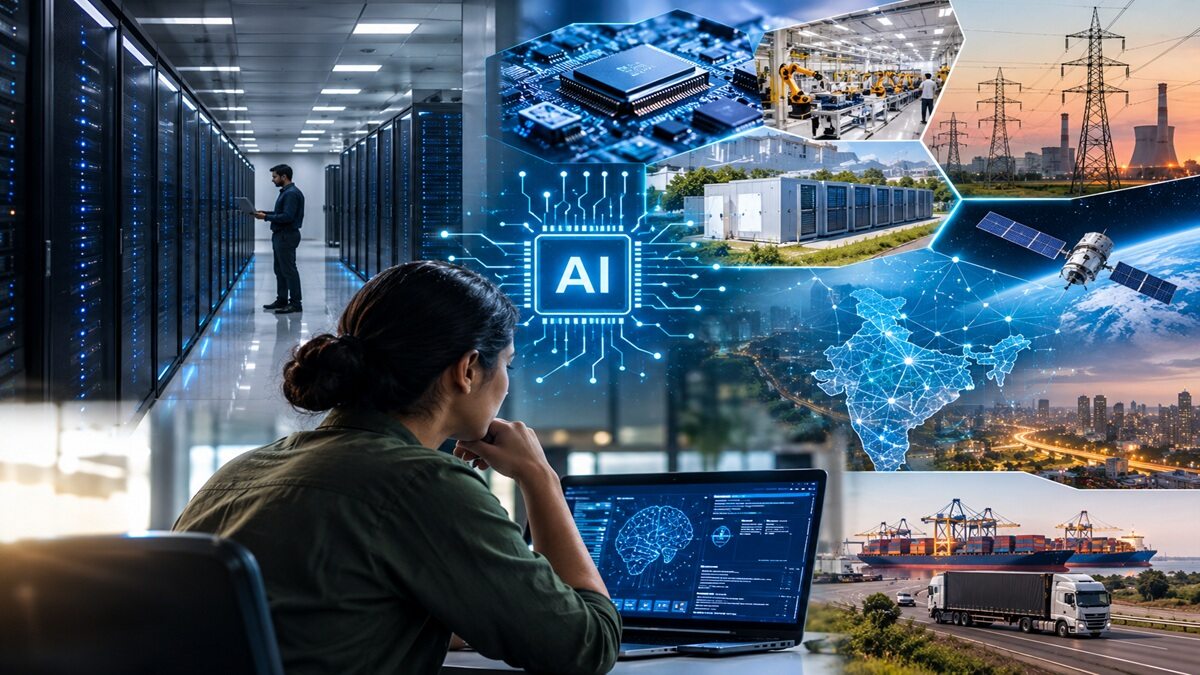
India’s AI debate is stuck on data centers. The real question is who owns the value chain
India risks becoming a hub for global computing while relying on foreign AI models and platforms, leaving domestic firms as users rather than creators of core technology.
India’s AI debate has largely focused on computation—how many data centers can be built, how much power they will consume and how many Graphics Processing Units (GPUs) the country can assemble. But the more consequential question is whether India will merely host global Artificial Intelligence infrastructure or own a meaningful share of the value chain: chips, models, platforms, software, talent and intellectual property.
Data centers are indispensable to artificial intelligence, but they are not the whole AI economy. They consume electricity, water and land while housing servers and GPUs; the higher-value layers—semiconductor design, foundation models, developer platforms and proprietary AI systems—often remain controlled by foreign firms. “We often talk about AI as if it exists in a world of algorithms, models and code.
But behind every AI system is a very physical infrastructure—data centers, servers, electricity, cooling, water and land,” Dr Ajai Chowdhry, co-founder of HCL, founder of the EPIC Foundation and chairman of the Mission Governing Board of the National Quantum Mission, told The Financial Express Digital. “The argument is to look at them the way we would look at any major industrial project—by weighing investment, value, resource consumption and social impact,” he said.
India’s data-center capacity has expanded sharply, and global hyperscalers and domestic cloud providers continue to announce new facilities. These investments are necessary because AI training and inference require large pools of GPUs, high-speed networking, reliable power and cooling systems. But a data center is closer to a factory floor than a finished product. If global companies locate compute capacity in India while advanced chips, AI platforms, models and intellectual property remain abroad, the country captures only part of the economic value created by its own land, power and water resources.
“If global companies bring very large data centers into India, we need to look at the broader economic value being created,” Chowdhry said. “These facilities can consume substantial amounts of land, power and water, while the number of direct jobs they generate can be relatively small compared with the scale of the infrastructure and resources involved.” The strategic risk is familiar: India could become a preferred location for global compute while continuing to import intelligence.
In such a model, Indian data and user demand support foreign models and platforms, while domestic firms remain largely downstream adopters rather than upstream creators. 2 stocks riding the surge India’s AI foundations are growing The IndiaAI Mission, approved with an outlay of about Rs 10,372 crore, is attempting to build the base layers of a domestic AI ecosystem. Its shared compute capacity had crossed 45,000 GPUs by June 2026, according to the Press Information Bureau release.
By August 2026, around 237 projects had accessed subsidised AI computing, using 93.18 lakh GPU hours. The support is intended to lower the cost barrier for startups, researchers and institutions that cannot easily afford commercial cloud rates for large-scale model development. At the model layer, the government has selected 20 indigenous foundation-model proposals from 506 applications. These include 12 Large Multimodal Models and eight Small Language Models, with applicants retaining intellectual-property rights.
The AI Kosh platform is intended to act as a shared resource base for developers, hosting datasets, models and validated use cases. The government has also identified AI use cases across ministries and departments, signalling demand for public-sector deployment. From AI users to AI builders India has repeatedly shown that it can deploy digital public infrastructure at population scale, from UPI and Aadhaar to AI-enabled public services.
The harder challenge is to convert that adoption capacity into creation capacity—Indian-owned models, accelerators, systems, applications and intellectual property. “The more important question is what does India own and what capabilities are we building around that infrastructure?” Chowdhry said. “If India becomes primarily a location where global companies put compute capacity, while the chips, AI platforms, models and intellectual property remain controlled elsewhere, then a significant part of the value chain continues to sit outside the country.”
That does not make data centers unimportant. It means they should be treated as one layer of a broader industrial strategy, alongside chip design, AI software, model development, talent formation and export-oriented products. The dominant AI architecture today depends on hyperscale cloud infrastructure and large language models. Enterprises send data to distant facilities, where GPUs process requests and return outputs.
The approach works, but it can increase token costs, latency and dependence on foreign platforms. Chowdhry argues that India’s next phase should include smaller, task-specific models and specialised AI accelerators operating closer to where data is generated. For enterprises handling sensitive, regulated or highly specialised information, local processing can improve data control and reduce the need to route every workload through a hyperscale facility.
“There is a growing opportunity for smaller, purpose-built models and specialised AI accelerators that can operate closer to where the data is generated,” he said. “For many enterprises, particularly those handling sensitive or specialised data, it may not make economic or operational sense to send every workload to a hyperscale data center.” The case for sovereign models India’s opportunity may not lie in competing head-on with global consumer LLMs on scale.
A more realistic strategy is to build specialised small models for sectors such as healthcare, banking, manufacturing, education, agriculture and climate—systems tuned to Indian languages, local regulations and enterprise workflows. The Indian AI Research Organisation (IAIRO), jointly funded by the Gujarat government, the central government and the Indian Pharma Alliance, is working on compact, domain-specific “sovereign” models for real-world deployment.
“Such specialised language models are already being crafted for various sectors including education, healthcare, agriculture, climate, manufacturing and finance,” an IAIRO official said. “These tailored models will constitute the core intellectual property for startups and enterprises engaged in AI solution development.” The objective is not to eliminate large data centers. India will still need centralised compute for workloads that genuinely require it.
But a resilient AI strategy would combine large-scale facilities with edge infrastructure, specialised hardware and smaller domain models. What quantum execution shows The National Quantum Mission offers a useful comparison for AI policymakers. India has demonstrated a 1,000-km secure quantum communication link, ahead of an original eight-year target of 2,000 km. The mission’s startup support has expanded from eight to 17 companies, including nine new ventures working on quantum biosensors, photon sensing, quantum positioning systems and precision electronics.
Separately, the government’s Rs 1-lakh-crore Research, Development and Innovation Fund received more than 100 proposals within two months of its call. These examples suggest that milestone-driven, product-first programmes can move faster than planned. India’s AI-building effort will need a similar discipline: clear targets, domestic IP retention, procurement pathways and support for companies that can convert research into deployable products.
AI-generated code is becoming mainstream, but developers will still need to validate, test, secure and govern that code. Engineering work is therefore shifting from routine coding towards reviewing AI output, securing applications, governing AI systems and validating models and data. New roles are emerging in AI implementation, model validation, data governance and cybersecurity, even as some entry-level coding roles come under pressure.
The implication for education is direct: AI literacy must become as fundamental to engineering training as programming itself. India has laid much of the groundwork for AI—compute capacity, datasets, model proposals, use cases and laboratories. But the next phase will be judged not by the number of GPUs installed or data centers announced, but by the number of Indian-owned models, products and companies that emerge from that base.
“If we get this right, India will not simply become a major destination for global data centers,” Chowdhry said. “India becomes a builder of AI—with its own models, accelerators, systems, applications and intellectual property.”