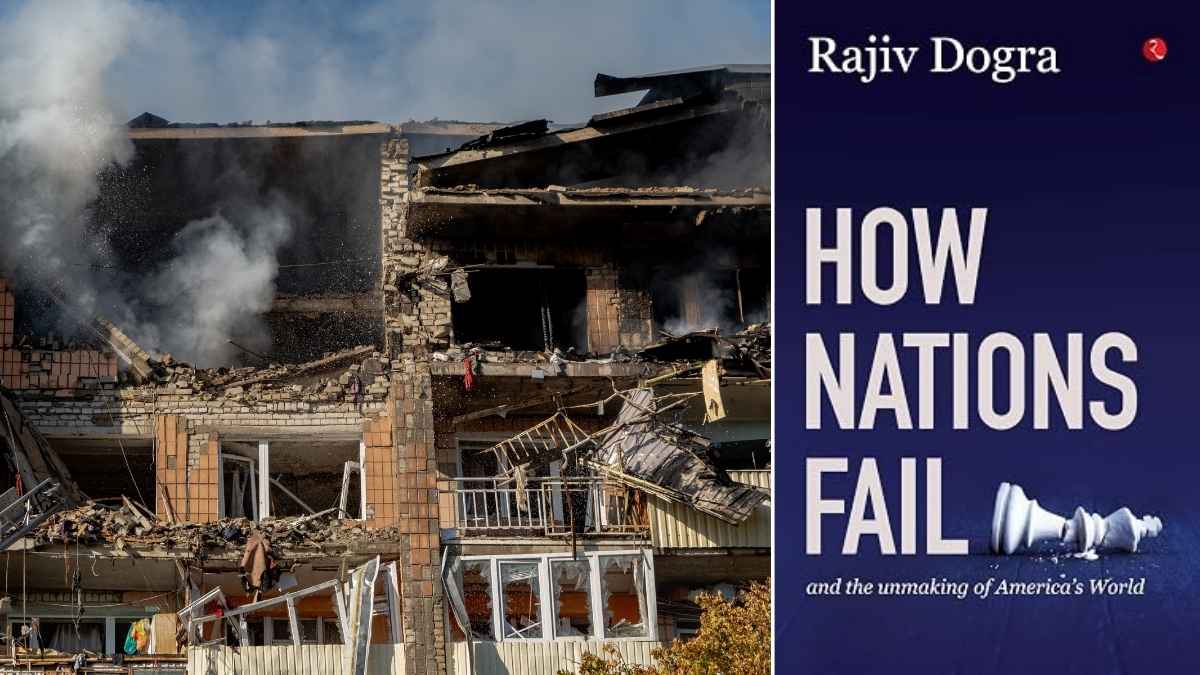
Book review of How Nations Fail: And the Unmaking of America’s World
The gathering storm: In a volatile world, both leadership and the masses need to find solutions
By Amitabh Ranjan The Earth is littered with the ruins of empires that once believed they were eternal.” This observation by renowned author and humanities professor Camille Paglia serves as the epigraph for Chapter 18 of Rajiv Dogra’s latest work, How Nations Fail: And the Unmaking of America’s World. In a nutshell, it also captures the book’s central theme. In a cogently written, 25-chapter scholarly account capped by an insightful epilogue, the prolific writer and former diplomat weaves history and contemporary events together to analyse current global dynamics and the precarious path the world appears to be walking on.
It was World War I that shattered the centuries-old dynastic rule of four powerful continental empires — the German, Austro-Hungarian, Russian and Ottoman. These regimes had stubbornly retained quasi-medieval institutional elements, maintaining absolute monarchies and feudal-agrarian power bases. Given the unprecedented destruction of men and material, the world should ideally have collaborated to build a peaceful coexistence.
Instead, the arrogance of the victorious allies — reflected in the flawed architecture of the League of Nations — and an unbridled competition for colonies sowed the fundamental seeds of World War II just two decades later. The inter-war years witnessed tectonic shifts far beyond mere geographical boundaries. On the economic front, the United States transformed into a titan, riding the wave of its booming mass production economy that would cement its superpower status by the tail-end of World War II.
Conversely, Britain and France devolved from the world’s primary creditors to heavily indebted nations, Germany was crushed by staggering war reparations, and the rise of the Soviet Union split the global economic order into two ideologically competing blocs. Concurrently, warfare gained a dangerous technological edge, pivoting away from mass infantry charges toward motorised mobility and engineering superiority.
The misguided belief that Nazism would self-correct plunged the world into a conflict far more devastating than its predecessor. The aftermath reshaped the globe: exhausted European powers were sapped of their economic might, a wave of newly independent colonies desperately scrambled to find their moorings, and the US stood at the pinnacle of its military power, closely countered by a rising Soviet Union in a weaponless Cold War.
Despite these deep geopolitical fractures, the world managed to stabilise by the end of the last millennium. Yet, well into the third decade of the new millennium, that hard-won sense of comfort has been thoroughly ruffled. Drawing on his long years as a diplomat, Dogra sharply analyses modern national fault lines, exploring how ancient civilisations collapsed and why modern powerful nation-states are squandering their pre-dominance.
Where the West once read out diagnoses for the misfortunes of other countries, it must now prescribe those same remedies for itself. The warning signs are ubiquitous: moral decay, falling birth rates, a widening chasm between the ultra-wealthy and the hopeless poor, marginalised minorities, and a profound loss of faith in traditional beliefs without a new value system to replace them. The author exhibits an expansive understanding of history, guiding the reader through the rise and fall of ancient Greece, Rome, Mesopotamia, the Indus Valley, and China.
The persistent pattern across eras is clear: The flourishing or decay of societies is never simple. It is invariably determined by a complex interplay of geography, political leadership, technological heft, military capability, and social cohesion. The world is caught in a poly-crisis— a knot of interconnected, unprecedented global challenges: Europe faces its most severe crisis since WWII, driven by the Russia-Ukraine war and systemic economic stagnation.
An assertive China continues its military expansion and aggressive foreign policy across the South China Sea and Taiwan, alongside territorial incursions along the Indian border. A domestic shift toward protectionism, an intense political polarisation, and the selective application of international laws have compromised America’s moral standing as a global arbiter. Unstable, internationally isolated regimes like Pakistan and North Korea present persistent nuclear threats.
Artificial intelligence introduces immediate systemic risks, including mass algorithmic bias and widespread disinformation. The book’s theme is a sobering reminder: National failure does not happen overnight. The decay of a state and its institutions happens incrementally through inept leaders, misguided governance, corruption, excessive centralisation, and the erosion of public trust. Yet, the book ultimately chooses hope over despair.
If leadership stands up to take a realistic measure of where the world is headed, solutions can be found. Above all, the author underlines that the people themselves must wake up to demand real accountability from their representatives. It is a lesson beautifully encapsulated by the book’s opening metaphor — the Bangaramdevi tradition of remote Bastar — which reminds us that even the gods must answer to the people they serve.
The immense readability of the book lies in the fact that it delves into some of the most critical contemporary issues like geopolitics, strategic alliances, economic competitions, wars, and emerging powers, among others. Students, researchers, policymakers, and even casual book lovers will do well to pick up this feast of drama, anecdotes, and inside stories told with a rare finesse. The writer is a former journalist who teaches at Patna Women’s College How Nations Fail: And the Unmaking of America’s World Rajiv Dogra Rupa Publications Pp 333, Rs 895