‘Deliberate attacks calculated strategy to hold energy prices hostage’: Jaishankar at G20
Jaishankar said the energy crisis stems not from a shortage of resources but from unstable supply chains, high prices and limited access, particularly for poorer nations.
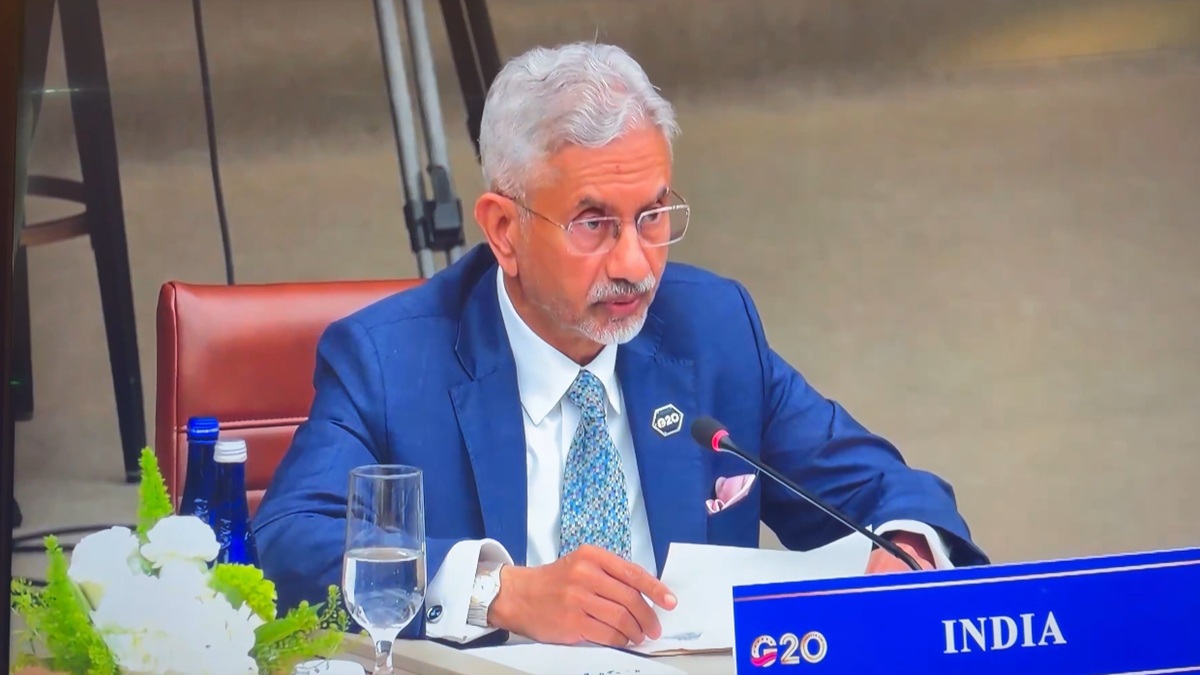
External Affairs Minister Dr S Jaishankar told the G20 Foreign Ministers’ Meeting in Atlanta that the world is facing an energy crisis driven not by a shortage of production, but by unpredictability, disruption, high costs and unequal access. He sharply criticised sanctions, transit chokepoints and attacks on energy infrastructure, arguing that these were distorting global markets and hurting poorer countries the most.
Speaking at the second plenary session, Jaishankar said deliberate attacks on energy trade and infrastructure had become a “calculated strategy to hold energy prices hostage.” He urged the G20 to show leadership in keeping energy markets open, stable and predictable. The @G20org #Atlanta today concluded with the Plenary III focussed on Supply Chains. Highlighted the following: ➡️ Securing supply chains and ensuring their resilience is today central to the well-being of the global economy. ➡️ The right to industrialise must be promoted; predatory practices and targeting competition should be firmly resisted. ➡️ Diversification and de-risking, including in connectivity is the key to supply chain resilience, threatened by pandemics, conflicts, climate events and mishaps. ➡️ De-concentration of global economy and optimisation of production across geographies can discourage the weaponisation of finance, resources, production and market share. ➡️ The G20 should work towards de-politicisation of markets. ➡️ G20 countries must reconcile their national interests for the collective good by promoting transparent and multiple supply chains, making the global economy truly multi-stakeholder.— Dr.
S. Jaishankar (@DrSJaishankar) October 31, 2026 An energy crisis of disruption and deliberate attacks Jaishankar said the central problem today is not that the world lacks oil, gas or other energy resources. Instead, he argued, the crisis stems from instability in supply chains, unaffordable prices and barriers that prevent countries—especially low-income nations—from accessing energy. “Underlined that the world today stares at an energy crisis, not of production, but of unpredictability & disruption, unaffordable costs, and challenges of access,” he said in a post on X after the session.He warned that obstacles, sanctions and chokepoints were disrupting energy markets with “increasing frequency, greater complexity & wider impact.”
According to Jaishankar, these actions show “little regard” for the difficulties faced by low-income countries, which are often least able to absorb price shocks or supply interruptions. The minister said attacks on oil and gas infrastructure, shipping and energy trade routes were not random disruptions. In his view, they formed part of a deliberate strategy aimed at influencing prices and creating economic pressure.
“Highlighted that deliberate attacks on energy trade & energy infrastructure are a calculated strategy to hold energy prices hostage,” Jaishankar said. His remarks come at a time when energy infrastructure and commercial vessels have faced attacks in the Russia-Ukraine war and in West Asia. The issue has become especially sensitive because disruptions in key maritime routes can quickly raise fuel, food and fertiliser costs for countries far from the conflict zones.
He said distinctions were being drawn between oil and gas, and that “selective carveouts” reflected political convenience rather than a consistent approach to energy security. He cautioned that the world should not underestimate the knock-on effects of such decisions in a deeply interconnected global market. A restriction imposed in one region can affect prices, shipping costs, insurance, fertiliser production and household energy bills elsewhere.
“This distortion of the energy markets, the politicisation of energy flows, this is something which is very harmful,” Jaishankar said, adding that the Global South was bearing the brunt of energy shortages. India’s energy priorities For India, Jaishankar stressed the importance of reliable and predictable supplies of LPG for clean cooking. This is a major domestic priority because millions of Indian households depend on LPG for daily cooking, and sudden price increases or supply disruptions can directly affect family budgets.
He also highlighted India’s national mission on critical minerals, which covers the full cycle from exploration to recycling. India has proposed a G20 Critical Minerals Circularity Initiative, aimed at reducing dependence on limited sources and encouraging reuse and recycling of minerals needed for clean-energy technologies. Jaishankar called on the G20 to improve access to finance and invest in energy storage, small modular reactors, green hydrogen and biofuels.
His message was that energy security and the clean-energy transition must move together, rather than being treated as separate challenges. No military solution to conflicts During the first plenary session, Jaishankar said the world’s major conflicts cannot be resolved through military means alone. He argued that diplomatic negotiations are the only realistic path to ending wars that are now affecting global trade, energy supplies and food security.
“Look, there are big conflicts today, two major conflicts which are having global ramifications,” he said. “There are no military solutions; we have to find a diplomatic pathway.” He also pointed to disruptions in grain shipments through the Black Sea and fertiliser shortages linked to tensions around the Persian Gulf and Red Sea corridors. These problems, he said, threaten food security well beyond the countries directly involved in conflict.
He argued that countries should not depend excessively on one geography, one supplier or one route for critical goods. “Today we need more diversified supply chains,” he said, calling for more diversified production and manufacturing across the world. He said pandemics, wars, climate events and accidents have shown how quickly concentrated supply chains can break down. Diversification and de-risking, including in connectivity, would make economies less vulnerable to such shocks.
‘Right to industrialise’ Jaishankar made a strong case for developing countries’ ability to build industrial capacity without facing unfair barriers or coercive economic practices. He said the G20 should promote the “right to industrialise” and resist “predatory practices” and actions that target competition. “The right to industrialise must be promoted; predatory practices and targeting competition should be firmly resisted,” he said.
He also urged the G20 to work towards the “de-politicisation of markets.” In his view, finance, resources, production capacity and market share should not be used as weapons in geopolitical competition. “G20 countries must reconcile their national interests for the collective good by promoting transparent and multiple supply chains, making the global economy truly multi-stakeholder,” Jaishankar said.
India’s wider diplomacy in Atlanta Jaishankar’s intervention came during the G20 Foreign Ministers’ Meeting hosted by US Secretary of State Marco Rubio. The meeting covered geopolitical challenges, energy and food security, and resilient supply chains. After the energy session, Jaishankar met Rubio and reviewed bilateral cooperation between India and the United States. He also held meetings with counterparts from Canada, Australia, Germany, Brazil, Mexico, Argentina, Poland and other countries.
He met Russian Foreign Minister Sergey Lavrov on the sidelines and discussed the Ukraine conflict, the Gulf situation and multilateral issues. Jaishankar also participated in a Quad Foreign Ministers’ Meeting with Rubio, Japan’s Toshimitsu Motegi and Australia’s Penny Wong, where the focus included supply-chain resilience, critical minerals, energy security and countering non-market practices in the Indo-Pacific.
Jaishankar’s core argument was that energy, food and industrial security are now inseparable. Conflicts disrupt shipping; sanctions and chokepoints distort markets; price shocks hurt vulnerable economies; and concentrated supply chains leave the world exposed to sudden shocks.