Why Piyush Goyal says EU’s carbon rules could make European industries uncompetitive
The minister also cited differences in per capita emissions, claiming that Europe's per capita carbon emissions and environmental impact were around seven or eight times those of India.
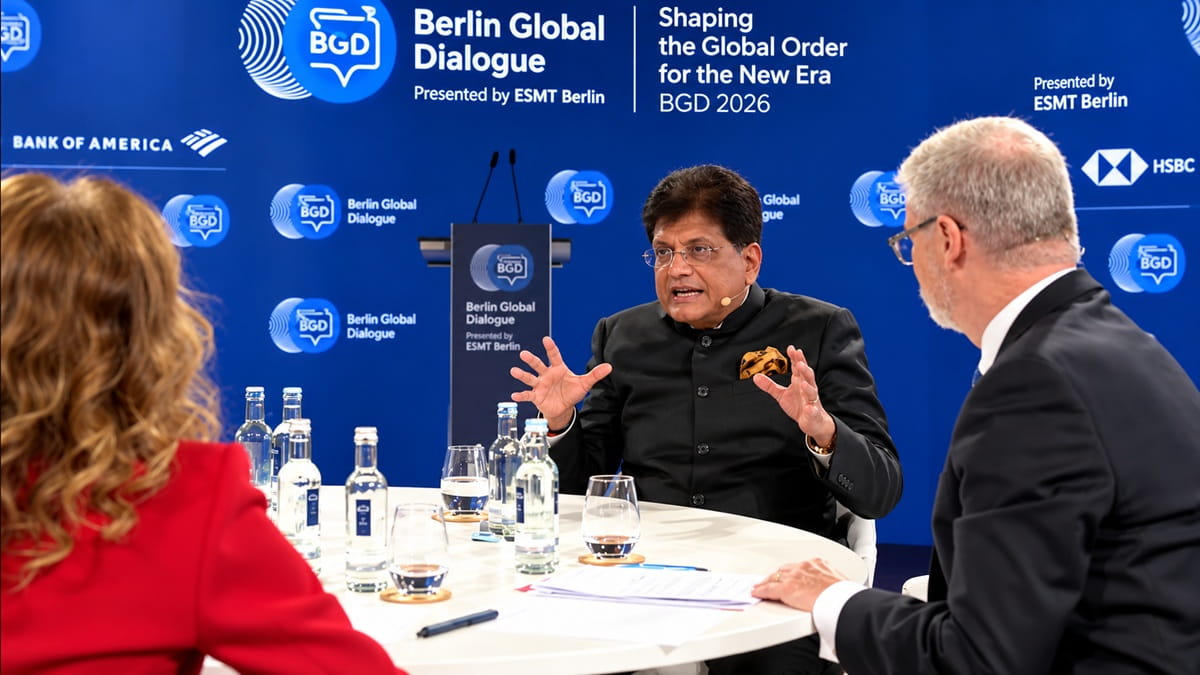
Union Commerce and Industry Minister Piyush Goyal hit out at the European Union's carbon-related trade measures, warning that the bloc risks making its own industries less competitive by raising the cost of steel and other industrial materials. Speaking at the Berlin Global Dialogue, Goyal argued that the EU's Carbon Border Adjustment Mechanism (CBAM), import duties and other regulatory requirements could push up infrastructure costs, fuel inflation and hurt European businesses.
In a video shared on his X account, Goyal also challenged Europe over its historical contribution to global carbon emissions, contrasting it with India's relatively low share despite the country accounting for around 17% of the world's population. "You put a CBAM on yourself. You put a 50 per cent import duty to bring steel into your country. You're inviting disaster. Your cost of living will go up," Goyal said.
India is conscious of and committed to its role in climate action. https://t.co/ONx3nB0ik8— Piyush Goyal (@PiyushGoyal) October 22, 2026 His remarks come amid India's concerns over the implications of the EU's carbon border policy for exporters of emissions-intensive products, particularly steel and aluminium. The mechanism requires importers to account for emissions embedded in certain goods entering the European market, potentially adding compliance costs for businesses supplying these products.
Goyal argued that the cumulative effect of carbon-related charges and other regulations could hurt European manufacturers as well as overseas suppliers. "We've lost count. You keep adding to your regulations, add to the burden of your industry, make yourself uncompetitive," he said. The minister's argument was that regulations intended to govern industrial activity and imports could also have unintended economic consequences if they significantly increased production costs.
Businesses facing higher input prices and compliance expenses could find it harder to compete with manufacturers operating under different cost structures. Steel, aluminium and cement are among the key materials used across manufacturing, construction and infrastructure. Any increase in their costs can affect businesses beyond the industries that produce them, particularly when the materials are used in large-scale projects.
For Indian exporters, the concern is that carbon-related requirements could increase the cost and complexity of supplying goods to the European market. For European companies, the question is whether the regulatory burden could raise input costs and affect their competitiveness. Costlier steel and cement could raise infrastructure expenses Goyal warned that the impact of the EU's approach could extend to major infrastructure projects, from transport networks to public utilities.
"Now, imagine going forward, every infrastructure, whether it's a port or an airport or your autobahns in Germany or your expressways, your utilities, your water pipelines, you name the infrastructure with costlier steel, costlier aluminium, costlier cement, with all the overlay of CBAM and deforestation rules," he said. The minister pointed to the wide use of steel, aluminium and cement in infrastructure development, arguing that higher material costs could increase the expense of building and maintaining roads, airports, ports and water networks.
For governments, more expensive construction materials can put pressure on infrastructure budgets. Private developers and industrial companies may also face higher project costs, potentially affecting investment decisions and profitability. The eventual impact would depend on how much additional cost businesses face, how suppliers respond and whether companies can adjust their sourcing or production processes.
Goyal's warning was that the combined effect of multiple regulatory requirements could make infrastructure and industrial activity more expensive. Officials’ phones are off’: Why are Gurugram residents left in the dark? Goyal warns that trade restrictions could invite retaliation The minister also cautioned that regulatory barriers imposed by one trading partner could prompt reciprocal measures, creating further difficulties for businesses operating internationally.
"And in this reciprocal world, you bring in a regulation and stop some other country from working with you. They'll bring in two regulations, which will hurt your businesses," he said. Goyal argued that the spread of restrictive measures could create a cycle in which countries respond to one another with additional rules, increasing the compliance burden on companies and complicating cross-border trade.
For businesses operating across international supply chains, such uncertainty can affect sourcing decisions, market access and investment planning. Companies may need to absorb higher costs, restructure supply chains or reassess the markets in which they operate. Warning that the additional burden could undermine Europe's industrial position, Goyal said, "You will not be able to compete in global markets.
Your auto industry is suffering that already." His reference to the automobile sector underscored his broader argument that industrial competitiveness depends partly on controlling input costs and avoiding regulatory burdens that could place domestic manufacturers at a disadvantage. 'Who caused this mess?' Goyal questions Europe's climate responsibility Alongside his criticism of the EU's trade measures, Goyal challenged Europe over its responsibility for global emissions, arguing that countries' contributions to climate change should be considered in the context of their population sizes and development needs.
"Who's responsible for this mess in the first place? Where did the ozone layer get damaged? Who sent all that carbon into the atmosphere?" he asked. Goyal said India accounts for around 17% of the world's population but contributes only about 3% to 3.5% of global carbon emissions. He contrasted India's share with Europe's historical contribution to emissions, arguing that the climate burden should not fall disproportionately on developing countries.
"I represent 17% of the world's population, but my contribution to global carbon emissions is less than 3%," he said. The minister also cited differences in per capita emissions, claiming that Europe's per capita carbon emissions and environmental impact were around seven or eight times those of India. India faces the challenge of meeting rising demand for energy, food and infrastructure while continuing to expand cleaner sources of power.
Goyal argued that these development requirements should be recognised when assessing the responsibilities of emerging economies. Bombay HC answers India's clean energy push and development needs Goyal said India was expanding its clean energy programme while balancing the needs of its population and its wider economic and security priorities. "I'm representing 17% of the world's population, and I am more conscious of waste and the circular economy.
I also have to meet the needs of 1.4 billion people. I have to meet their energy needs, their food needs, and ensure that my nation remains secure. Despite all of that, we have one of the world's fastest-growing clean energy programmes," he said. The minister used India's clean energy expansion to argue that the country was pursuing environmental objectives while continuing to address the needs of a large and growing population.
He also defended India's approach to international trade, saying the country was building partnerships around competitiveness and complementary strengths. "We've got fair, equitable, and balanced agreements with every one of the partners with whom we are working," Goyal said. The comments positioned India's trade approach as one that seeks to balance market access and international partnerships with domestic industrial competitiveness.
What the CBAM dispute means for India-EU trade The dispute over the EU's Carbon Border Adjustment Mechanism highlights the growing overlap between climate policy and international trade. While the mechanism seeks to account for emissions associated with certain imported goods, exporters face questions over the costs of compliance and the implications for their competitiveness in the European market.
For Indian steel and aluminium producers, the additional requirements could affect the economics of exporting to Europe, depending on the emissions associated with their products and the applicable rules. The wider concern is whether carbon-related trade measures could become a significant consideration in commercial decisions between India and the EU. Goyal's remarks also raised questions about the economic consequences for European businesses themselves, particularly if the cost of industrial materials rises or regulatory requirements complicate supply chains.