‘Who do I go to? Officials’ phones are off’: Why are Gurugram residents left in the dark?
Haryana’s electricity dispute escalates as private company Eleven Power enters distribution in Gurugram and Nuh, sparking protests, power cuts, and concerns over subsidies and state utility revenues.
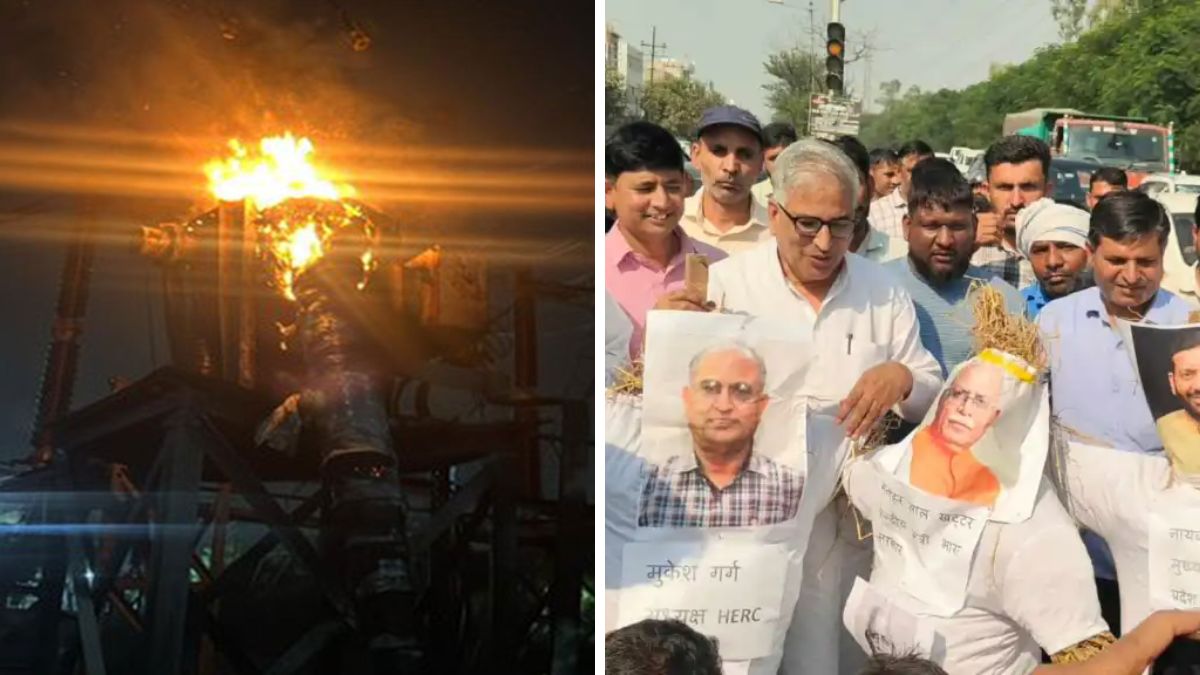
Haryana's decision to allow a private company to distribute electricity in Gurugram and Nuh has triggered a statewide protest by power sector employees, leaving several areas without electricity and disrupting water supply and industrial activity. On Monday, October 19, the Haryana Electricity Regulatory Commission (HERC) granted Eleven Power Pvt Ltd a 25-year licence to distribute electricity alongside existing state-owned utilities.
According to UNI, the move could give more than 8.3 lakh consumers a choice between electricity suppliers. The decision has faced strong opposition from electricity employees, unions and the Haryana government. The state has said it will challenge the order in court, while employees have warned that allowing a private company into the sector could threaten jobs and lead to privatisation. It has raised concerns about water supply, factory operations, the finances of state-owned power companies and the future of electricity subsidies for households and farmers.
Power strike leaves several areas in the dark A three-day strike by around 40,000 electricity employees and engineers plunged several parts of Haryana into darkness on Thursday. Gurugram, Faridabad and Nuh were among the worst-hit areas, with power cuts also affecting water supply and industrial production. In Gurugram, more than 3,000 power complaints were reportedly received within 12 hours. Factories in Sector 37, Kadipur and Basai were among those said to have halted operations because of the disruption.
The district administration had made contingency arrangements to deal with the strike. UNI reported that officials had directed authorities to ensure electricity supply to essential services, including hospitals, water installations and Metro services. The strike is part of a wider protest against HERC's decision to allow Eleven Power to enter a sector that has so far been dominated by state-owned distribution companies, commonly known as DISCOMs.
Gurugram power cuts hit homes, offices Ashish Sardana, 50, woke up on Thursday morning to find that his inverter had run out, the taps were dry and the WiFi was not working. The power supply to his home in Sector 7 had stopped at 10 pm on Wednesday, leaving him unable to work from home. Sardana works on the artificial intelligence team of a leading American multinational company. His children, who are preparing for engineering entrance exams and government competitive examinations, were also unable to study, he told The Indian Express.
Sardana, an executive member of his local Residents' Welfare Association (RWA), said he tried to register a complaint through the electricity distributor's 1912 helpline. However, after being kept on hold for several minutes, the call disconnected with a message saying, “something went wrong”. “The phones of the officials concerned are switched off or not available, and linemen are on strike. Who do I go to?
No one has a clue about when or whether things will normalise,” he said. The power cuts affected several parts of the city, disrupting household water supply, office work and children's studies. Harish Sardana, former president of the Sector 7 RWA, said the outage was caused by a fault in the main electricity distribution line from Palam Vihar. “The power cut was due to a snag in the master distribution line from Palam Vihar.
The entire staff is on strike against privatisation. The sub-divisional officer of the discom is not responding. Life is at a standstill for students, office-goers, professionals working from home,” he told The Indian Express/ In Sector 5, the outage also disrupted water supply to homes. “I have got at least five calls from people who haven’t been able to go to office, and 10 from those not being able to work from home,” said T R Adalkha, president of the Sector 5 RWA.
“Many children haven’t gone to school as there is no water in the house. Our tanks are full, but water cannot reach homes as there is no power. Inverters have been exhausted since the cut began at 10 pm.” What is a parallel electricity licence? Electricity distribution in India has traditionally been handled by a single utility in a particular area. In Gurugram, the main distributor is Dakshin Haryana Bijli Vitran Nigam (DHBVN), while Uttar Haryana Bijli Vitran Nigam (UHBVN) serves northern parts of the state.
However, the Electricity Act, 2003, allows regulators to grant licences to more than one company to distribute electricity in the same area. The sixth proviso to Section 14 of the Act allows an electricity regulator to issue parallel distribution licences to companies that meet the required conditions. It also says that an eligible applicant cannot be refused a licence simply because another distributor already operates in that area.
This is what HERC has allowed in Haryana. Eleven Power will have to build its own electricity distribution network, including the wires and other infrastructure needed to supply power to consumers. Once its network reaches an area, consumers will be able to choose whether to remain with the existing distributor or switch to the private company. DHBVN will continue operating its own network and supplying electricity to its existing consumers.
Mumbai is the best-known example of parallel electricity distribution in India. Tata Power Company Ltd, BEST (Brihanmumbai Electric Supply and Transport Undertaking) and Adani Electricity Mumbai Ltd operate in overlapping areas of the city. Bombay HC answers Who is Eleven Power? Eleven Power Pvt Ltd was incorporated in June 2025. According to The Indian Express, 99.99% of the company is owned by SAS Fininvest LLP, the investment arm of Eleven Group, which is led by Sunil Sachdeva, the co-founder of Medanta – The Medicity.
The company has proposed an investment of Rs 4,717 crore over five years, from 2026-27 to 2030-31, to develop its electricity distribution network in Gurugram and Nuh, reported The Indian Express. According to ThePrint, Eleven Power plans to source around 80% of its electricity from renewable energy and the remaining 20% from thermal power plants. It has also proposed battery storage as part of its plans.
To develop its electricity distribution network in Gurugram and Nuh, Eleven Power has formed a strategic consortium with Advait Energy Transitions, Vision India Services and HEC Infra Projects. Why are existing DISCOMs concerned? One of the biggest objections to the licence comes from DHBVN, which has warned that the entry of a private distributor could affect its revenue and make it harder to meet its financial obligations.
According to The Indian Express, Gurugram and Nuh accounted for 35.23% of DHBVN's total electricity sales and 42.98% of its revenue of Rs 9,493.75 crore in 2025-26. The utility fears that if consumers who pay higher electricity tariffs move to Eleven Power, its revenue could fall sharply. It would then have to meet many of the same costs while collecting money from a smaller customer base. The utility has argued that even a small shift in electricity sales could affect its finances.
A much larger shift, it says, could put greater pressure on its ability to supply electricity at subsidised rates to certain groups of consumers. Eleven Power has disputed these estimates. According to The Indian Express, the company has said its business plan assumes that only 2.5% of existing electricity sales will shift to it in 2027-28. It expects most of its growth to come from new connections.
Under the cross-subsidy system, commercial and industrial consumers pay higher tariffs to help keep electricity cheaper for households and farmers. The money collected from these consumers helps support the cost of supplying power to groups that receive subsidised rates. DHBVN fears that if a private company attracts a large number of commercial and industrial consumers, the state-owned utility could lose an important source of revenue.
The remaining consumers would then account for a larger share of the utility's customer base, while the money available to support subsidised electricity could fall. This could put pressure on the existing system and potentially lead to higher tariffs for some consumers or a greater need for government subsidies to support households and farmers. Eleven Power has challenged the argument that the existing distributor should be protected from such competition.
The company has argued that cross-subsidy is not a permanent entitlement of an existing distributor. It has also pointed out that its licence covers both Gurugram and Nuh, including the latter's rural and agricultural areas. The company says its plans are not based mainly on taking away customers who currently pay higher tariffs. Critics fear Eleven Power may focus on profitable urban areas in Gurugram and neglect rural and agricultural consumers in Nuh.
According to ThePrint, HERC said a phased rollout could meet its service obligations, with around Rs 304 crore, or 6.5% of the proposed investment, allocated to Nuh. Critics consider this insufficient, while the company says Nuh's rural and agricultural areas are included in its first phase. Whether it delivers reliable power across both districts remains a key test. Haryana government plans legal challenge Haryana Energy Minister Anil Vij told UNI that the state would challenge HERC's order within five to six days and seek a stay.
He said the government would approach the Supreme Court if needed. Chief Minister Nayab Singh Saini appealed to employees not to strike. Vij told ThePrint that HERC operates independently under a central law. While the government plans legal action, power employees fear the licence could threaten jobs and lead to further privatisation. One union leader compared the risk to the decline of state-owned telecom operator BSNL, according to the Business & Human Rights Resource Centre. Last-minute talks failed to stop the strike.