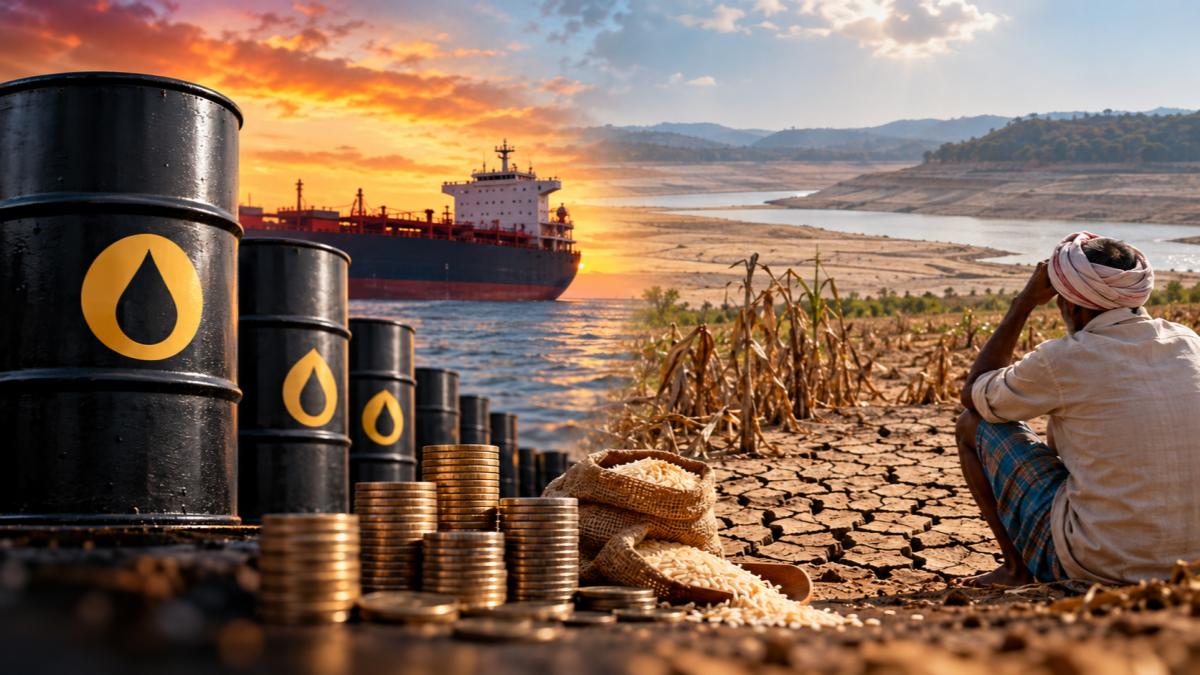
What’s the big worry for India now? Crude, drought or both?
Costlier crude raises transport and production costs, while drought puts crops and irrigation at risk. Their combined impact could squeeze household budgets and leave the RBI facing difficult choices on inflation and growth.
India is paying more for its oil just as a poor monsoon threatens to make food costlier. Either problem would complicate economic policy. Together, they put pressure on household budgets, farm incomes and the Reserve Bank of India’s effort to contain inflation without slowing growth too sharply. The combined effect is already visible in official data. The Petroleum Planning and Analysis Cell’s latest monthly snapshot shows that India’s crude import bill reached $90.6 billion in April-September, against $61.9 billion a year earlier, although import volumes increased by less than 1%.
Meanwhile, the India Meteorological Department recorded a 12.6% shortfall in June-September rainfall. The question, therefore, is not about focussing on a single problem between crude and drought than understanding how they together impact the economy. Oil creates an immediate pressure on imports and production costs. Drought can weaken farm output and rural spending, with consequences that continue long after the monsoon ends.
India imported 122.7 million tonnes in the first half of FY27, compared with 121.8 million tonnes a year earlier. The larger consumption of crude and consequent increase in expenditure points primarily to a price problem. Its published price series put the Indian crude basket’s October average so far at about $120 a barrel, against $82 in July. For an economy dependent on imports for most of its crude requirements, that increase spreads well beyond petrol pumps.
It raises the cost of supplying fuel to transporters, factories and farms. When the rupee weakens, each dollar of oil imports also costs more in domestic currency. IndicatorEarlier figureLatest figureCrude import bill$61.9 billion (April-Sept 2025)$90.6 billion (April-Sept 2026)Crude import volume121.8 million tonnes (April-Sept 2025)122.7 million tonnes, (April-Sept 2026)Indian crude basket price$82 a barrel (July 2026)About $120 a barrel (Oct 2026 to date) The RBI’s October Monetary Policy Report describes these channels: expensive oil raises the import bill, can pressure the currency and pushes up business costs.
Companies then face a choice between absorbing the increase through lower margins and passing it on to customers. Retail petrol and diesel prices need not move immediately or by the same proportion as crude. Taxes, refining economics and fuel retailers’ pricing decisions affect the transmission. But holding pump prices steady does not eliminate the cost; it changes where the burden falls. Drought threatens the next crop as well The rainfall shortfall creates a different problem.
A weak summer harvest can reduce farmers’ earnings before they have financed the next crop. Insufficient soil moisture and depleted water supplies can then make winter sowing more difficult. Central Water Commission figures for October 22 show the gap between the national picture and the south. The 178 monitored reservoirs across India were 66.7% full, while only the 50 southern reservoirs were at 42.34%, against a corresponding ten-year average of 77.94%.
These figures cover monitored reservoirs, rather than every source of irrigation. Even so, they indicate why a national storage total offers limited reassurance to a farmer whose local reservoir cannot supply water. The geographical spread of the problem is also widening. Gujarat announced drought status for Devbhumi Dwarka, Porbandar, Jamnagar and Kutch on October 26. According to Indian Express, Chief Minister Bhupendra Patel said the declaration and relief measures would take effect from November 1.
Where the two pressures meet For households, the most immediate meeting point is inflation. The Ministry of Statistics and Programme Implementation’s September release put retail inflation at 5.54%, up from 4.83% in August. Food inflation rose to 7.74% from 5.97%. Rural consumers faced a sharper overall increase than urban consumers. IndicatorAugust 2026September 2026Retail inflation4.83%5.54%Food inflation5.97%7.74% Those figures do not establish that drought caused every food-price increase.
Seasonal supply changes, distribution costs and the previous year’s price base also matter. They do show that the rainfall shock is arriving when food inflation is already elevated. The combined risk is straightforward as a smaller marketable harvest can constrain supplies, while expensive fuel raises the cost of moving what is available. A farm household with less produce to sell may simultaneously have to spend more on food and cultivation.
This is also why higher crop prices do not automatically compensate farmers for drought. A producer who loses much of the harvest has fewer goods to sell. Agricultural labourers can face reduced work without receiving any benefit from higher wholesale prices. RBI has already changed course The RBI raised the repo rate by 25 basis points to 5.50% on October 7 and adopted a stance of calibrated tightening.
Its policy resolution specifically identified deficient rainfall, El Nino and elevated energy prices as risks to the inflation outlook. Interest rates cannot replenish reservoirs or restore disrupted oil supplies. Their role is to limit the spread of an initial supply shock into broader price-setting and inflation expectations. That comes with a trade-off: higher borrowing costs can restrain spending and investment.
The RBI has also opened a special dollar window for Indian Oil, Bharat Petroleum and Hindustan Petroleum, effective October 12. The facility meets their daily dollar requirements through designated banks. It can ease pressure on the foreign-exchange market, but it does not make imported crude cheaper. What would ease the pressure? An easing of energy prices would provide relatively quick relief to the import bill.
Agricultural recovery depends on rain reaching the right catchments, irrigation remaining available and farmers being able to afford fresh sowing. IMD’s northeast monsoon outlook offers some hope. It forecasts normal October-December rainfall across its defined southern peninsular region. That is a regional seasonal forecast, however, and cannot guarantee adequate water for every drought-hit district.
So far, in the third week of October 2026 rainfall was 28% below the Long Period Average (LPA) across the country. Cumulatively, in the first week of October, rainfall was 58% below LPA. The RBI still projects FY27 growth at 7.1%, citing investment and services activity, while identifying foodgrain buffers and government intervention as cushions against agricultural weakness. Taken together, the data point to both crude and drought as concerns.
The more difficult outcome would be expensive energy persisting while water shortages damage another crop, keeping living costs high even as rural purchasing power weakens.