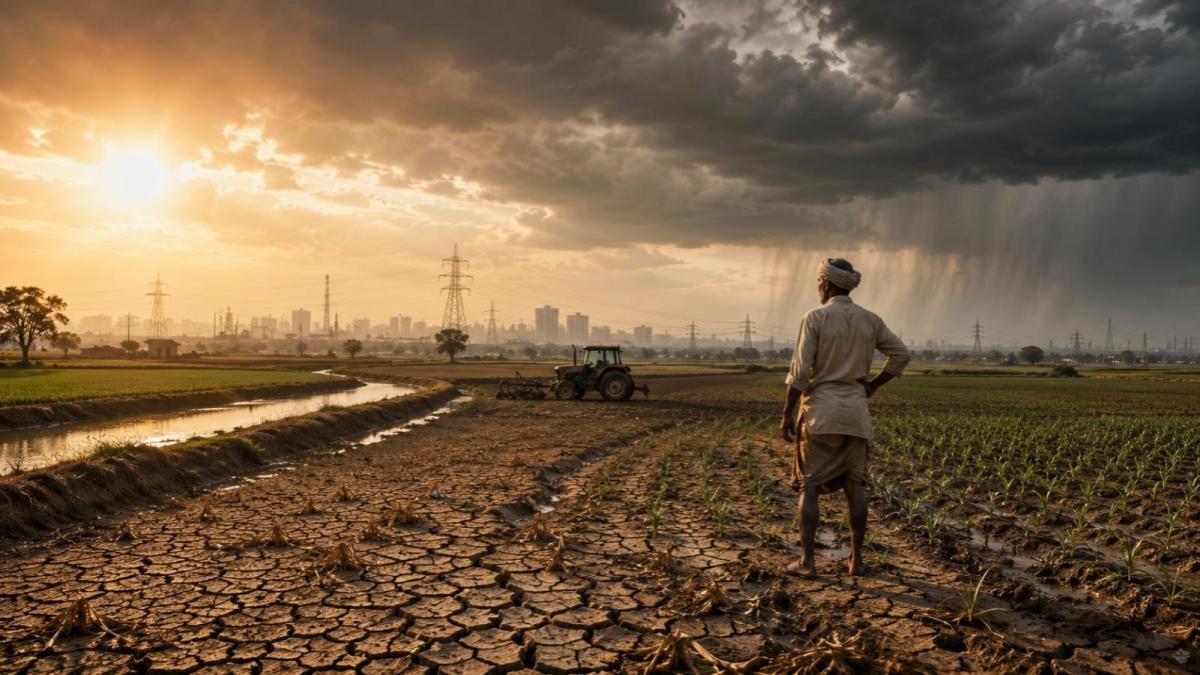
India faces critical water security challenges as the 2026 El Niño intensifies groundwater depletion and rainfall deficits, threatening agriculture, economic growth, and food inflation amid climate volatility.
By Amit Kapoor Recently, the International Research Institute for Climate and Society estimated “very strong” El Niño conditions through the winter of 2026-27. For an economy seeking to grow faster, the most important resource may be the one it cannot manufacture. India’s growth constraints are increasingly becoming physical. After years of treating groundwater as insurance against an unreliable monsoon, India may now be discovering that water security is economic security.
The monsoon season ended in September with the India Meteorological Department recording a 13% deficit in overall rainfall. The largest seasonal deficit in more than a decade, and it is only bringing India’s growing water vulnerabilities into sharper focus. It has long-standing water issues that only become more dangerous when rainfall fails. The 2026 El Niño was only adding pressure to an already fragile irrigation, groundwater, and food system.
The first concern is already visible in reservoirs as storage in 178 major reservoirs stood at 70% of total capacity as of September-end. The coming rabi season will put further pressure on already stretched reservoirs. Farmers turn to groundwater when rains, canals, and reservoirs cannot provide enough. That is not resilience. It is borrowing water from the future. India extracted about 256.9 billion cubic metres (BCM) of groundwater in 2025, with nearly 87% going towards irrigation.
This is precisely the point where a seasonal rainfall deficit becomes a structural economic problem. India has long relied on groundwater as a safeguard against unreliable monsoons. However, the 2026 season began with shortfalls even before the El Niño strengthened. In several of India’s agricultural states, this safeguard was already under strain, a consequence of intensive extraction which did not arise overnight.
The Central Ground Water Board's 2025-26 data points how uneven the vulnerabilities are. States like Punjab, Haryana, and Rajasthan have reached a stage of groundwater extraction above 100%. Effectively, you are withdrawing more than what nature is putting back. It means annual groundwater extraction is exceeding the extractable groundwater resource. The aquifer balance is negative and it has shifted from groundwater use to groundwater mining.
The remaining headroom makes the problem even starker. The net annual groundwater available for future use is just 6.37% in Rajasthan, 10.78% in Punjab, and 14.12% in Haryana against their extractable groundwater resources. These are evidences of structural pressures that predate any rainfall deficit of this monsoon. Uttar Pradesh, for instance, does not appear among the states with extraction above 100%.
Yet, it extracts an estimated 47.18 BCM of groundwater, the largest volume among all Indian states. The number matters more because groundwater is overwhelmingly being used to sustain agriculture. In Uttar Pradesh, 88% of extracted groundwater is used for irrigation. Similarly, several major agricultural states are heavily dependent on groundwater, with Punjab having a 95% dependency followed by Gujarat at 93%, Tamil Nadu at 92%, and Maharashtra at 90%.
It makes this rabi season the immediate test of India’s water security, as increasing rainfall uncertainty pushes its farmers to rely more heavily on groundwater extraction. The vulnerabilities become even more concerning when this groundwater recharge is considered. Approximately 58% groundwater recharge happens through rainfall in India. They highlight a very crucial interaction here as several states that rely heavily on groundwater for agriculture also depend materially on rainfall for replenishment.
Rajasthan and Madhya Pradesh have more than 70% dependency on rainfall. Maharashtra offers a crucial example. Its statewide extraction stage, at about 51%, can appear relatively comfortable. Yet, the state extracts roughly 16.38 BCM of groundwater, around 91% of it for irrigation, while nearly 64% of its gross recharge comes directly from rainfall. A state need not cross the 100% extraction threshold for a weak monsoon to become a serious agricultural water shock.
Uttar Pradesh, along with having the largest volume of groundwater extraction, has a 50% reliance on rainfall for recharge of the same. In Maharashtra and Karnataka, drought and erratic rainfall are intensifying pressure on already stressed water systems. Yet, the same climate volatility is also producing another extreme. Assam, Bihar, and most recently Uttar Pradesh have faced episodes of heavy rainfall and flooding during the monsoon, while other regions struggled with deficits.
India is not experiencing one uniform water crisis but scarcity and excess simultaneously. This is why the problem cannot be reduced to how much rain falls nationally. It is about where it falls, when it falls, how much can be stored, and how efficiently it can be moved to where it is needed. The significance is that climate risk is elevated at a time when India's water buffers are already weaker.
Eleven of the most water-stressed states in the country roughly account for three-quarters of its GDP. The water stress cannot merely be treated as an agricultural problem. If water availability affects production in any agricultural state, the consequences can ripple through food supply, farm incomes, inflation, and household water security. Food inflation was already at 5.95% in August, with rural food inflation higher at 6.13%, emphasising how closely food prices remain tied to supply-side pressures.
Water stress is not the sole explanation for these movements. However, it adds another supply-side vulnerability to an economy already exposed to weather and geopolitical shocks. This dilemma is likely to intensify as India pursues economic growth through the expansion of data centres, manufacturing, and urban infrastructure, all of which will compete, directly or indirectly, for increasingly valuable water resources.
With El Niño effects still looming over India’s rabi season and uncertainties ahead of the 2027 pre-monsoon, India cannot continue to plan for faster growth without planning around its water budget. The immediate test may be the rabi season, but the larger challenge extends beyond a single season: how India manages increasingly variable rainfall while its groundwater, reservoirs, and irrigation system remain under pressure.
Co-authored with Darshana Gauratra, researcher at Institute for Competitiveness The writer is Chair, Institute for Competitiveness Disclaimer: The views expressed are the author's own and do not reflect the official policy or position of Financial Express.