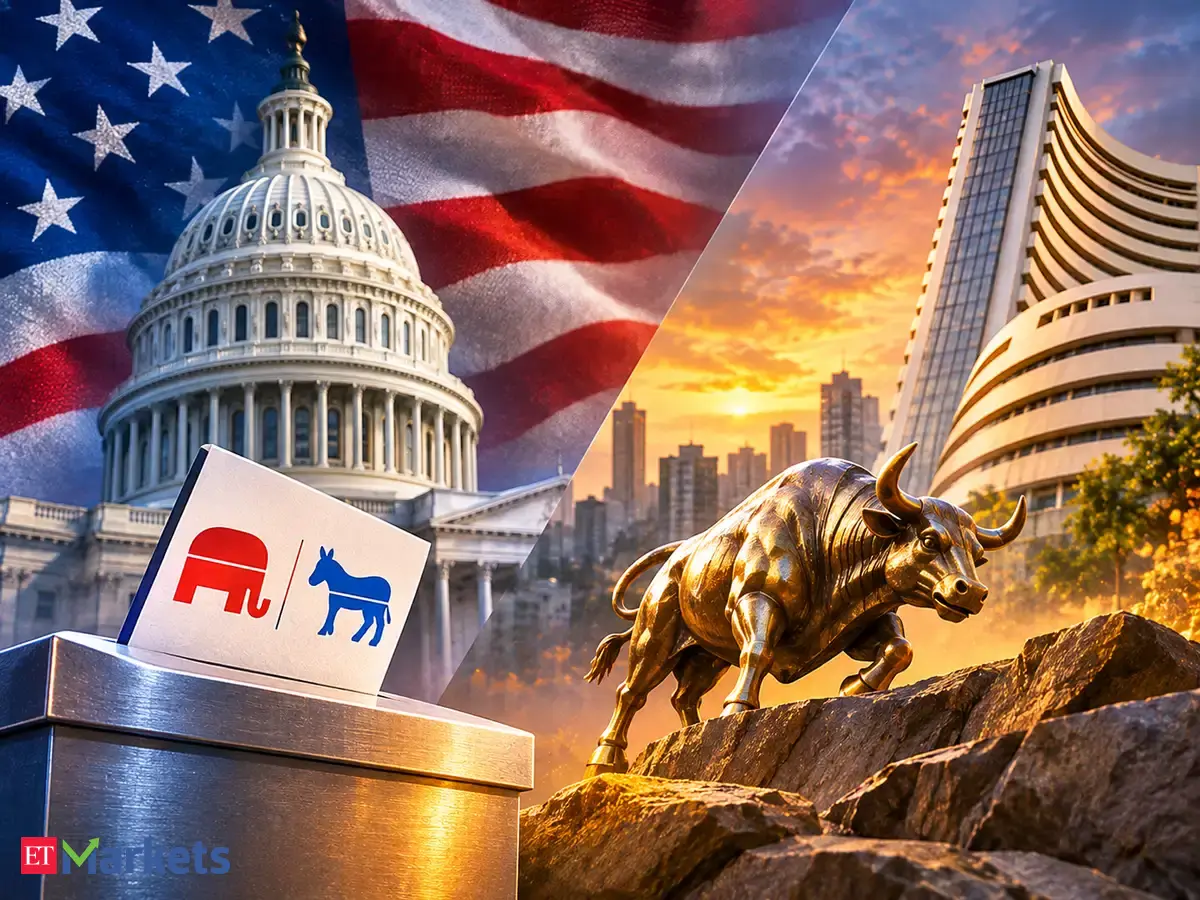
The US will hold voting for its midterm elections 2026 on Tuesday, with an increasing number of experts expecting President Donald Trump’s Republican party to be defeated by the Democrats and resulting in a divided Congress. While investors on Dalal Street are bracing for impact, analysts have listed out three possible scenarios in the American political game and what impact India can have in each of them.Republicans currently hold a slight advantage in the House of Representatives and a majority in the Senate, meaning Democrats need to win some seats in each chamber to overturn the Republican majority.
Irrespective of who wins the midterm elections, Trump will stay at the White House.What are US midterm elections?As the name suggests, midterm elections are typically held as a President’s four-year term hits the halfway point. Unlike the Presidential elections that selects a President and sees massive participation, midterm elections see Americans choose members of the country’s legislative body Congress and typically see lower voter turnout.However, it is important as it elects which party will hold control over the Congress, which is made up of two houses- the upper house or Senate, and the lower house or the House of Representatives.
Congress is tasked with creating and passing federal laws. The midterm results are also seen as a measure of how happy people in the US are with the President's performance so far. Here’s what analysts sayLive EventsPresident Donald Trump’s Republican party currently holds control over both the houses of Congress. However, a survey conducted ahead of the 2026 US midterm elections indicated that Trump was losing ground among several voter groups that helped return him to the White House in 2024.
A victory in the House alone would give Democrats control of committees, investigative powers and the ability to summon Trump admin officials for congressional hearings. Winning both chambers would provide them with considerably greater influence over legislation, government spending and presidential appointments.End to the Republican trifecta?The midterm elections are likely to end the Republican trifecta, with Democrats expected to win majority in the House of Representatives and having an increasingly viable path to the four Senate seats needed for a majority.
“President Trump’s weak approval ratings, elevated fuel prices, and tariff-related dissatisfaction point to substantial Republican losses. But a Democratic sweep would constrain Trump’s legislative agenda more than his ability to make policy: tariffs, immigration, deregulation, and foreign policy remain heavily dependent on executive authority, which Trump may use even more aggressively in the final two years of his presidency,” Emkay Research explained.This comes as Trump’s raging war along with Israel on Iran raised inflationary pressures in the economy, while sparking a skyrocketing rally in oil prices that has rattled global markets.What does it mean for Indian investors?Dalal Street, meanwhile, faces several headwinds of its own.
Trump's tariff flip-flops, rising oil prices and bond yields, and persistent FII outflows have dragged the Sensex and Nifty down up to 12% so far in 2026. Against this backdrop, investors are closely tracking the US midterm elections for their potential implications for global markets.For India, the implications are likely to be more geopolitical than directly market-related, according to Emkay Research.
It noted that Democratic control of Congress may increase scrutiny of tariffs and immigration but is unlikely to materially change these frictions. A likely re-escalation of the Iran conflict after the midterms will continue to weigh on India’s balance of payments, foreign exchange, and markets, it said.The brokerage has listed out three scenarios and how India will likely be impacted.Scenario 1: Democrats win House and Senate (60% probability)If Democrats win control over both houses of Congress, that is the House of Representatives as well as the Senate, then it would result in greater scrutiny on Trump’s tariff tantrums, although Emkay Research expects the existing tariff structures to be largely unaffected.
For immigration, the brokerage expects ICE funding to become constrained as investigations intensify, with some legislative push to reduce barriers to skilled immigration.However, foreign policy may become the area where Trump takes his revenge in this scenario. Emkay Research expects leverage over funding and authorisation, while investigations may intensify, but executive latitude will likely remain.
Foreign policy could become an outlet forTrump, risking conflict re-escalation and higher oil prices, it warned.Scenario 2: Democrats win House, Republicans retain Senate (30% probability)If Democrats succeed in taking control over only the House of Representatives, Emkay Research sees tariffs remaining largely unaffected. The house can however restrict funding, leading to some pushback towards Trump’s immigration crackdown.In case of foreign policy, this scenario will lead to more oversight but few constraints on Trump’s foreign policy decisions.
The risk of conflict escalation and higher oil prices remains as a result.Scenario 3: Republicans retain Congress (10% probability)In case Trump’s Republican party manages to hold its control over both the houses of Congress, this would result in maximum executive and congressional alignment, and Trump’s current policies on immigration may continue.This would give the greatest freedom of action, implying a significant risk of Iran conflict re-escalation and much higher oil prices, according to Emkay Research.ICICI Global Markets, however, does not expect a Democrat sweep in the midterm elections to alter the course of the Middle East war, as the previous attempts by Congress to end the war were unsuccessful.
“A split Congress, however, may increase the chances of a government shutdown as different policy priorities of Democrats and Republicans lead to a gridlock on budget and spending. Shutdowns significantly lower growth rates in the affected quarter, depending on their extent and length,” it noted.Disclaimer: This article has been written by Debaroti Adhikary, who is not a SEBI-registered Research Analyst or an Investment Adviser.
Debaroti Adhikary and his/her ‘relative(s)’ (as defined under Section 2(77) of the Companies Act, 2013) do not hold any financial interest in the companies mentioned in this article as of the date of publication. The views/recommendations mentioned in this article, wherever applicable, are those of the respective SEBI-registered Research Analyst/brokerage and have been reproduced/reported with due attribution.
They should not be construed as the views or recommendations of The Economic Times Digital or the journalist. Readers are advised to consider the original research report and make their investment decisions based on their own assessment. Brokerage disclaimers here.(You can now subscribe to our ETMarkets WhatsApp channel)