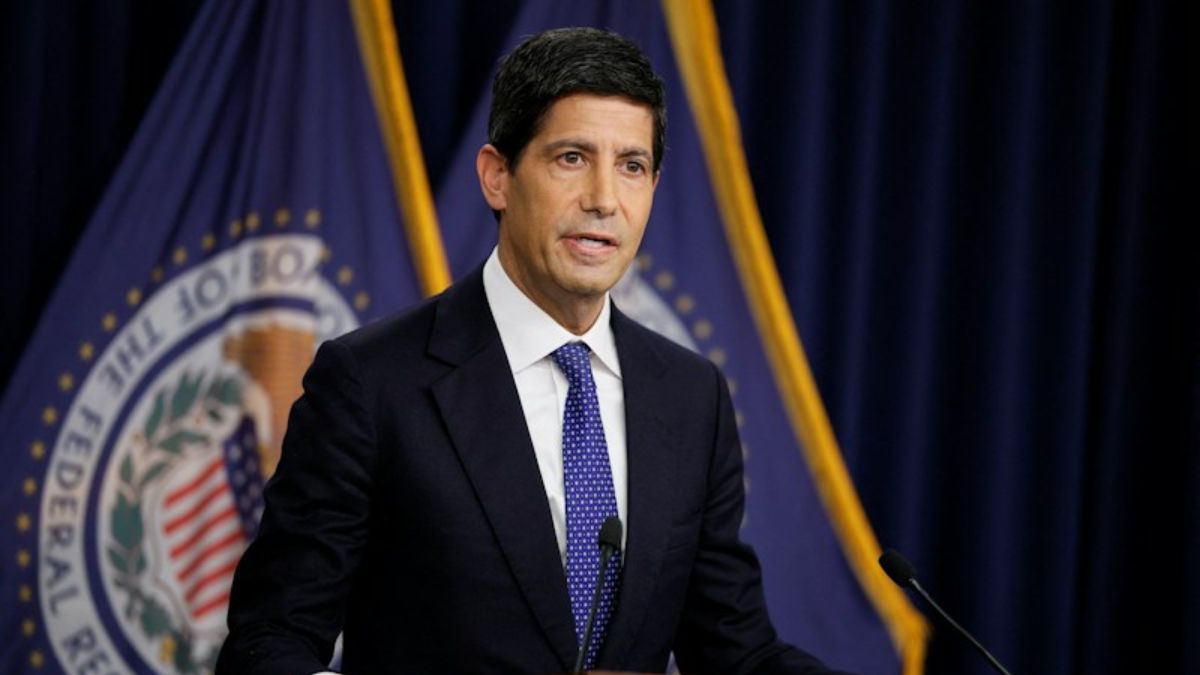
US Fed Meeting 2026: Fed holds rate steady at 3.75%-4%
US Fed Meeting Today Live: Fed holds rates at 3.75%-4% as inflation stays elevated and future hikes remain possible; follow live updates for market reaction.
Fed Meeting Today: The US Federal Reserve held its benchmark interest rate steady at 3.75% to 4%, as persistent inflation continues to complicate the outlook for monetary policy. The central bank said inflation remains elevated and upgraded its assessment of the economy, indicating that further rate hikes could be considered depending on how inflation evolves. Higher energy costs, tariffs, strong consumer spending and demand from the artificial intelligence industry have added to price pressures.
Interest rate decision: The Fed kept its benchmark rate unchanged in the 3.75% to 4% range, as widely expected by markets. Inflation outlook: The central bank said inflation remains elevated, with higher energy costs, tariffs, strong consumer spending and demand from the artificial intelligence industry contributing to price pressures. Future rate hikes: With inflation remaining a concern, markets are now focusing on the pace and extent of potential rate increases, depending on incoming economic data.
Political backdrop: The decision comes less than a week before the November 3 US midterm elections, which will determine whether President Donald Trump’s Republicans retain control of Congress. Kevin Warsh declined to respond to US President Donald Trump's October 7 comments that he was “great” but had only one vote on the Federal Reserve's board. Warsh said he would not respond to quotes from public officials.
He described his experience at the Fed over the past five months and said policymakers had held a serious discussion before reaching their latest decision. “What I can tell you is my experience in five months here, we just came out of a heck of a family fight, a serious, sober discussion. I think we came to the right policy decision for this moment,” Warsh said. “I think we came to the right ... policy decision for this moment, and I'm honored to be here and honored to be the chairman of this group,” he added.
Kevin Warsh said the five Federal Reserve task forces reviewing the central bank's operations are still working on their findings. Some, but not all, are expected to meet the year-end deadline for submitting their reports. Warsh announced the task forces after his first policy meeting as Fed chief on June 16-17. They are reviewing the central bank's operations, including technical issues such as balance sheet management and emerging areas such as the impact of artificial intelligence.
“These five task forces are hard at work. I have scarcely seen anything that would constitute a final report, but I have done some periodic check-ins with them, and I am impressed by the rigor of the intellectual discussions, by the seriousness of the task that we've given them,” Warsh said. “I gave them, like I told you, a year-end deadline. I think some, but not all of the groups will probably hit their deadline and turn their homework in on time,” he added.
Kevin Warsh said the Federal Reserve has not yet finalised the format for its new strategy-focused meetings, which will begin next year. “It’s not obvious yet,” Warsh said of what the meetings will look like. “There’s more news to come on that, the decision on the new format for the meetings is relatively new.” He said the Fed had held “a robust discussion” over a couple of meetings on how to structure the sessions.
More details will be shared as the plans are worked out. Kevin Warsh announced a change to the Federal Reserve's meeting schedule, with one meeting in 2027 dedicated exclusively to broader monetary policy strategy instead of setting interest rates. The meeting will not include a vote on the federal funds rate, and no policy statement is expected. The remaining meetings will follow the regular policy-setting format.
Warsh said the Fed plans to hold two strategy-focused meetings and six policy-setting meetings in 2028. “It's equally important we reserve time and space as an intellectually diverse group for strategic deliberations, for thinking anew about big questions, looking out over longer time horizons, focusing, as I say, on the left side of the decimal point,” he said. He described the meeting schedule as “more than some administrative detail,” saying it affects the nature and quality of the Fed's discussions and, ultimately, its decisions.
“It's yet another change to get the conduct of monetary policy on the right track,” he added. Federal Reserve Chair Kevin Warsh said policymakers focused mainly on price stability during their two-day meeting. He said financial and credit conditions had tightened for some businesses and households since the Fed's September policy action. Market participants had also become more selective in their capital allocations.
“While overall financial conditions are tighter, I'm unwilling and unable to call them tight,” Warsh said, adding that these developments were broadly moving in the direction of longer, more durable economic growth and price stability. Kevin Warsh said controlling inflation does not depend on a specific date or a single data point. He made the remarks when asked why the Federal Reserve did not raise interest rates at this meeting.
“Quashing inflation is not about some fixed individual date on a calendar. Same way it's not about some isolated data point. If it were about those two things, this job would be easier, and we wouldn't be suffering from nearly six years of inflation above target,” he said. Warsh added that inflation expectations had moved in the right direction since the Fed raised rates in September. “I feel good about those signposts,” he said.
Kevin Warsh said the US labour market remains in relatively strong shape, while inflation continues to stay above the Federal Reserve’s 2% target. “On the employment side of the Fed's dual mandate, conditions are quite positive. And yet Americans, of course, are still dealing with inflation that has been running above the committee's objective for close to six years. It's our responsibility to get inflation down,” he said.
Kevin Warsh said the Federal Open Market Committee needs more information to determine the appropriate policy stance and ensure inflation returns to its 2% target. "My colleagues and I assess the economy by looking out the window. It's what we call 'interrogating reality' to gauge what's really going on. It is not a task that has grown easier," he said. Kevin Warsh said high-tech investment, led by artificial intelligence, is driving the acceleration in economic activity.
He also said the US economy is expanding at a strong pace, reflecting resilient domestic spending, robust capital investment and strong productivity growth. US Fed chair Kevin Warsh's press conference begins US stocks traded mixed after the Federal Reserve’s policy announcement. The Nasdaq Composite fell 0.2%, while the S&P 500 rose 0.1%. Treasury yields remained slightly higher on the day. The two-year Treasury yield, which is particularly sensitive to Fed policy, rose 3.9 basis points to 4.776%.
The 10-year yield climbed 5 basis points to 5.047%, while the 30-year yield gained 3.8 basis points to 5.338%. The US dollar index edged up 0.02%. The Federal Reserve’s latest policy statement marks a notable change from its September 15-16 meeting, with a hint of the forward guidance that Kevin Warsh has said he wants to avoid. The Fed upgraded its assessment of economic activity to “strong” from “solid” in September.
It also said investment remained robust and job gains continued to keep pace with workforce growth. The vote in favour of keeping policy unchanged was 10-2. Governor Lisa Cook and Cleveland Fed President Beth Hammack dissented in favor of a 25-basis-point rate hike. "The Federal Open Market Committee approved the following statement for release by a 10 – 2 vote: The Committee decided to maintain the target range for the federal funds rate at 3-3/4 to 4 percent, in support of the Federal Reserve's dual mandate.
The Committee is continuing its policy of maintaining ample reserves in the banking system. Economic activity is expanding at a strong pace. While uncertainty remains elevated owing, in part, to geopolitical developments, domestic spending has been resilient. Productivity growth is strong, and capital investment is robust. Job gains have kept pace with the workforce, and the unemployment rate has changed little.
Inflation remains elevated. The accumulation of more information will help the Committee determine the policy stance appropriate to ensure a timely return of inflation to the Committee's 2 percent goal. The Committee will deliver price stability. Voting against the monetary policy action were Lisa D. Cook and Beth M. Hammack, who preferred to raise the target range for the federal funds rate by 1/4 percentage point at this meeting."
The Federal Reserve directed its Open Market Desk to roll over at auction all principal payments from its Treasury holdings. It will also reinvest all principal payments from its agency securities holdings into Treasury bills. These steps form part of the central bank’s approach to managing its securities portfolio. The Federal Reserve directed its Open Market Desk to increase securities holdings when appropriate by purchasing Treasury bills and, if needed, other Treasury securities with remaining maturities of three years or less.
The aim is to maintain an ample level of reserves in the banking system. The Federal Reserve set the offering rate for standing overnight reverse repurchase agreement operations at 3.75%, effective October 29, 2026. The directive also set a daily limit of $160 billion per counterparty for these operations. The Federal Reserve directed the New York Fed’s Open Market Desk to conduct standing overnight repurchase agreement operations at an interest rate of 4%, effective October 29, 2026.
These operations are part of the Fed’s framework for keeping short-term interest rates within its target range. The Federal Open Market Committee directed the Open Market Desk at the Federal Reserve Bank of New York to conduct operations as needed to keep the federal funds rate within its target range of 3.75% to 4%. The directive takes effect on October 29, 2026, and will remain in place until further instructions.
The Federal Reserve Board of Governors unanimously voted to maintain the interest rate paid on reserve balances at 3.90%, effective October 29, 2026. The rate is part of the central bank’s tools for guiding short-term interest rates. Federal Reserve officials Lisa D. Cook and Beth M. Hammack voted against the decision to hold rates steady. Both preferred to raise the federal funds rate target range by 25 basis points at the October meeting, while the majority voted to keep rates unchanged.
The Federal Reserve said inflation remained elevated and reiterated its goal of bringing it back to 2%. The committee said more economic data would help it determine the appropriate policy stance to ensure inflation returns to its target in a timely manner. The Federal Reserve said job gains had kept pace with workforce growth, while the unemployment rate had changed little. The assessment points to continued stability in the US labour market, even as policymakers weigh the outlook for inflation and interest rates.
The Federal Reserve said US economic activity was expanding at a strong pace. Despite elevated uncertainty, partly due to geopolitical developments, domestic spending remained resilient. Strong productivity growth and robust capital investment also supported the economy. The Fed left interest rates steady in the current 3.75%-4.00% range. Warsh has expressed confidence in the strength of the US economy, saying global economies have also held up better than expected despite energy shocks and inflation.
Speaking at theInternational Monetary Fund and World Bank annual meetings in Bangkok earlier this month, he said central bankers were seeing a surge in prices across economies. He said an investment boom led by artificial intelligence was spreading to other sectors, boosting demand and putting upward pressure on inflation. At the same time, the wider investment trend was helping the US economy remain resilient.
Warsh said the US had strong economic tailwinds that were not present in many other parts of the world. Savings remain a bright spot for consumers, as high-yield savings accounts continue to offer relatively strong returns compared with traditional bank accounts. These accounts can help savers earn more interest on their deposits while borrowing costs remain high. US consumer prices rose at a faster pace in September as gasoline prices surged.
The latest Consumer Price Index report also showed price pressures spreading beyond energy, raising concerns among economists that underlying inflation could remain stubbornly high. Higher costs linked to artificial intelligence also added to inflation last month. The Federal Reserve’s rate decision comes less than a week before the US midterm elections, with the cost of living emerging as a key issue.
Three-quarters of Americans say their cost of living is heading in the wrong direction, according to the latest Reuters/Ipsos poll. Inflation has become a major concern after US military strikes on Iran in February pushed gasoline prices higher. Keeping the Fed’s benchmark rate in the current range of 3.75% to 4% would put discussions of further rate hikes beyond the midterm elections. President Donald Trump has called for rates to fall to 1%, a level analysts say is impractical and could backfire.
Thirty-year mortgage rates have remained above 7%, adding to the cost of buying a home. Auto loan rates have also stayed close to 7%, while borrowers in the used-car market often face even higher rates.