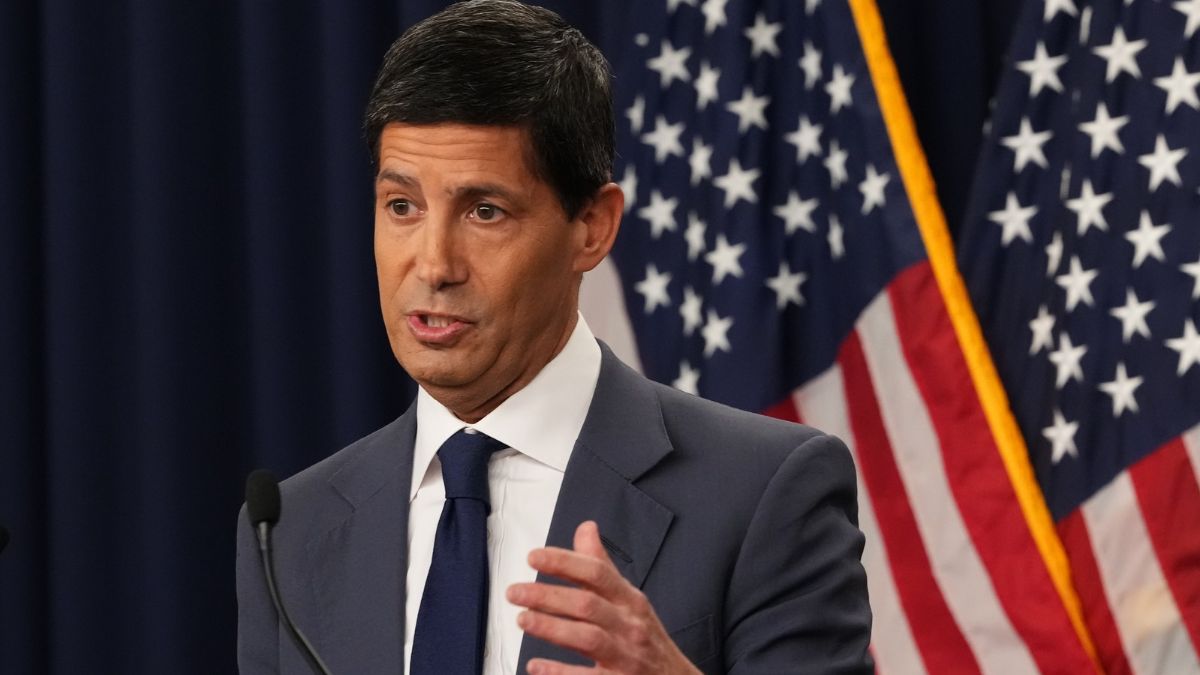
US Fed keeps rates unchanged: Key takeaways from Kevin Warsh’s press conference
The US Federal Reserve held interest rates steady at 3.75%-4%, citing persistent inflation above 2% and the need for more data before future moves. Fed Chair Kevin Warsh highlights resilient economic activity and AI-driven growth.
The US Federal Reserve kept its interest rate unchanged at 3.75% to 4%, as inflation remains above its 2% target. Fed Chair Kevin Warsh said policymakers need more data to assess the economy and decide on their next move. The central bank upgraded its assessment of economic activity, citing resilient consumer spending, strong productivity growth and robust capital investment. The decision comes less than a week before the November 3 US midterm elections.
Here are the 13 key takeaways from Kevin Warsh’s press conference: Inflation remains the Fed’s biggest concern Warsh said inflation has remained above the Fed’s 2% target for close to six years, making price stability a key priority for policymakers. “Americans, of course, are still dealing with inflation that has been running above the committee’s objective for close to six years. It’s our responsibility to get inflation down,” Warsh said in the press conference.
Fed needs more data before deciding its next move Warsh said the Federal Open Market Committee (FOMC) needs more information to determine the appropriate policy stance and bring inflation back to its 2% target. “My colleagues and I assess the economy by looking out the window. It’s what we call ‘interrogating reality’ to gauge what’s really going on. It is not a task that has grown easier,” Warsh explained in the press conference.
He said assessing the economy has become more difficult, making it important to look at actual conditions before deciding on interest rates. 75%-4% Warsh says inflation control cannot follow a fixed timeline The Fed chair said policymakers cannot rely on a specific date or a single economic indicator to determine when inflation will come under control. He also said inflation expectations had moved in the right direction since the Fed’s September rate increase.
“Quashing inflation is not about some fixed individual date on a calendar. Same way it’s not about some isolated data point,” Warsh said while answering a question from the press. AI investment is driving economic growth Warsh said investment in high-tech industries, particularly artificial intelligence, is helping accelerate economic activity. He pointed to strong capital investment, resilient domestic spending and productivity growth as key supports for the US economy.
Labour market remains in good shape Warsh said employment conditions remain positive, with the labour market holding up regardless of persistent inflation. The Fed must balance its objectives of maximum employment and price stability as it decides its next policy steps. Financial conditions have tightened, but Warsh stops short of calling them tight Warsh said financial and credit conditions had tightened for some businesses and households since the Fed’s September policy action.
Investors have also become more selective about where they allocate capital. “While overall financial conditions are tighter, I’m unwilling and unable to call them tight,” he said. Fed to hold separate strategy meetings in 2027 and 2028 Warsh said the Fed plans to hold a dedicated meeting on broader monetary policy strategy in 2027, separate from its regular interest rate-setting meetings. The meeting will not include a vote on interest rates or a policy statement.
In 2028, the central bank plans to hold two strategy-focused meetings and six regular policy meetings. “It’s equally important we reserve time and space as an intellectually diverse group for strategic deliberations, for thinking anew about big questions, looking out over longer time horizons,” Warsh said. Format of new strategy meetings is still undecided Warsh said the Fed has not finalised how the new strategy-focused meetings will work.
Policymakers have held discussions on the format, with more details expected as the plans take shape. “It’s not obvious yet,” he said, adding that “there’s more news to come on that”. The reviews cover issues including balance sheet management and the impact of artificial intelligence. He said he was impressed by the quality of the discussions but did not expect every group to meet the year-end deadline.
“I think some, but not all of the groups will probably hit their deadline and turn their homework in on time,” he said. Warsh declines to respond to Trump’s remarks about his influence Warsh declined to comment on US President Donald Trump’s October 7 remarks that he was “great” but had only one vote on the Fed’s board. He said he would not respond to quotes from public officials and defended the committee’s decision-making process.
“What I can tell you is my experience in five months here, we just came out of a heck of a family fight, a serious, sober discussion. I think we came to the right policy decision for this moment,” Warsh said. Warsh unaware of Fed involvement in Lisa Cook hearing Federal Reserve Chair Kevin Warsh said he was unaware of any involvement by him or the central bank in the upcoming White House hearing on Fed Governor Lisa Cook.
“Not to my knowledge,” he said at a press conference. US President Donald Trump has ordered a hearing for next Thursday over allegations that Cook made false statements on mortgage applications. Warsh says oil price movements need scrutiny Federal Reserve Chair Kevin Warsh said the central bank would examine the implications of any further decline in oil prices, particularly amid recent market movements.
“There had been a stable correlation between oil prices – they’ve moved up this year, generally – and interest rates. Not the interest rates that we control, but interest rates set in the market. That correlation has been quite strong until very recently,” he said. Warsh added that a further fall in oil prices due to geopolitical developments would require closer examination. “To the extent that oil prices were to move lower again, probably due to geopolitical events, that's something that we're going to have to interrogate,” he said.
Warsh says politics did not influence Fed rate decision Federal Reserve Chair Kevin Warsh said political considerations, including the upcoming US midterm elections, did not influence the decision to keep interest rates unchanged. “Politics played no role in the decision. I just spent two days with my colleagues upstairs. I didn't hear an utterance about politics. I didn't hear a reference to politics, elections, what's happening in the next week or so,” he said.
Warsh reiterated that neither he nor his colleagues considered political factors while making the decision. The Federal Open Market Committee voted 10-2 to keep the federal funds rate target range unchanged at 3.75% to 4%. The committee upgraded its assessment of economic activity to “strong” from “solid” in September, saying domestic spending remained resilient regardless of elevated uncertainty linked partly to geopolitical developments.
Job gains have kept pace with workforce growth, while the unemployment rate has changed little. The Fed said inflation remains elevated and that more economic data would help policymakers determine the appropriate policy stance to bring inflation back to its 2% target in a timely manner. Governors Lisa Cook and Cleveland Fed President Beth Hammack dissented, favouring a 25-basis-point rate hike. The central bank also directed its Open Market Desk to roll over principal payments from Treasury holdings and reinvest payments from agency securities into Treasury bills.