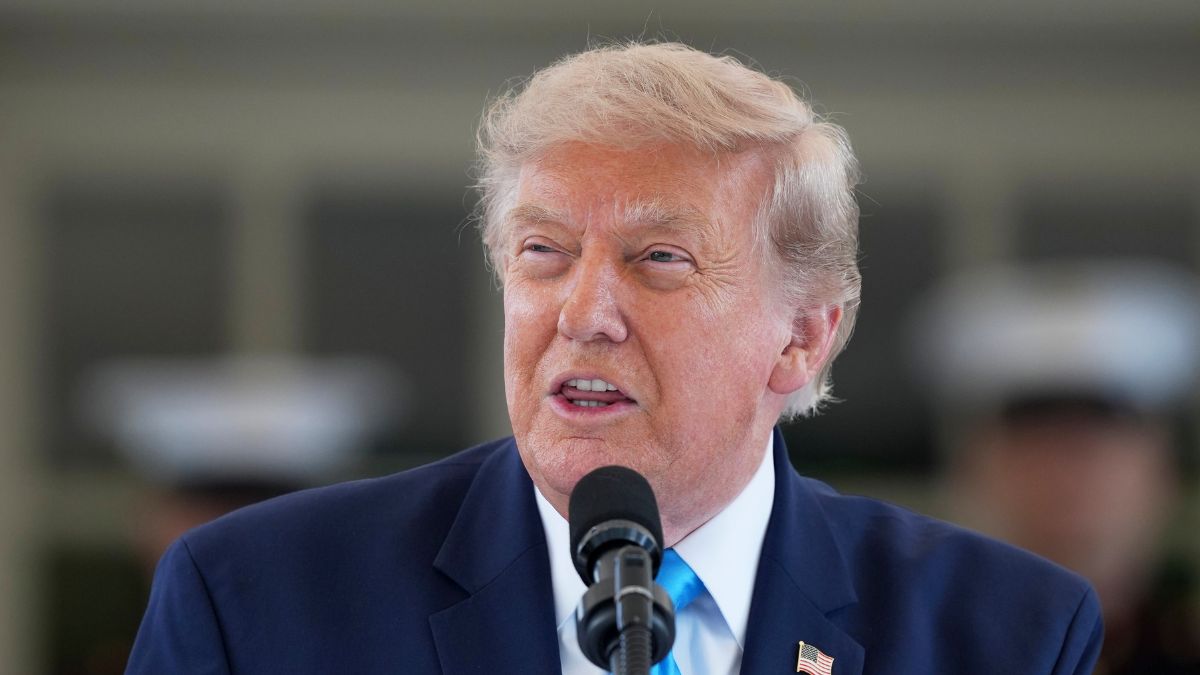
Trump approval drops to 33%: What latest US polls say about economy and midterms
US President Donald Trump’s approval fell to 33% in a Washington Post-ABC News-Ipsos poll, with 66% of Americans disapproving of his performance.
US President Donald Trump’s approval rating has fallen to 33%, while Democrats have gained an advantage in national congressional preferences ahead of the November midterm elections, according to a Washington Post-ABC News-Ipsos poll. Rising living costs, dissatisfaction with the economy and concerns about the administration’s policies are emerging as key issues for voters. The midterms will determine control of the US House of Representatives and Senate, shaping Trump’s ability to advance his agenda during the second half of his term.
Republicans currently control Congress, but recent surveys point to growing voter frustration with the administration and greater engagement among Democratic voters. The Washington Post-ABC News-Ipsos survey was conducted online from October 9 to 13 among 2,545 US adults, with an overall margin of error of plus or minus two percentage points. The findings offer a snapshot of public opinion, not a prediction of individual congressional races.
Why has Trump’s approval rating fallen? Trump’s 33% approval rating was four percentage points lower than in July and eight points below the level recorded at the same point a year earlier, The Washington Post reported. Among likely voters, 38% approved of his performance and 62% disapproved. More than half of all adults surveyed, or 52%, strongly disapproved of the president. The poll also found that 72% of Americans believed the country was heading in the wrong direction, up five percentage points since April.
The findings suggest that dissatisfaction extends beyond individual policies to the broader direction of the country. The economy was a major source of concern. Trump’s approval rating for his handling of the economy stood at 28%, down from 33% in July and 41% in February, according to the Washington Post-ABC News-Ipsos poll. About three-quarters of Americans disapproved of his handling of inflation and the cost of living.
The Washington Post reported that this was the highest share expressing that view for any president in its polling dating back to 1986. Among respondents who said they were financially worse off, 78% favoured Democrats for Congress. Independents in this group also leaned towards Democrats, with 71% supporting them. While the findings suggest a link between financial concerns and congressional preferences, they do not establish that economic hardship alone determines voting choices.
Affordability concerns extended to fuel, groceries, healthcare and home energy. Before the United States launched military action against Iran, 71% of respondents in the February survey said gasoline was affordable. In October, the same share said it was unaffordable. The Washington Post linked the shift to the conflict’s effects on energy supplies and shipping, which pushed gasoline and diesel prices higher.
Primary turnout is not a reliable forecast of the November result. (AI-generated image) Majorities also said groceries, healthcare and home energy were unaffordable, with concerns rising since February. Fewer than four in 10 respondents said they could afford to dine out, down from about half in the earlier survey. A separate Associated Press-NORC poll, conducted from October 8 to 12, found similar concerns.
About eight in 10 registered voters said the cost of living was among their leading concerns for the midterms. Roughly three-quarters disapproved of Trump’s handling of the economy, while nearly eight in 10 disapproved of his handling of living costs. The findings also pointed to concerns among Republicans. Only 44% of Republican voters approved of Trump’s handling of the cost of living, although 54% approved of his overall economic leadership.
On foreign policy, 69% of Republican voters supported his handling of the issue as the war with Iran continued. “Everything’s going up,” Republican voter DonnaJean Weber of Michigan told the Associated Press. She said she was unhappy with the effects of the war with Iran and some of Trump’s tariff decisions, showing concerns about the economy that have surfaced across party lines. It surveyed 5,062 US adults, including 3,917 registered voters, from September 28 to October 4.
Overall, 84% of registered voters said the economy was very important to their midterm vote, including 88% of Democratic supporters and 82% of Republican supporters. Pew put Trump’s approval rating at 30%, compared with 33% in the Washington Post-ABC News-Ipsos poll. The figures should not be treated as contradictory or combined into a single estimate, as the organisations conducted separate surveys using different samples and polling methods.
Both, however, found low approval for the president. Trump also faced criticism on issues beyond the economy. In the Washington Post-ABC News-Ipsos survey, 65% of respondents said the decision to take military action against Iran was a mistake. Around 60% disapproved of his handling of immigration, while 56% said he had gone too far in deporting undocumented immigrants. The poll found that 66% of Americans believed Trump was using the presidency to enrich himself, up from 56% the previous autumn.
Another 66% viewed him as “too extreme”. The findings indicate that dissatisfaction involves both policy decisions and concerns about his conduct in office. What do the polls say about 2026 midterms? The Washington Post-ABC News-Ipsos poll found that Democrats held an eight-percentage-point lead over Republicans in congressional preferences among registered and likely voters. The lead had widened from three points among registered voters in the newspaper’s July poll.
The survey also found that 58% of registered voters preferred a Democratic-led Congress that would act as a check on Trump, compared with 39% who favoured a Republican-led Congress that would support his agenda. The gap was roughly twice as wide as it had been a year earlier. Pew Research Center reported a similar Democratic advantage. In its October survey, 44% of registered voters said they would vote for the Democratic candidate in their congressional district if the election were held at that time, while 36% preferred the Republican candidate.
Another 5% chose a different candidate and 15% were unsure. The outcome of the November elections will decide which party controls the House of Representatives and the Senate for the final two years of Trump's presidency. (AI-generated image) The Pew findings also pointed to a gap in voter engagement. Among respondents who supported a Democratic House candidate, 78% said it really mattered which party controlled Congress.
That compared with 69% of Republican candidate supporters. Half of Democratic supporters said they had given a lot of thought to the election, compared with 36% of Republican supporters. Similarly, 63% of Democratic supporters said they were extremely motivated to vote, against 46% of Republican supporters. Pew found that 44% of registered voters viewed their congressional vote as a vote against Trump, while 19% saw it as a vote for him.
Another 36% said the president was not a factor in their decision. The findings suggest that Trump’s record could influence congressional contests, even though voters will be choosing individual House and Senate candidates rather than voting directly on his presidency. The Associated Press-NORC survey also found greater enthusiasm among Democratic voters. Around three-quarters of Democratic registered voters said voting in November was extremely important, compared with roughly six in 10 Republicans.
About half of registered voters preferred Democratic control of the House or Senate, while around four in 10 wanted Republicans to retain control. About half favoured substantial change in how the country was run, while roughly three in 10 wanted complete and total upheaval. Even among Republican voters, 45% wanted substantial change and 13% favoured a complete overhaul. However, the surveys do not suggest that voters have embraced Democrats without reservations.
The Associated Press found that about four in 10 voters had a favourable view of the Democratic Party, while around half viewed it unfavourably. About six in 10 viewed Republicans unfavourably. Independent voters could play an important role in competitive races. The AP-NORC survey found that about two-thirds of independents viewed the Republican Party negatively, compared with roughly four in 10 who viewed Democrats negatively.
However, dissatisfaction with Republicans does not necessarily mean these voters will support Democratic candidates. The Washington Post also reported that Republicans retained an overall advantage in money available for political advertising. Campaign spending, local candidates, turnout and the distribution of competitive seats could all influence the final results. The newspaper cautioned that its poll did not predict the outcome of individual House or Senate races.
The election will therefore depend on more than Trump’s approval rating. Democratic voters appear more engaged in national surveys, while concerns about the economy and living costs present challenges for Republicans. Local contests, candidate quality, campaign organisation and turnout will also shape results in individual districts and states. Disclaimer: This article is based on publicly available polling data and agency reports.
Poll results reflect public opinion at the time of the surveys and do not predict election outcomes. Financial Express Digital does not endorse or oppose any political party, candidate or government policy.