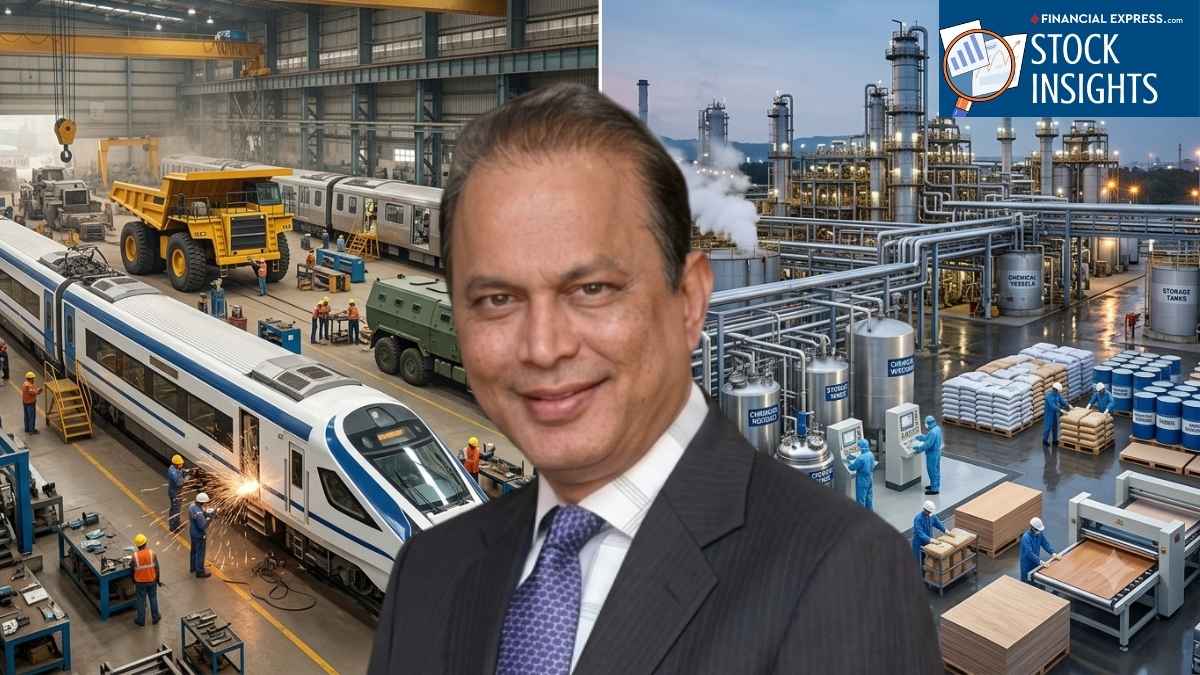
Sunil Singhania’s latest PSU bet has a bullet train order bigger than its annual sales
Sunil Singhania's new mutual fund has crossed the 1% mark in a PSU that just won an order worth over Rs 5,400 cr for India's first bullet train line.
Spotting Hidden Value in Legacy Chemicals and Defence PSUs Every round of shareholding filings throws up a few names that look odd at first glance. This time, two stand out. One is a defence PSU that builds metro coaches, mining dumpers and army trucks, and is now set to build high-speed trains. The other is a 66-year-old chemicals company from Kolkata whose stock slid to Rs 56 in March 2026. The first move belongs to Sunil Singhania, founder of Abakkus Asset Managers.
His Abakkus Flexi Cap Fund appears on the list of shareholders holding more than 1% for the first time in the September 2026 filing of a PSU that just grabbed a huge order. The second belongs to Sanjiv Shah, a seasoned investor whose disclosed portfolio of about 14 stocks is worth close to Rs 703 cr. He lifted his stake in a chemicals manufacturing company from 2.79% in March 2026 to 3.97% in June 2026.
The timing makes them worth reading side by side. Shah's stock is up about 127% in a year. Singhania's is down about 11%, even after landing the biggest order in its history. Let us dive in. #1 BEML: Sunil Singhania's Ticket to India's Bullet Train Plans Incorporated in 1964 as Bharat Earth Movers, BEML is a Schedule A PSU in which the President of India holds 54.03%. It runs three businesses: defence vehicles, mining and construction equipment, and rail and metro coaches.
08%, worth about Rs 180 cr. He is not alone. Domestic institutions raised their combined stake from 19.40% in June to 21.52% in September 2026. Foreign investors moved the other way, cutting their holding to 5.27% from 9.91% in March 2024. The ₹5,400-Crore Bullet Train Catalyst: Singhania’s Bet on BEML’s Order Book On 18th September 2026, BEML told the BSE it had won an order worth over Rs 5,400 cr from the National High-Speed Rail Corporation.
It covers the supply and upkeep of high-speed trains for the Mumbai-Ahmedabad corridor. The order is about 24% larger than BEML's entire FY26 revenue. Add it to the Rs 16,285 cr order book the company reported for 30th June 2026, and BEML is sitting on about Rs 21,700 cr of work. That is roughly five years of revenue at the FY26 pace. Financial YearFY21FY22FY23FY24FY25FY265Y CAGRSales (Rs cr)3,5974,3373,8994,0544,0224,3514%EBITDA (Rs cr)1913393774545153009%Net Profit (Rs cr)7513515928329414815%Source: Screener.in EBITDA is operating profit before other income.
Here is the uncomfortable part. Sales have barely grown in five years, and FY26 profit fell by half to Rs 148 cr as the operating margin dropped from 13% to 7%. BEML also leans heavily on the March quarter. In FY26, that quarter alone earned close to Rs 180 cr, more than the full year, which means the first nine months ran at a loss. There are early signs of a turn. In the June 2026 quarter, revenue rose 29% to Rs 819.62 cr and the loss narrowed to Rs 27.01 cr from Rs 64.11 cr.
High Valuations, Execution Delays, and Cash Flow Constraints The share price of BEML was around Rs 2,235 in October 2025 and as of closing on 14th October 2026 it was Rs 1,994, a fall of about 11% in one year. It is still up about 47% from its 52-week low of Rs 1,355. The stock trades at a PE of about 92x and 5.7 times book value. The current industry median PE is 30x. The 10-year median PE for the company is 50x while the industry median for the same period is again 30x.
The risks are mostly about cash and time. Customers took 191 days on average to pay in FY26. Free cash flow was negative at Rs 250 cr. Return on equity has slipped to about 5%. And high-speed trains need long testing before they earn money. #2 Kanoria Chemicals: Sanjiv Shah’s Clean-Up Nobody Noticed Incorporated in 1960, Kanoria Chemicals & Industries makes formaldehyde, hexamine, pentaerythritol and phenolic resins.
These are the glue and binding chemicals behind plywood, laminates, paints and construction products. Formaldehyde alone made up 47% of its FY26 standalone revenue, as per the AGM presentation the company filed with the BSE on 2nd September 2026. With a market cap of about Rs 830 cr, the company has had Shah in the shareholders register for a while. He first showed up in March 2021 with about 7.6 lakh shares.
He held 1.84% in September 2024, 1.95% in December 2024 and 2.73% by March 2025. Then came the big step. In the June 2026 quarter he added roughly 5.25 lakh shares to reach 17,36,376 shares, or 3.97%. That quarter opened just days after the stock touched its 52-week low of Rs 56. He is now the largest public shareholder, and his stake is worth about Rs 31 cr. Shah’s APAG Spin-Off To see why Shah may have kept buying, look at what left the company.
In 2012, Kanoria bought APAG, a Swiss maker of car and industrial electronics. It never quite worked. By FY25, APAG brought in about half of the group's total income but carried a negative net worth. In FY26, two outside investors put fresh money directly into APAG. That cut Kanoria's stake from 55% to about 14.3%, and APAG stopped being a subsidiary. Kanoria received no cash in this round. A second round, in which the buyers take the remaining 14.3%, is slated for FY30.
Financial YearFY21FY22FY23FY24FY25FY265Y CAGRSales (Rs cr)1,0951,3691,5781,4751,537981-2%EBITDA (Rs cr)946872523171-5%Net Profit (Rs cr)162-13-55-108113NMSource: Screener.in EBITDA is operating profit before other income. NM: not meaningful. Read this table with care. FY21 to FY25 include APAG. FY26 does not. So, the fall in sales is an accounting effect, not a shrinking business. The FY26 profit of Rs 113 cr is also flattered.
It includes a non-cash gain of Rs 97.65 cr booked when APAG stopped being a subsidiary. The continuing business earned about Rs 32 cr, helped by a deferred tax write-back of Rs 21 cr. Core Business Turnaround: Analyzing Kanoria Chemicals' FY26 Revenue Growth Strip out APAG and a cleaner picture shows up. Standalone chemicals revenue rose from Rs 388 cr in FY21 to Rs 875 cr in FY26, a compound growth of about 18% a year.
The June 2026 quarter then delivered a consolidated profit of Rs 26.36 cr, against a loss a year earlier. That single quarter came close to the whole of last year's profit from continuing operations. Consolidated borrowings also fell from Rs 595 cr in FY25 to Rs 291 cr in FY26, largely because APAG's loans left the books. The promoters are also putting in Rs 49.5 cr through 7% preference shares. Share Price Surge: Book Value, Promotor Pledges, and Market Risks The share price of Kanoria Chemicals was around Rs 80 in October 2025 and as of closing on 14th October 2026 it was Rs 181, a jump of about 127% in one year.
From its 30th March low of Rs 56, the gain is about 223%. In March, the market valued the company at less than half its book value of Rs 131 per share. Today it trades at about 1.4 times book. The reported PE says little, because the one-off APAG gain inflates earnings. A 10-year median PE is not useful either, since the company posted losses in six of the last ten years, so we have left it out. The risks are simple.
Promoters have pledged 29.57% of their holding. Formaldehyde prices swing with methanol. The stock has hit both its upper and lower 5% circuit limits in recent weeks, and only about a quarter of the shares sit with the public. 18 billion by 2031: 3 pharma stocks to watch Weighing Current Cash Generation Against Future Order Book Potential The contrast is sharp. Shah bought a small, messy company while it was cheap, and stayed while it cut loose a loss-making subsidiary.
The market has since repriced it. Singhania is buying a large, well-known PSU whose order book is at a record but whose profits have not caught up. He is paying for what BEML could earn, not what it earns today. Neither move is a guarantee. Kanoria still has to show that its June quarter was not a one-off. BEML has to turn a Rs 21,700 cr order book into profit and cash, on time. The next two quarters should tell us a lot.
A sensible step would be to add these stocks to a watchlist and track them closely. Disclaimer: Note: We have relied on data from www.Screener.in and www.trendlyne.com throughout this article. Only in cases where the data was not available, have we used an alternate, but widely used and accepted source of information, including filings made available on the BSE website. The purpose of this article is only to share interesting charts, data points and thought-provoking opinions.
It is NOT a recommendation. If you wish to consider an investment, you are strongly advised to consult your advisor. This article is strictly for educative purposes only. Suhel Khan has been a passionate follower of the markets for over a decade. During this period, He was an integral part of a leading Equity Research organisation based in Mumbai as the Head of Sales & Marketing. Presently, he is spending most of his time dissecting the investments and strategies of the Super Investors of India.
Disclosure: The writer and his dependents do not hold the stocks discussed in this article. The website managers, its employee(s), and contributors/writers/authors of articles have or may have an outstanding buy or sell position or holding in the securities, options on securities or other related investments of issuers and/or companies discussed therein. The content of the articles and the interpretation of data are solely the personal views of the contributors/ writers