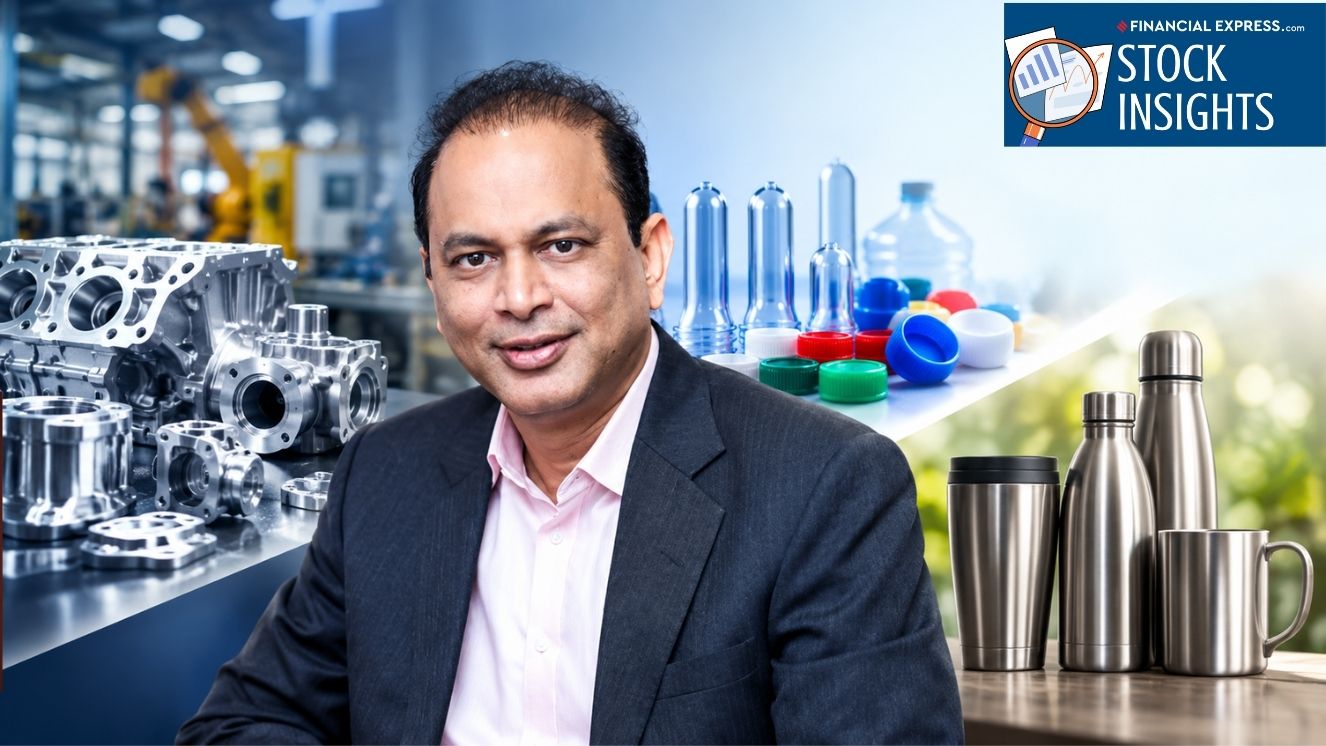
Sunil Singhania’s 3 new SME bets: One is already up 189% from his entry
Sunil Singhania's Abakkus has quietly stepped into three small companies listed on the BSE SME platform. A maker of aluminium engine parts, a Latur bottle-cap producer and a Delhi steel-bottle brand. One stake is up about 189%. Another is barely ahead of the IPO price and below its listing price. Here is how he got in, and what the small print says.
Sunil Singhania's Fresh SME Stocks: Three Bets, Three Very Different Results Singhania is no stranger to big money. He spent about 15 years at Reliance Mutual Fund, now Nippon India Mutual Fund, where he rose to chief investment officer for equities, before leaving in 2018 to set up Abakkus Asset Manager. Abakkus now runs alternative funds, portfolio management services and a mutual fund. In September 2026 it filed draft papers with SEBI for its own IPO, which makes it one of the few money managers in India preparing to list on the market it invests in.
Singhania has been on a what we can call a buying spree. Its recent moves into 5 stocks has caught investor attention. A few days earlier, he bought BEML betting on India’s bullet train aspirations. No wonder search interest in Sunil Singhania's portfolio tends to spike each time a filing shows him in a new name. SME stocks pull even harder, because the companies are small and the moves can be violent.
Put the two together and you get a crowd of retail buyers asking one question. Should I follow him in? FE Stock Insights on WhatsApPGet instant alerts on high-conviction investment themes and fundamental deep dives—direct from Financial Express.Join now The honest answer starts with how he got in. All three stakes sit with the Abakkus Venture Opportunities Fund, an alternative investment fund. In two of the companies, Abakkus did not buy on the exchange at all.
It took shares in the IPO anchor book before listing at prices no retail buyer can get today. In the third, it bought through a bulk deal months after listing. That difference in entry price is the whole story. It explains why one position has nearly tripled while another is roughly where it started. Let us take them one by one, starting with the biggest winner. #1 Poojaa Precision Engineering: The Aerospace Vendor Driving a 189% SME Stock Gain Incorporated in 1992, Poojaa Precision Engg makes aluminium die-cast and machined parts.
These go into car and truck engines, electric vehicles and industrial machines, and it has more than 600 products. It recently won vendor approval for aerospace parts and sells to customers in Germany, the US, Italy and Switzerland. Abakkus came in through the anchor book on 27th July 2026 at the issue price of Rs 301. The shareholding filed with BSE at listing showed Abakkus Venture Opportunities Fund with 2.35%.
It also showed a second big name. Mukul Agrawal held 5.12%, the largest non-promoter stake. The IPO was subscribed 259 times and listed on 4th August at Rs 470. It closed at Rs 869 on 19th October 2026, about 2.9 times the anchor price. At that price, a 2.35% stake would be worth about Rs 41 cr against a cost of roughly Rs 14 cr. Promoters hold 60.63% of a business now valued at Rs 1,733 cr. Poojaa Precision Financials: Analyzing the 27% Sales CAGR Financial YearFY21FY22FY23FY24FY25FY265Y CAGRSales (Rs cr)8713016317322229327%EBITDA (Rs cr)9162428405242%Net Profit (Rs cr)391416243160% Source: Screener.in EBITDA here refers to operating profit before other income.
FY21 was a Covid-hit year with a small profit base, which flatters the 5-year profit CAGR. Operating margin has climbed every single year, from 10% in FY21 to 18% in FY26. Return on capital is 33% and return on equity 28%. Poojaa Precision Share Price Valuation: Is 56x Earnings Too High? The rally has run ahead of the numbers. At Rs 869, the Poojaa Precision share price values the company at about 56 times its FY26 profit of Rs 31 cr.
After spending on a new plant, it burned Rs 30 cr of free cash in FY26. Of the Rs 160 cr IPO, Rs 106 cr is going into a new manufacturing facility. Inventory days rose from 76 to 148 in two years. Half of the anchor shares were freed on 29th August and the rest come free on 28th October 2026. So Abakkus may already hold less than its listing-day 2.35%. The board meets on 22nd October to approve its first half-yearly results as a listed company, according to a BSE filing dated 16th October. #2 Bai-Kakaji Polymers: Sunil Singhania’s Bet on India’s Bottled Water Boom Incorporated in 2013 and based in Latur, Maharashtra, Bai-Kakaji Polymers makes PET preforms and plastic caps.
A preform is the small test-tube shaped piece that is blown into a bottle. Its buyers are packaged water, soft drink, juice and dairy companies, which makes this a play on India's thirst for bottled drinks. Promoters, the Mundada family, held 74.07% as of March 2026. Of the three, this is the one Abakkus bought on the exchange. On 30th July 2026, Abakkus Venture Opportunities Fund picked up 6.08 lakh shares, or 2.84%, at an average of Rs 200.34 each, about Rs 12.18 cr.
The company had listed on 31st December 2025 after an IPO at Rs 186 that was subscribed just 4.5 times. At Rs 288.95 on 19th October, that holding carries a value near Rs 17.6 cr, a gain of 44%. Bai-Kakaji Polymers Financials: Debt Reduction and the Impact of Other Income Financial YearFY22FY23FY24FY25FY264Y CAGRSales (Rs cr)19327329432535316%EBITDA (Rs cr)131421344839%Net Profit (Rs cr)449182660% Source: Screener.in EBITDA here refers to operating profit before other income.
Only five years of data are available, so a 5-year CAGR cannot be computed. Other income of Rs 12 cr made up about a third of FY26 pre-tax profit. Operating margin rose from 7% in FY22 to 14% in FY26. The IPO money paid down debt, with borrowings falling from Rs 109 cr to Rs 32 cr in a year. But other income of Rs 12 cr formed about 34% of FY26 pre-tax profit of Rs 35 cr, so the core business earned less than the headline suggests.
Depreciation also more than doubled to Rs 18 cr after a big capacity spend. Bai-Kakaji Share Price Liquidity: Why Low SME Volumes Carry Hidden Risks At Rs 288.95, the Bai-Kakaji Polymers share price values the company at Rs 618 cr, about 24 times FY26 profit. The trouble is liquidity. In the week to 19th October, daily volume ranged from 5,400 to 22,200 shares, or between 9 and 37 trading lots of 600 shares each. #3 Maharaja & Speedex India: The Steel Drinkware Brand Trading Below IPO Listing Incorporated in February 2006, Delhi-based Maharaja & Speedex India makes and sells stainless steel bottles and drinkware, mainly under the Speedex brand.
Think of the steel water bottle in a school bag or on an office desk. The anchor allocation letter filed with BSE shows Abakkus Venture Opportunities Fund as the joint-largest of 10 anchors on 9th September 2026. It took 2.70 lakh shares at Rs 186, about Rs 5.02 cr, or roughly 1.65% of the company. The IPO was subscribed 30 times and listed on 18th September at Rs 250. At Rs 245.40 on 19th October, the stake is up 32% on cost but the stock sits below its listing price.
Maharaja & Speedex Financials: 41% Sales Growth vs. Weak Cash Conversion Financial YearFY24FY25FY262Y CAGRSales (Rs cr)619312241%EBITDA (Rs cr)31123NMNet Profit (Rs cr)1615NM Source: Screener.in EBITDA here refers to operating profit before other income. Only three years of data are available. Growth rates on a base of Rs 1-3 cr are not meaningful (NM). Sales doubled in two years, and profit went from Rs 1 cr to Rs 15 cr.
Return on equity is 73%, a figure flattered by a tiny equity base before the IPO. The cash story is weaker. Operating cash flow was just Rs 4 cr in FY26 against a profit of Rs 15 cr, and inventory days more than doubled from 85 to 192. There is also a flag that the company may be adding some interest costs to its assets rather than charging them to profit, which can make earnings look better. On 25th September 2026, the company told BSE it had put Rs 19.8 cr into its subsidiary Dewdrop Bottles through a rights issue, to fund plant and machinery.
At Rs 245.40 the stock trades at about 26 times FY26 profit. The first half of the anchor shares came out of lock-in on 17th October. The rest follow on 16th December 2026. BSE SME Platform Rules: 5 Hidden Risks of Buying SME Stocks All three companies trade on the BSE SME platform, not the main board. That changes the rules in five ways. You buy and sell in fixed lots of 400 or 600 shares, so the smallest ticket here runs from about Rs 1.5 lakh to Rs 3.5 lakh.
Fewer reports. SME companies report results every six months, not every quarter. Bad news can sit unseen for longer. Lighter governance. Several corporate governance rules under SEBI's listing regulations, covering board make-up and committees, do not apply to SME-listed firms. Thin trade. Volumes are small. Getting out can be harder than getting in, especially in a falling market. Lock-in supply.
Anchor and pre-IPO shares unlock on fixed dates. For these three, the dates to mark are 28th October for Poojaa Precision and 16th December for Maharaja & Speedex. Should Retail Investors Replicate Sunil Singhania's SME Portfolio? None of these companies has a 10-year price history, so the usual test against a 10-year median PE simply cannot be run. Investors are left with growth, margins and cash flow.
On that score, Poojaa Precision has the longest record but the richest price. Bai-Kakaji is cheaper but leans on other income. Maharaja & Speedex has the fastest growth and the weakest cash conversion. The bigger lesson is about price. Abakkus paid Rs 301 for Poojaa Precision. A retail buyer today pays Rs 869. Abakkus paid Rs 186 for Maharaja & Speedex through the anchor book. Anyone who chased it on debut day paid Rs 250 and is now slightly under water.
Following a super investor into an SME stock is one thing. Following him in at his price is quite another. The coming months will test all three. Poojaa reports first-half numbers this week. Bai-Kakaji and Maharaja & Speedex follow with their half-yearly results, and both anchor unlocks fall before the year ends. Keep all three on a stock watchlist and tick off each checkpoint before acting. Disclaimer Note: We have relied on data from www.Screener.in and www.trendlyne.com throughout this article.
Only in cases where the data was not available, have we used an alternate, but widely used and accepted source of information, including filings made available on the BSE website. The purpose of this article is only to share interesting charts, data points and thought-provoking opinions. It is NOT a recommendation. If you wish to consider an investment, you are strongly advised to consult your advisor.
This article is strictly for educative purposes only. Suhel Khan has been a passionate follower of the markets for over a decade. During this period, He was an integral part of a leading Equity Research organisation based in Mumbai as the Head of Sales & Marketing. Presently, he is spending most of his time dissecting the investments and strategies of the Super Investors of India. Disclosure: The writer and his dependents do not hold the stocks discussed in this article.
The website managers, its employee(s), and contributors/writers/authors of articles have or may have an outstanding buy or sell position or holding in the securities, options on securities or other related investments of issuers and/or companies discussed therein. The content of the articles and the interpretation of data are solely the personal views of the contributors/ writers