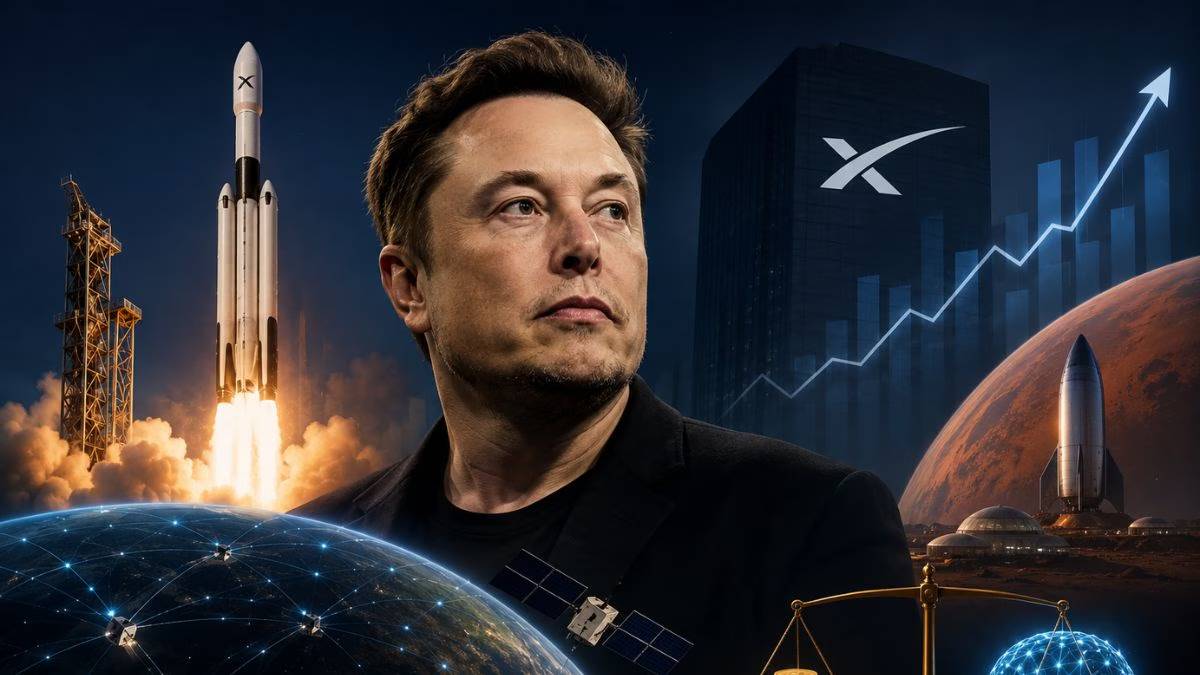
SpaceX’s AI boom pays off: $4.4 bn profit, 161% revenue growth & a Tesla merger in sight
SpaceX achieved its first profit as a public company in Q3 2026, driven by a surge in AI revenue, strong Starlink growth, and successful space launches, surpassing Wall Street expectations. Musk also confirmed discussions on a potential Tesla merger.
SpaceX reported its first profit as a publicly listed company in the July-September quarter, as a sharp rise in artificial intelligence (AI) revenue helped the Elon Musk-led company beat Wall Street estimates. The company also saw strong growth in its Starlink internet business and space launch operations. SpaceX's revenue jumped 161% year-on-year to $14.58 billion in the third quarter, up from a year earlier, according to its official earnings release and subsequent investors' earnings call on October 20, 2026.
Net income stood at $4.4 billion, compared with a loss of $1.1 billion in the same period last year. The profit was also well above analysts' expectations. The results came as Musk said SpaceX and Tesla had formed special committees to discuss a possible merger. He called the idea a good one, adding that any final decision would rest with the committees and would require shareholder approval. 5 billion impact of Indian-American businesses revealed ahead of Rubio talks in Mumbai SpaceX shares rose 4.9% in extended trading after Musk's comments.
The stock had also gained 7.3% in after-hours trading to $158.68, according to Investing.com. SpaceX revenue beats estimates as AI business takes the lead SpaceX's revenue for the quarter ended September 30 reached $14.58 billion, well above the Wall Street estimate of $12.87 billion. The company's adjusted earnings per share also beat expectations, although estimates differed across reports. The company's AI business was the biggest driver of growth.
Revenue from its superintelligence (SI) division rose to $7.56 billion, almost 10 times the level recorded a year earlier. The figure was also higher than the $6.3 billion analysts had expected. Much of this revenue came from renting out computing capacity to AI companies and developers, including Anthropic, Google's parent company Alphabet and Reflection AI. SpaceX has signed agreements to provide computing power through its Colossus II data centre, helping it turn its acquisition of xAI earlier this year into a major source of revenue.
"We are in an inflection moment for SpaceX across launch, connectivity and superintelligence," Musk said during the earnings call. He also said SpaceX's annual recurring revenue could reach between $500 billion and $1 trillion by the end of 2027. Annual recurring revenue is an estimate of how much a company could earn over a year from its ongoing business at a given point. In a social media post after the results, Musk said, "As crazy as this sounds, $1T in SpaceX revenue in 2028 is no longer impossible."
SpaceX Chief Financial Officer Bret Johnsen reiterated that the company expects annual recurring revenue of around $100 billion by the end of 2026. Musk says Tesla-SpaceX merger would be a ‘good idea’ Musk said SpaceX and Tesla had set up special committees to examine the possibility of bringing the two companies together. This was the first official confirmation that they were formally discussing a merger.
"I think it would be a good idea, but it's really up to the special committees of both companies," Musk told investors during the earnings call. He added that he would not take part in the committees' discussions because of his position at both companies. "Because I'm a conflicted party, I can't actually be in the discussion of the special committees," he said. Shareholders would ultimately have to approve any deal, Musk added.
The possibility of a merger has attracted fresh attention in recent weeks, with investors pointing to the growing overlap between the two companies' businesses. Barclays suggested last week that a deal could be announced before Tesla's annual meeting in December. A merger would bring together Tesla's electric vehicle and energy businesses with SpaceX's rockets, satellite internet services and growing AI computing operations.
SpaceX raises AI spending as computing capacity expands SpaceX spent $19.6 billion on capital expenditure in the third quarter, in line with expectations and nearly three times the amount spent a year earlier. Of this, $16.4 billion went towards expanding computing infrastructure for its superintelligence business. The investment took the company's installed computing capacity to 1.7 gigawatts as of September 30, 2026.
The company expects capital expenditure to rise further, with spending of $35 billion to $40 billion forecast for the fourth quarter. 6 million SpaceX's satellite internet business continued to grow, with Starlink reaching 13.6 million subscribers in the third quarter. This was above the 12.19 million subscribers analysts had expected. The service has expanded through additional satellite launches and a wider range of offerings for households, businesses, airlines, ships and government agencies.
However, its average monthly revenue per subscriber has fallen as the company expands into more markets and offers cheaper plans. The figure dropped from $99 in 2023 to $69 in the third quarter. SpaceX has said that expanding beyond wealthier countries could push average revenue per user lower over time, even as its subscriber base grows. The connectivity segment generated $5.2 billion in revenue, above the estimated $4.9 billion.
The growth was supported by rising consumer demand for Starlink and more contracts with businesses and government agencies. Starship milestone boosts satellite capacity plans SpaceX also reported progress in its space business, which includes commercial rocket launches, government missions and the development of Starship. The company said its Starship programme completed its first revenue-generating payload mission, successfully deploying 26 Starlink V3 satellites.
The new satellites are expected to deliver roughly 10 times the downlink capacity per launch compared with Falcon 9. Starship, SpaceX's next-generation reusable rocket system, has yet to enter commercial service. The company expects it to help deploy more powerful Starlink satellites and eventually support AI computing infrastructure in orbit.