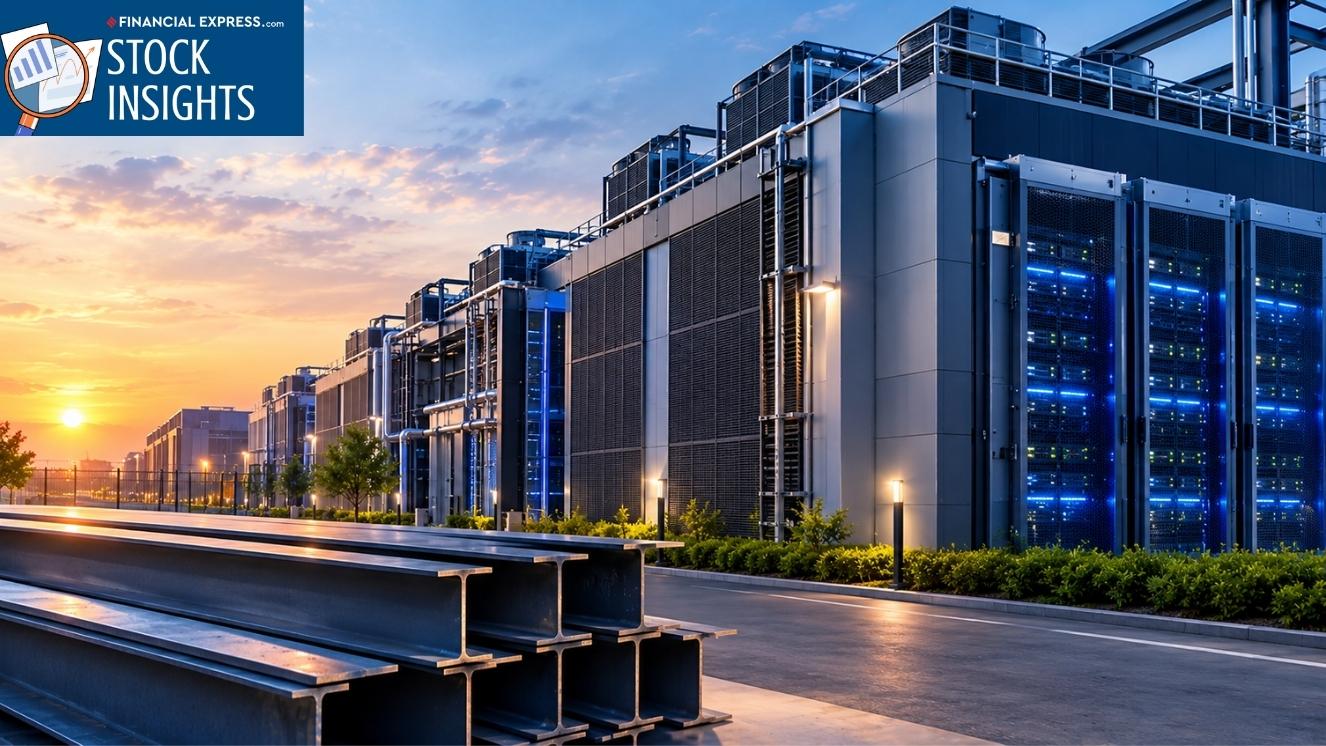
India's data centre boom is creating an unusual opportunity for businesses that have little to do with computers. Every new facility needs a building and the more complex the facility becomes, the more demanding its structural requirements can be. Steel manufacturers capable of supplying specialised structures could benefit from a construction market that is attracting billions of dollars in investment.
There is, however, a catch. Being present in a fast-growing market does not automatically make a company a good investment. The real test is whether it can win orders at attractive prices, deliver them without cost overruns and collect its money without tying up too much capital. M & B Engineering 1-Year Share Price Chart Source: Screener.in This is what makes M&B Engineering interesting. The company has capabilities in pre-engineered buildings, heavy structural steel and self-supported roofing systems and it is investing in additional capacity to address more complex construction projects.
Its opportunity is to move beyond conventional industrial buildings into specialised structures, including data centres, while maintaining the profitability of its existing business. FE Stock Insights on WhatsApPGet instant alerts on high-conviction investment themes and fundamental deep dives—direct from Financial Express.Join now Beyond Conventional Warehouses: The Structural Demands of Data Centre A data centre is not an ordinary warehouse.
It must support heavy equipment, meet demanding structural specifications and accommodate complex layouts. Developers also want these facilities completed quickly, because delays can push back the start of commercial operations. Pre-engineered buildings (PEBs) offer one way to speed up construction. Much of the structure is designed and manufactured before it reaches the site, reducing the work required there.
Heavy structural steel serves buildings that need greater load-bearing strength and more complex designs. M&B operates through two divisions. Phenix handles PEBs and heavy structural steel, while Proflex specialises in self-supported steel roofing systems. In Q1FY27, Phenix generated Rs 214 crore in revenue, up 22% year on year, while Proflex contributed Rs 77 crore, up 25%. Phenix accounted for roughly 74% of quarterly revenue, making it the company's larger business.
The margin problem behind the growth story Financial indicatorFY26Q1FY27What it tells investorsRevenue growth (YoY)27.4%22.5%Growth remains strongOperating margin11.3%11.4% EBITDA marginQuarterly margin remains below the year-ago levelYear-ago operating EBITDA marginNot comparable on this basis14.2%A 2.8 percentage-point decline year on year Source: M&B Engineering FY26 results and Q1FY27 investor presentation.
The proposed investment in heavy structural steel is therefore an expansion of an existing capability, not a bet on an entirely unfamiliar market. The question is whether data centres and other specialised projects can provide an additional source of growth without squeezing margins further. Management estimates that steel-intensive construction could represent a US$12-14 billion opportunity in India's data centre market over the next five years.
These estimates point to the scale of the potential market, not the revenue available to M&B. Steel construction accounts for only around 8-10% of a data centre's total investment, with civil works and mechanical, electrical and plumbing requirements accounting for the rest, according to management. M&B will capture only a fraction of the steel opportunity, depending on the projects it wins and the value of the structures it supplies.
The opportunity is real, but the size of the market alone tells investors very little. What matters is whether M&B can win enough orders at attractive margins to turn this potential demand into profitable growth. The Sanand Expansion: A Rs 30 Crore CAPEX Bet on 22,000-Tonne Capacity M&B is investing to capture this opportunity. In August 2026, its board approved Rs 30 crore for a fully automated heavy structural steel processing line at Sanand.
The investment will increase annual capacity from 12,000 tonnes to 22,000 tonnes, with operations expected to begin in Q1FY28. The line is aimed at data centres, high-rise buildings and other complex structures. The company is also adding 20,000 tonnes of annual PEB capacity at Sanand, taking it from 72,000 tonnes to 92,000 tonnes after commissioning in October 2026. A further 20,000-tonne expansion at Cheyyar is targeted for completion in Q3FY28, taking total PEB and structural steel capacity to approximately 1,54,000 tonnes annually.
For a company of M&B's size, these are significant additions. But capacity creates value only when customers use it. If orders arrive slowly or pricing weakens, the new facilities could add costs without delivering the expected returns. Ultimately, utilization, product mix and margins will determine whether this expansion pays off. 5% Revenue Growth Masked by a 2.8% EBITDA Drop The company's financial performance offers a useful starting point for assessing its expansion plans.
Consolidated revenue rose 27.4% in FY26, but the operating profit margin fell from 12.8% in FY25 to 11.3% in FY26. The latest quarter showed a similar trend. Revenue grew 22.5% year on year in Q1FY27, while the operating EBITDA margin declined to 11.4% from 14.2% a year earlier. Management attributed the pressure partly to higher freight costs on shipments to the US and increased inland transportation costs there.
Geopolitical uncertainty surrounding West Asia added to the strain. The company expects lower US Section 232 duties, higher export revenue and additional capacity to support a gradual margin recovery, particularly in the second half of FY27. Analysing the Rs 1,053 Crore Order Book: Visibility vs. Execution Timelines M&B ended June 2026 with an order book of Rs 1,053 crore, up approximately 25% from a year earlier.
Phenix accounted for Rs 837 crore and Proflex for Rs 216 crore, giving the company a reasonable base for future revenue. But an order book is not the same as revenue and revenue is not the same as cash. Management said some large inquiries took longer to convert because customers and consultants were still finalising project specifications. Source: Company Presentation The inquiry pipeline stood at approximately Rs 4,000 crore for Phenix and Rs 200 crore for Proflex.
Order inflows in Q1FY27, however, were Rs 262 crore, against Rs 278 crore a year earlier. Management expects larger inquiries to convert in subsequent quarters, but the timing remains uncertain. The company is targeting revenue growth of more than 25% in FY27 and compound annual growth of over 20% in the next three to four years. This should come alongside improving profitability. However, these are ambitious targets.
Investors will need to watch whether new orders arrive fast enough and whether the company can fulfil them without sacrificing margins. Exports offer growth, but bring their own costs M&B operates in 23 countries, while repeat customers contributed approximately 54% of consolidated operating revenue in FY26. Its export ambitions received a boost when the Cheyyar facility secured certification from the American Institute of Steel Construction (AISC), making both its PEB manufacturing facilities AISC-certified.
Management expects shipments from Cheyyar to the west coast of the United States to begin in FY28, using the Pacific route. It is targeting utilization of approximately 60% at Cheyyar in FY27. Exports can broaden the customer base, but they also expose the company to freight costs and tariffs. The latest quarter showed how quickly these costs can eat into the benefits of higher revenue. Proflex is expanding too.
But the challenge is to turn this additional capacity into profitable business, rather than simply a larger revenue number. The balance sheet is stronger. Cash flow is not. M&B's balance sheet improved in FY26 as borrowings fell from Rs 191 crore to Rs 84 crore. Lower debt gives the company more room to invest without putting the same pressure on interest costs. Source: Company Presentation The cash flow statement, however, tells a different story.
Cash flow from operating activities turned negative against a positive Rs 33 crore in FY25. Free cash flow was negative Rs 62 crore. For a manufacturer, growth consumes cash before it generates cash. Steel must be purchased, structures manufactured and delivered and customers must pay. The longer this cycle takes, the more money the business needs to keep growing. New capacity must earn a return M&B spent approximately Rs 27 crore on capital expenditure in Q1FY27, covering the Phenix expansion, two Proflex mobile manufacturing units and a 2.5-megawatt solar plant for captive consumption.
For FY27, management has indicated capex of around Rs 100 crore, with a further Rs 30 crore earmarked for the new heavy structural steel line at Sanand. Meanwhile, the company reported a return on capital employed (ROCE) of 22.9% and a return on equity (ROE) of 19.4% in FY26. These provide a benchmark for judging whether the expansion creates value. New capacity is useful only when it attracts enough orders and generates adequate operating profits.
If utilization rises and margins recover, returns could improve. If demand arrives slowly or working capital consumes more cash, the benefits may take longer to emerge. 8x P/E a Bargain or a Margin-Risk Discount? Presently, M&B trades at approximately 14.8 times earnings, below its five-year average multiple of 19.9 times. The stock had fallen from a 52-week high of Rs 536, although its low during the period was Rs 223.
The correction makes the valuation less demanding, but a falling share price does not automatically make a business cheap. The market may be accounting for margin pressure, weak cash generation and the capital required to fund expansion. If revenue grows as management expects, margins improve and operating cash flow turns positive, the current valuation could look attractive in hindsight. If growth comes at the cost of weaker margins and higher working-capital needs, the discount to the historical multiple could persist.
The risks have not disappeared M&B remains exposed to project delays, changes in steel-related input costs, freight volatility and slower order conversion. New facilities also need to attract enough business to justify the investment, while small-cap stocks can face sharp price swings and limited liquidity. Investors should therefore look beyond revenue growth. Order inflows, operating margins, working capital and cash flow will show whether the company is building a stronger business or merely a bigger one.
The real test is profitable growth M&B has several potential growth drivers, including data centre construction, exports, a sizeable order book and additional manufacturing capacity. But the opportunity is only half the story. FY26 brought higher revenue alongside lower operating margins and negative operating cash flow. Management is targeting strong growth and expects profitability to improve, but has not yet provided a specific full-year margin target for FY27.
The coming quarters will show whether the company can convert demand into orders, capacity into profits and profits into cash. Until then, the lower valuation is a reason to investigate M&B, not a reason to assume the investment case is proven. Disclaimer Note: We have relied on data from www.Screener.in throughout this article. Only in cases where the data was not available, have we used an alternate, but widely used and accepted source of information.
The purpose of this article is only to share interesting charts, data points and thought-provoking opinions. It is NOT a recommendation. If you wish to consider an investment, you are strongly advised to consult your advisor. This article is strictly for educative purposes only. Manvi Aggarwal has been tracking the stock markets for nearly two decades. She spent about eight years as a financial analyst at a value-style fund, managing money for international investors.
That’s where she honed her expertise in deep-dive research, looking beyond the obvious to spot value where others didn’t. Now, she brings that same sharp eye to uncovering overlooked and misunderstood investment opportunities in Indian equities. As a columnist for LiveMint and Equitymaster, she breaks down complex financial trends into actionable insights for investors. Disclosure: The writer and her dependents do not hold the stocks discussed in this article.
The website managers, its employee(s) and contributors/writers/authors of articles have or may have an outstanding buy or sell position or holding in the securities, options on securities or other related investments of issuers and/or companies discussed therein. The content of the articles and the interpretation of data are solely the personal views of the contributors/ writers Investors must make their own investment decisions based on their specific objectives, resources and only after consulting such independent advisors as may be necessary.