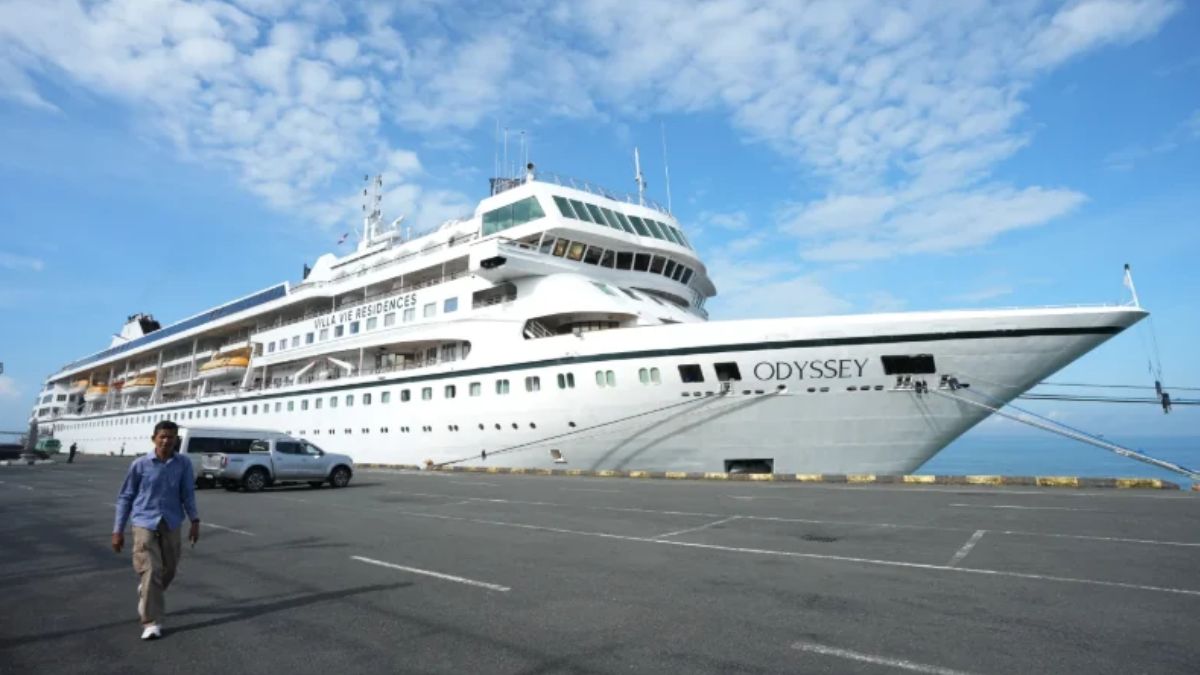
Rising fuel costs cut short ‘endless’ US cruise tour, hundreds stranded in Cambodia
Soaring fuel prices due to the US-Israel war on Iran have severely impacted global transportation, causing oil, gas, and diesel prices to spike and disrupting voyages like the MV Odyssey cruise ship.
Soaring fuel prices triggered by the ongoing US-Israel war on Iran have detrimentally impacted global transportation. A continued spate of attacks in and around the crucial maritime region of the Strait of Hormuz has severely prompted oil and gas price spikes. The crucial route was generally responsible for the passage of 20% of the world's oil and liquified natural gas (LNG) before the West Asia war broke out.
However, with the war's onset on February 28, the waterway has mostly been closed while the United States and Iran consistently remain entangled in a power tussle over its authority. Eight months into the conflict, the international benchmark for oil, Brent, has surged from pre-war levels of $72.87 a barrel to $112.39 a barrel (on October 22). Meanwhile, gasoline and diesel have jumped from $2.98 a gallon to $4.27 a gallon, and $3.75 per gallon to $6.31 per gallon, respectively, according to the Fact Sheet published by the Centre for American Progress a week ago.
These dramatic spikes in Brent, gas and diesel account for more than 54%, 43% and 68% increases, respectively. At one point this month, oil prices even climbed above $117 a barrel. The MV Odyssey, a US vessel that set sail on an around-the-world voyage three years ago, suspended its three-year journey in Cambodia, citing fuel costs. The major decision has left hundreds of passengers stranded, as they were forced to disembark the huge ship.
US vessel leaves hundreds stranded amid high fuel cost crisis Cambodian officials have since revealed that the Odyssey was carrying 203 passengers, mostly Americans, the Associated Press reported. With a 650-passenger capacity, it had 156 crew members on board before the ship was docked at the Cambodian port of Sihanoukville on the Gulf of Thailand. The vessel's marketing, as pushed by its Florida-based operator Villa Vie Residences, touted how the Odyssey could become passengers' "permanent home" with the purchase price of a suite for the ship's lifetime starting around $230,000, the Associated Press reported.
“Extraordinary increases in fuel costs have placed our current operating model under unsustainable financial pressure,” stated a statement published on the company’s website on Tuesday (US time). The operator further revealed that the monthly fuel cost per cabin surged to an estimated $6,000 to $8,000 from $1,800 in parts of Asia. In its public release on Tuesday, the company clarified that despite its measures to cut down fuel consumption, those steps failed amid severe price spikes.
"Passing the full increase on to residents is not a realistic solution,” it stated further. Given the current "stranded" situation the passengers are in now, the company asserted that it is working with residents to "coordinate disembarkation and temporary living arrangements, and are supporting residents, crew, and employees as we evaluate restructuring and recapitalisation alternatives over the next 60 days.”
What's next for the MV Odyssey? Although the 642-foot cruise ship's promises of "an unparalleled lifestyle of luxury and exploration" remain unfulfilled, the Deputy Governor of Preah Sihanouk Province offered a much-needed update in dire times. He told reporters that the ship is scheduled to refuel before departing from Cambodia on Saturday, NBC News reported. 1 billion Iran war bill: where the money went and what’s missing Villa Vie Residences, however, has not offered any further promises about the voyage's future, as it added in its Tuesday release, ".work is ongoing, and no outcome is assured."
The MV Odyssey started its multi-continent voyage from Belfast, Northern Ireland, three years ago. It now continues to evaluate potential paths forward. As of now, no financing or transaction has been finalised. "The company will provide further updates as material developments occur," the Odyssey's Florida operator concluded in its Tuesday statement. Trump's comment stoke public's wrath amid rising Iran war costs The US vessel disclosed its ongoing crisis on the heels of US President Donald Trump's response to rising oil and gas prices.
Speaking at a rally in Georgia last weekend, he said that he didn't "give a damn" about the criticism directed his way for the same reason. Trump and the Republican Party have been facing intense pressure due to inflation and rising costs of living ahead of the upcoming November 3 midterm elections in the US. Several polls have continued to show the MAGA leader's approval rating hitting new lows repeatedly, while American adults continue to blast his handling of the US economy.
At the recent rally stop, Trump insisted that fuel prices would only remain "temporarily high" and were, in the meantime, helping the country "make a fortune. While his claims are consistent with oil company-related earnings, they don't align with the general public's negative fervour. According to Oil & Gas Journal's Q2 report, “surging crude prices tied to ongoing Strait of Hormuz disruptions" have resulted in unprecedented good fortune for North American oil firms.
The trade publication reported that year over year, a sample of 38 American producers and refiners grew their collective revenues by about $140 billion. This compares to an average of about $60 more for people worldwide. CREA further said American consumers are paying more due to reliance on less-efficient private vehicles, longer-distance travel and a relatively slow transition to electric vehicles.
While at a different rally in Texas this week, Trump reiterated that the Iran war will end "whenever I want it to," insisting yet again that Tehran can't have a nuclear weapon. His statement comes as new estimates provided by the Pentagon to the US Congress indicate that the cost of the ongoing war to US taxpayers has ballooned to $47.1 billion. This revelation, in turn, comes a little over a month after US officials reported that figure stood at about $43.6 billion, marking a $3.5 billion surge in US spending since early September.
In other news, October has emerged as the worst month for attacks on commercial shipping in the Hormuz Strait and nearby waterways, according to data compiled by the think tank Washington Institute for Near East Policy. At least 28 strikes were confirmed and reported in and around the region, and 113 since the war with Iran started in late February.