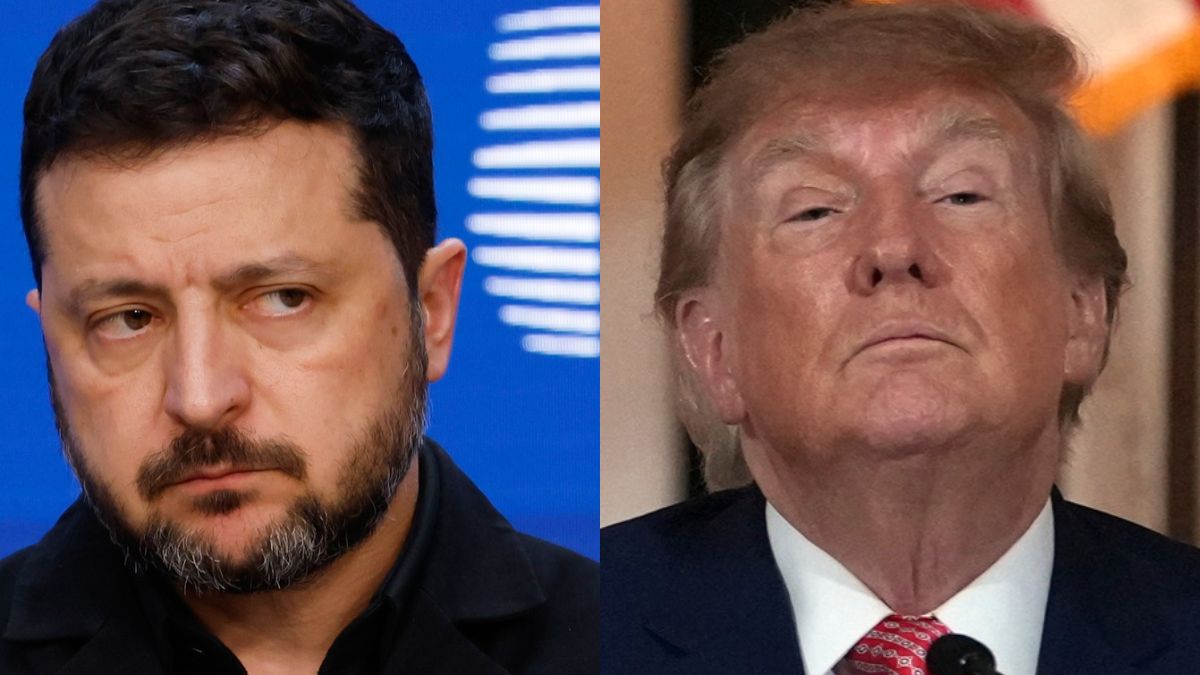
Relief in Delhi, Anger in Kyiv: Zelenskyy hits out at Trump’s Russian oil sanctions waiver
US President Donald Trump's waiver of sanctions on Russian fossil fuel sales eased India's energy concerns but drew criticism from Ukraine’s Zelenskyy and US officials, highlighting geopolitical tensions.
US President Donald Trump's recent waiver of sanctions related to Russian fossil fuel sales has offered temporary relief to India's energy security and exporters. However, it has again invited criticism from within the United States and Ukrainian President Volodymyr Zelenskyy, who warned that the decision will empower Moscow to keep attacking Kyiv. Taking to his official X account, Zelenskyy said that the move to "undo all of this, to block all of it, seems wrong" to him, and would "definitely" help "only the Russians."
As Ukraine launches strikes on Russia in retaliation, Zelenskyy has continued to accuse Moscow of ramping up its attacks on his country. Noting that Russia hit more than 15 Ukrainian power generation and transmission sites on Friday, the Ukrainian president wrote online, "It only fuels their satisfaction and their desire to keep killing people." He further stressed it "certainly does not stop the war."
Although the Graham Act was meant to exert increased pressure on Russia, pushing President Vladimir Putin to call off the war in Ukraine, Donald Trump's recent moves have appeared to stray from that path. Having agreed to a separate diesel deal with Moscow, the POTUS recently took aim at Zelenskyy, calling for his replacement. "I think the diesel deal and the move regarding the Lindsey Graham Act are not the end of it.
Unfortunately," wrote Zelenskyy. "It’s unfortunate because we all had great respect for Lindsey … It’s difficult without him, I’ll be honest." On the other hand, Russia's investment envoy, Kirill Dmitriev, hailed the Trump waiver as a "truly historic moment" on X, adding that had the sanctions gone into effect, they would have notably impacted economic cooperation between Russia and the US. Russia-related sanctions also targeted India Trump's Friday night executive order waived sanctions and tariffs due next week under the legislation known as the Lindsey O.
Graham Sanctioning Russia and Iran Act of 2026, or simply the Graham Act, which was signed into law last month. The law would have imposed tariffs of up to 100% on goods from certain importers of Russian oil or gas. India would have been among other countries, including China, owing to its growing imports of Russian oil since the country's invasion of Ukraine in 2022. Defending Trump's decision, US Secretary of State Marco Rubio told reporters on Saturday that the US leader now has time to "study" the impact of the sanctions on the global economy.
Ahead of his upcoming second official India trip this week, Rubio acknowledged that it was "hard" for New Delhi to move away from Russian energy. "The problem is that these sanctions were not just sanctions on Russia. They include tariffs on a number of countries, India, for example, and others. And so I think the president wants to take the 60-day period of time to sort of analyse what imposing both sanctions and tariffs will mean to the global economy and even to the US economy," the Trump admin official told reporters.
Global Trade Research Initiative (GTRI) founder Ajay Srivastava, on the other hand, noted that while the waiver "buys time" for India, it doesn't offer any "lasting certainty," as quoted by PTI. "India should protect its energy security, buy oil on commercial terms and prepare for renewed US pressure," he went on. "Temporary tariff relief is no basis for permanent trade concessions." India and the US have yet to reach an agreement on a much-stalled bilateral trade pact, with negotiations stretching nearly a year.
Just days ago, India's Commerce and Industry Minister Piyush Goyal said at an event in Delhi that the first tranche of the agreement has been finalised and is "going through final contours, the legal drafting." He emphasised that India seeks to operationalise it once it gets a competitive advantage over peer countries. US divide intensifies after Trump waiver Trump has asserted that the waiver of the Russia-related sanctions and tariffs is in the national interest of the US.
He announced the waiver weeks before the November 3 US midterm elections, in which his Republican Party is struggling to maintain its lead in both US Congress chambers while facing intense backlash for fuel price hikes. Staunch Trump allies are also questioning the POTUS' decision. US Senator Darline Graham, whose late brother the bill is named after, didn't necessarily directly oppose the waiver, but told reporters on Saturday she would have personally chosen to "keep the pressure on Russia" because she didn't trust Putin and his country.
Republican Rep. Don Bacon also said that Donald Trump was "prolonging the war, not ending it." GOP Rep. French Hill echoed the sentiment, posting on X that the US should be "increasing economic pressure on Russia, not easing up." 'Ukrainians sours on US leadership': Survey On the flip side, multinational analytics and advisory company Gallup released a report in late June, revealing results of a survey conducted among Ukrainians in April.
It showed a 59-percentage-point drop in US approval among Ukrainians since 2022, marking the largest ever recorded. In comparison, Ukrainian approval of Washington soared from 37% in 2021 to 66% in the early months of the conflict as the United States increasingly provided Kyiv with significant military and financial support. According to Gallup's report, no other country in the world recorded such a massive jump in US approval between 2021 and 2022.
Cut to the April 2026 survey, just 7% of Ukrainian respondents said they approved of the US leadership, while 79% disapprove. Approval had already fallen by 9 percentage points since 2025, when it hit a then-record low of 16%. Despite Rubio's reference to a 60-day review, the Friday executive order indicated that the waiver will remain in effect until Trump or designated officials determine that "further action is appropriate." The order sets no fixed expiry date.