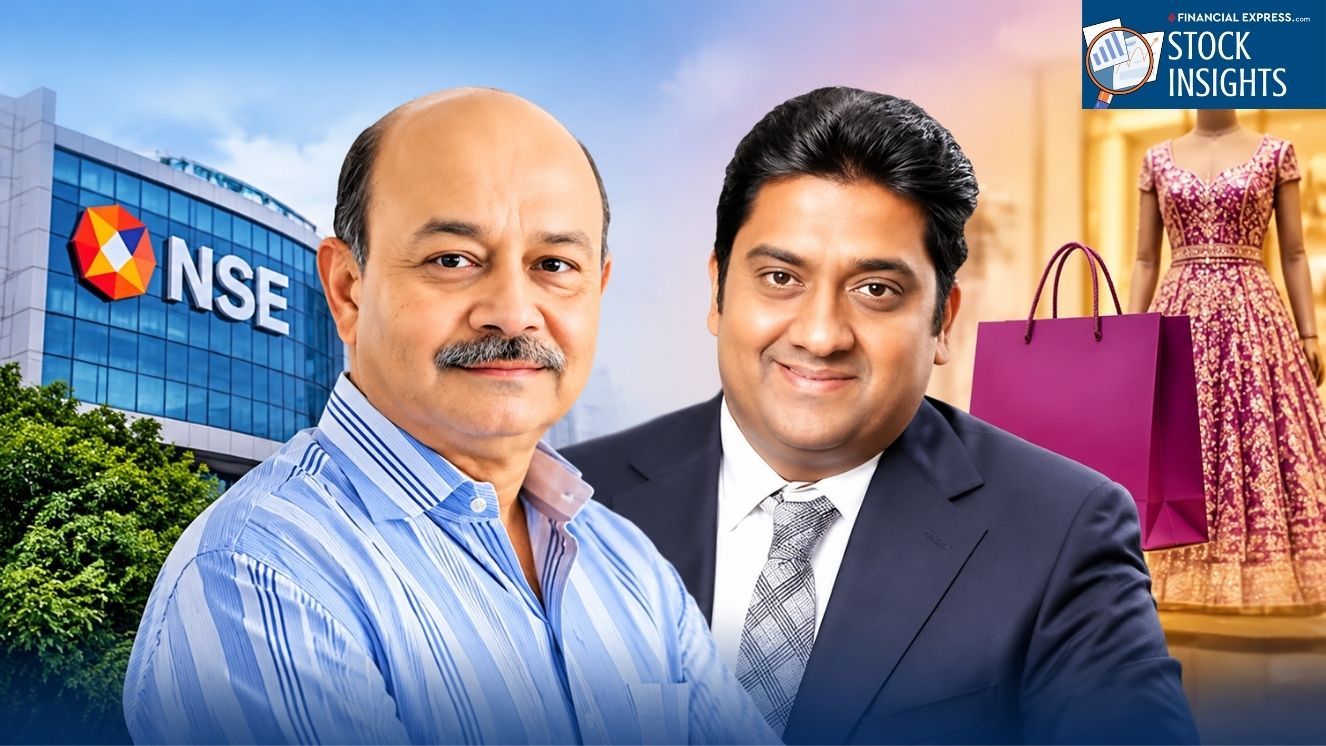
Radhakishan Damani and Mukul Agrawal’s stock picks: A cash cow and a luxury wedding bet
Two new names have turned up in the September 2026 filings of Radhakishan Damani and Mukul Agrawal: the National Stock Exchange and Purple Style Labs, the company behind Pernia's Pop-Up Shop. Neither stake was bought last quarter. Both were owned before the IPO, and both stocks now trade below their issue price.
Radhakishan Damani & Mukul Agrawal Portfolio: Fresh Big Moves Revealed Every quarter, portfolio trackers flag a fresh crop of "new buys" by super investors. This time, two of the most watched names in Indian markets show up with new entries. Mukul Agrawal appears in Purple Style Labs with a 1.25% stake. Radhakishan Damani, the founder of DMart, appears in the National Stock Exchange with 1.58%. Look closer, though, and neither is a buy in the usual sense.
Both companies listed only in September 2026. So, the September filing is simply the first time these holdings had to be shown to the market. Damani picked up his NSE shares in early 2020. Mukul Agrawal was already a shareholder in Purple Style Labs before its IPO opened in August. That difference matters more than it sounds. Investors who bought these shares at the IPO are sitting on losses. Early backers like Damani and Mukul Agrawal are not selling.
One company is among the most profitable businesses in India. The other has not yet made a profit. Here is what each one looks like today. FE Stock Insights on WhatsApPGet instant alerts on high-conviction investment themes and fundamental deep dives—direct from Financial Express.Join now #1 National Stock Exchange: Damani's Rs 6,600 Crore Stake in India's Toll Road for Trading Incorporated in November 1992, the National Stock Exchange of India is the country's largest stock exchange.
Almost every Nifty trade, option contract and mutual fund order a retail investor places passes through its systems. It earns a small fee on each one. Its IPO was one of the most awaited in Indian market history. The issue ran from 17th to 21st September 2026, priced at Rs 1,785 a share, and raised about Rs 22,563 cr. Every rupee went to selling shareholders such as State Bank of India and Canada Pension Plan Investment Board.
NSE itself raised nothing. The issue was subscribed 5.71 times, and the shares listed on BSE on 24th September. NSE cannot list on its own platform. Damani was not among the sellers. He bought his stake from Norwest Venture Partners in early 2020. After a 4:1 bonus issue in 2024, he holds 3.91 crore shares. At the closing price of Rs 1,688 on 22nd October 2026, that stake is worth about Rs 6,600 cr.
Within his public portfolio, only his DMart holding is larger. NSE Share Price Target: Why the Stock is Trading Below IPO Issue Price Few listed companies look like this on paper. Financial YearFY22FY23FY24FY25FY264Y CAGRSales (Rs cr)8,31311,85614,78017,14116,60119%EBITDA (Rs cr)6,6059,4299,87312,67111,26514%Net Profit (Rs cr)5,1987,3568,30612,18810,30219% Source: Screener.in EBITDA is operating profit before other income.
Screener's consolidated history for NSE begins in FY22, so a four-year CAGR is shown in place of five. Sales have doubled in four years. Operating margin was 68% in FY26, and borrowings are a mere Rs 412 cr. Return on equity has averaged about 35% over three years. The exchange paid out 84% of FY26 profit as dividends. But look at the last column of figures again. FY26 was the first down year in the table.
Sales slipped 3% and net profit fell 15%, after SEBI tightened rules on futures and options trading by retail investors. Other income, mostly returns on investments, was Rs 3,417 cr in FY26, about a quarter of profit before tax. The June 2026 quarter showed some steadiness. Net profit rose 7% from a year earlier to Rs 3,120 cr, on sales of Rs 4,560 cr. NSE has also moved to close its long-running co-location and dark fibre cases with SEBI through a settlement of about Rs 1,491 cr, according to its results filing.
As of closing on 22nd October 2026, it was Rs 1,688, which is 5% below the issue price and 10% below that high. The stock has been listed for less than a month, so there is no five-year price record to compare. On valuations, NSE trades at a PE of 46x, the same as the current industry median of 46x. A 10-year median PE for the company is not meaningful after one month of trading. The industry median for the same period is 41x.
Two pressures are worth watching. One is regulation, because SEBI can reshape derivatives volumes with a single circular. The other is rivalry. BSE's F&O turnover crossed NSE's for the first time in April. Supply is a third, shorter-term factor. Half of the anchor investors' shares became free to sell on 21st October 2026, and the rest unlock on 20th December. NSE reports its September quarter numbers on 3rd November 2026. #2 Purple Style Labs: Mukul Agrawal's Bet on India's Rs 10,000 Crore Luxury Wedding Market Incorporated in August 2015, Purple Style Labs runs Pernia's Pop-Up Shop.
It sells Indian designer wear, mostly for weddings and big occasions, through its website, app and large experience centres in Mumbai, Delhi, Hyderabad, London and New York. Its customers spend big. In India, the average store order is about Rs 90,000. The company's founder, Abhishek Agarwal, estimates that luxury makes up about 5% of India's Rs 2 Lakh Crore wedding and occasion-wear market. Shah Rukh Khan's family trust, Madhuri Dixit and Sachin Tendulkar were among its pre-IPO shareholders.
So was Mukul Agrawal. The company's red herring prospectus listed him with 10 lakh shares, or 1.37% of the pre-issue capital. He did not sell, and the fresh shares issued in the IPO diluted him to 1.25%. That stake is worth about Rs 51 cr today. His entry price is not disclosed. For context, the founder sold about Rs 45 cr of his own shares in August 2025 at Rs 500 each. The IPO raised Rs 680 cr at Rs 575 a share, all through fresh shares, and was subscribed just 1.19 times.
The stock listed on 7th September 2026. Purple Style Labs Financial Results: ₹558 Cr Sales vs Rising Net Losses Financial YearFY23FY24FY25FY263Y CAGRSales (Rs cr)36950449055815%EBITDA (Rs cr)0263821NMNet Profit (Rs cr)-41-48-188-285NM Source: Screener.in EBITDA is operating profit before other income. NM: not meaningful. Only four years of data are available, so a three-year CAGR is shown. Sales have grown about 15% a year, but the losses have grown much faster.
In FY26, an operating profit of Rs 21 cr was swamped by Rs 97 cr of interest, Rs 101 cr of depreciation and a negative other income of Rs 109 cr. The result was a net loss of Rs 285 cr. A growth rate for operating profit means little when the starting year was zero, and none can be worked out for a loss that has widened every year. The balance sheet is stretched. Net worth turned negative in FY26, and borrowings rose to Rs 784 cr, a figure that includes lease liabilities for the new stores.
Free cash flow has been negative in each of the last four years. The June 2026 quarter, which management called a seasonally lean period, brought a mix. Sales rose 13% to Rs 119 cr, and the loss narrowed to Rs 88 cr from Rs 100 cr. But operating profit swung to a loss of Rs 14 cr, as the cost of new experience centres kicked in. Purple Style Labs Market Cap & Valuation: Trading 11% Below Issue Price The share price of Purple Style Labs was Rs 568.55 at the end of its first day on NSE.
As of closing on 22nd October 2026, it was Rs 512.85, about 11% below the issue price. A loss-making company has no earnings multiple, and six weeks of trading give no history either. Its peers in specialty retail trade at a median PE of 37x today, and their median over ten years is 50x. Specialty retailers such as Trent sit in this peer group, but they make steady profits. At a market cap of about Rs 4,122 cr, investors are paying for a profit that has not arrived yet.
08%. The 90-day lock-in on the remaining anchor shares ends on 1st December 2026. Super Investor Portfolio Strategy: Why Entry Price Matters for Retail Investors On paper, both are "new stocks" in the portfolios of two famous investors. In practice, they are old positions finally coming into public view. Damani bought into NSE six years before listing. Mukul Agrawal was a pre-IPO shareholder in Purple Style Labs.
Neither had to pay the IPO price, and neither sold in the offer. The businesses could hardly be more different. NSE is a near debt-free fee collector with 68% operating margins and a profit dip that has already shown signs of steadying. Purple Style Labs is a loss-making retailer spending heavily on stores, chasing a small but fast-growing luxury market. For anyone tempted to follow the big names in, the lesson is about cost, not conviction.
Copying a portfolio means paying today's price, not theirs. The next few weeks will add facts. NSE reports on 3rd November, anchor lock-ins run out for both stocks, and Purple Style Labs enters its peak wedding season. It may help to put both on a watchlist and let the next two results do the talking. Disclaimer Note: We have relied on data from www.Screener.in and www.trendlyne.com throughout this article.
Only in cases where the data was not available, have we used an alternate, but widely used and accepted source of information, including filings made available on the BSE website. The purpose of this article is only to share interesting charts, data points and thought-provoking opinions. It is NOT a recommendation. If you wish to consider an investment, you are strongly advised to consult your advisor.
This article is strictly for educative purposes only. Suhel Khan has been a passionate follower of the markets for over a decade. During this period, He was an integral part of a leading Equity Research organisation based in Mumbai as the Head of Sales & Marketing. Presently, he is spending most of his time dissecting the investments and strategies of the Super Investors of India. Disclosure: The writer and his dependents do not hold the stocks discussed in this article.
The website managers, its employee(s), and contributors/writers/authors of articles have or may have an outstanding buy or sell position or holding in the securities, options on securities or other related investments of issuers and/or companies discussed therein. The content of the articles and the interpretation of data are solely the personal views of the contributors/ writers