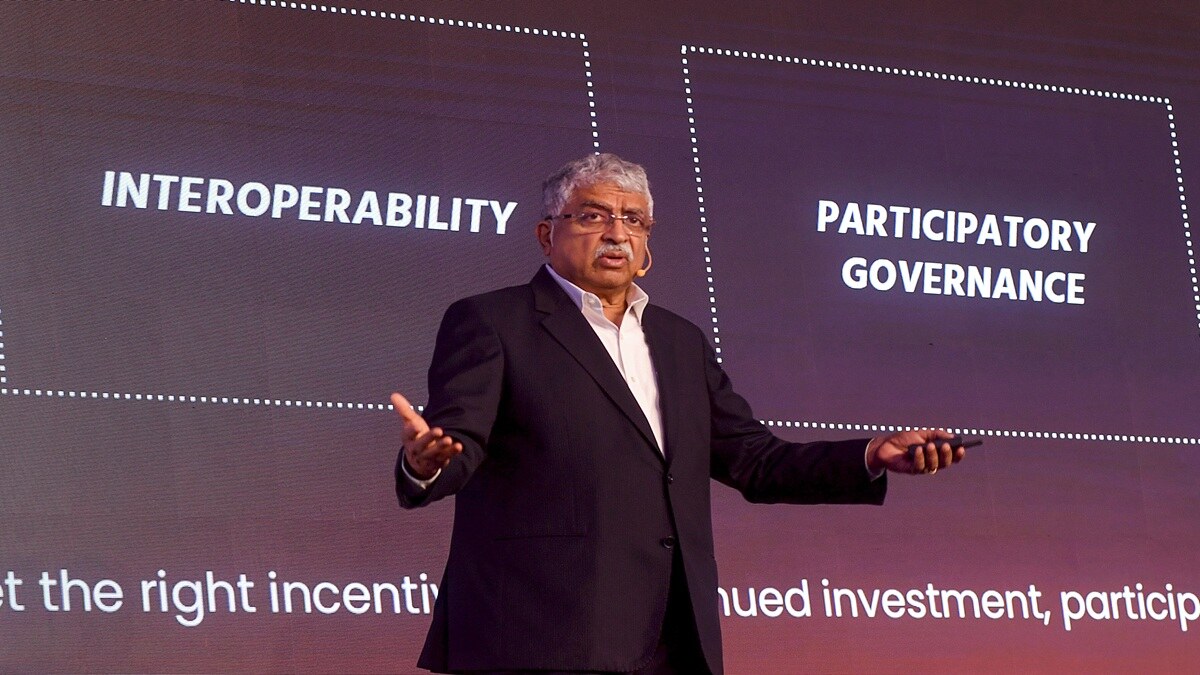
Question vaults to AI: Nandan Nilekani outlines new approach to tackle exam paper leaks
The Nilekani-led task force is considering a secure 'question vault' with over one lakh vetted and translated questions, from which papers would be randomly assembled shortly before each exam.
Curbing examination paper leaks requires changes to how India prepares question papers and conducts tests, Infosys co-founder Nandan Nilekani has said, as the Centre’s High Powered Task Force (HPTF) works towards finalising its recommendations on examination reforms. Nilekani, who heads the task force, questioned the reliance on a single, pre-fixed question paper, arguing that it creates an opportunity for leaks and an incentive to profit from them.
He was speaking at the Bloomberg New Economy Forum 2026 in Delhi. “Why do we need to have something called ‘A’ question paper? Because the moment you have ‘A’ question paper, that creates an economic incentive for that to be sold or whatever,” The Indian Express quoted him as saying. He added, “So the way to do that is to have a massive bank of question papers and only at the last minute generate the question paper for that day.
Then the question paper does not go away and there is no economic incentive for that.” The Nilekani-led task force is examining a “question vault” mechanism supported by secure software, under which more than one lakh questions would be prepared, vetted, translated and stored throughout the year. A question paper would then be assembled by randomly selecting questions from this pool shortly before the test.
The proposal seeks to ensure that even experts who create questions do not know which ones will appear in a particular examination. Officials told The Indian Express that, for example, if an SSC examination requires 20–30 questions, these could be selected at random from a pool of one lakh questions. The task force is also discussing “debundling” examination responsibilities. This means separating tasks such as question-paper preparation, examination-centre management and conduct of tests, so that no single service provider controls the entire process.
Why translation is a concern? Officials have identified translation as a major weak point in the existing system. When a question paper prepared in English is translated into regional languages, translators may gain access to the full paper or parts of it before the examination. Citing the recent NEET-UG paper leak, an official told The Indian Express that a Marathi translator allegedly came to Delhi, translated questions, memorised them and reproduced them for money.
A secure digital vault, with controlled access and technology-backed checks, is being considered to reduce such risks. The Staff Selection Commission (SSC) already uses a version of the question-vault system for its computer-based recruitment examinations. SSC Chairman S Gopalakrishnan said the Commission conducts about a dozen computer-based tests every year across more than 200 centres in roughly 140 cities, in over 300 shifts.
He said the SSC does not print question papers. Instead, subject experts upload questions online across subjects and topics; these are stored in an internal digital vault after vetting, verification and translation. “For instance, if an exam is scheduled at 5:00 pm, questions for the said test are randomly selected according to a predetermined design and blueprint specifying the difficulty level and question types,” Gopalakrishnan said.
“The question paper is assembled from the vault, compiled and encrypted at 4:45 pm and just before 5:00 pm, the encrypted question paper is sent to around 200 examination centres across the country.” Candidates can view the paper only after logging in with their passwords at the scheduled examination time. Gopalakrishnan said the SSC has not recorded a single paper leak in the last five years. AI and computer-based testing Nilekani also indicated that artificial intelligence could be used to generate question papers on the day of the examination.
Asked whether AI could spontaneously create an exam paper on test day, he replied, “Yeah. Sure. Yeah.” He further backed a wider shift to computer-based testing (CBT). According to Nilekani, India has about 1.5 lakh locations where candidates can take such tests and this network would need to expand if more examinations move online. “The other thing is, of course, how to make sure all exams are done on a computer-based testing, and that requires a network of locations,” he said.
“We have 150,000 locations where a young boy or girl can take a test. That needs to be expanded.” Industry representatives have welcomed the direction but cautioned that technology alone will not be enough. Doreswamy P, CEO of Excelsoft Technologies, which conducts examinations in India and abroad, said the main challenge is securing the entire examination lifecycle—not merely protecting the final paper.
“A secure question vault, combined with last-minute question paper generation, is a promising step towards reducing examination paper leaks,” he said. “However, the real challenge is not just protecting the final paper, but securing the entire process — from question creation and validation to storage, selection and delivery.” He said such a system would require strong encryption, controlled access, separation of responsibilities and detailed audit trails recording every critical action.
The six-member HPTF was constituted after the NEET-UG paper leak controversy. It has held more than 58 meetings and stakeholder consultations over the past two months and is expected to submit its final report by the end of October. Nandan Nilekani expressed confidence that the government would act on the panel’s recommendations. “I think these are all systemic issues which we will address in our committee. And the Prime Minister is very keen to implement our decisions,” he said.