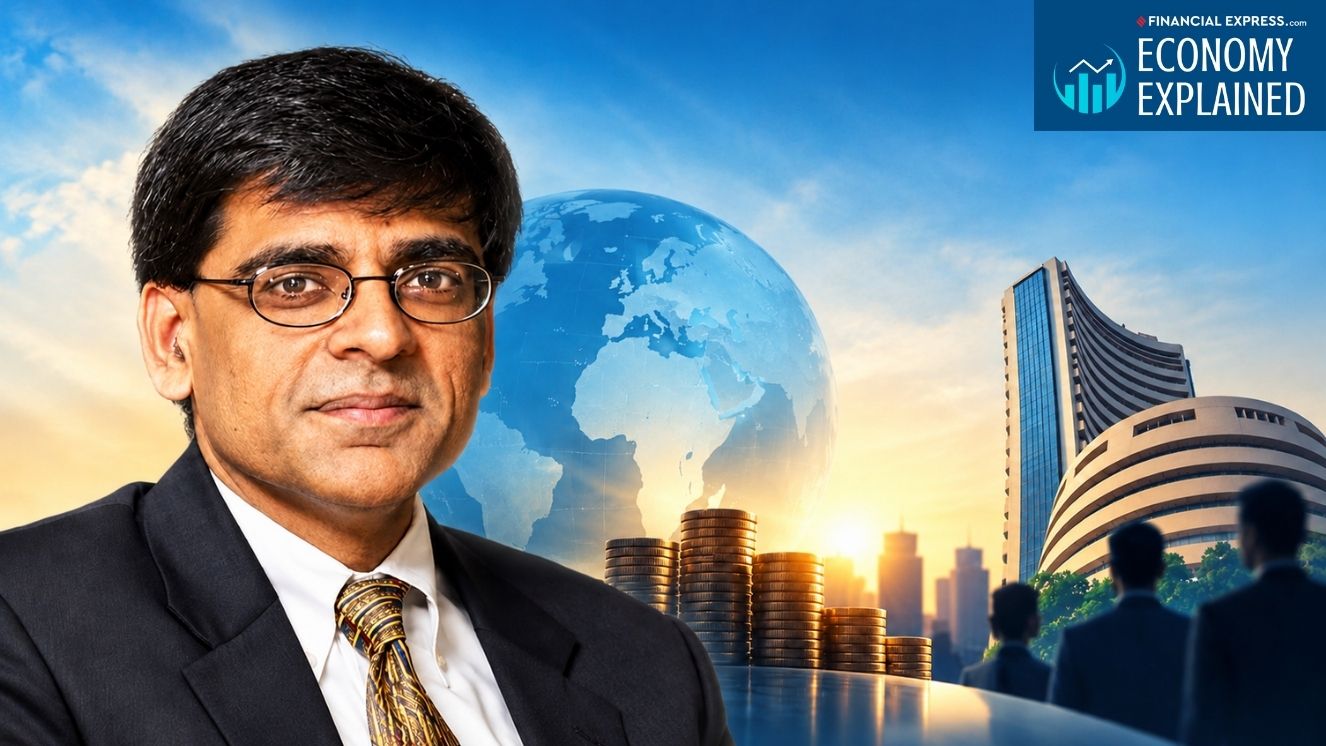
‘Never seen such dismay’: Why a 36-year market veteran is warning India
India's journey from a closed economy to a global investment hub has faced rising dismay among Foreign Portfolio Investors due to governance issues, taxation policies, and lack of ease in doing business.
Ignorance to Inquisitiveness to Dismay Having started Quantum Advisors in 1990 as India’s first institutional research house aimed at encouraging Foreign Portfolio Investors to allocate capital to India, I can state with confidence that, in 36 years of interaction with FPIs, we have never seen such dismay and irritation with India. While the level of inquisitiveness as indicated in the number of registered FPIs has surged 24x from 500 to 12,000 in the past twenty-five years and the current value of investments by FPIs in listed stocks is US$ 800 billion, the feeling of dismay is widespread.
The correct number is obviously 10% In 1990, India was a closed and insular economy. The market capitalisation of publicly listed stocks was US$ 60 billion and our GDP was US$ 350 billion. A series of reforms by successive governments has seen the market cap of India surge over 70 times in 36 years to US$ 4 trillion while GDP has surged 12x to US$ 4 trillion. The BSE-30 Index has delivered an astounding growth of 150x in INR and – after adjusting for the nearly 80% decline in the value of the Indian Rupee since 1991 – that is still a dollar increase of 25x in 36 years.
Governments – be it Congress or BJP, be it single party or coalition - have contributed to this mind-boggling success of the growth in India’s capital markets. Yet, despite all the bonhomie at well-curated conferences, ‘dismay’ and ‘irritation’ reflect the present mood of FPIs towards India. Worryingly, this is not all due to cyclical factors such as “the lack of an AI-story” or “higher oil prices” or “rising global interest rates”: all factors beyond India’s control.
The disappointment is that India could do far better on respecting foreign capital. As hosts we give the clarion call of welcoming the world to our doorsteps and, once in, we punish the FPIs who wish to participate - and help - in the growth of the Indian economy. In the past India’s fortunes were linked to emerging market flows but India came out of every global crisis with more capital and more positivity.
In 1991, India was a novelty – a large economy that had declared its willingness to accept foreign capital. Most FPIs were ignorant about India, and they invested in an “act of faith” as presciently described by Dr. Manmohan Singh, then the Finance Minister who led India’s reforms. By December 1994, FPI investment in India was US$ 10 billion but the Mexico Tequila crisis led to a sell-off in all emerging markets including India.
The short-lived recovery was derailed by the Asian Crisis in July 1997 followed by the bankruptcy in 1998 of Long Term Capital Management which gambled under the guise of “management”! Despite a multitude of traumatic global events such as the bursting of the tech bubble in February 2000, the 9/11 attacks on USA in 2001, the SARS pandemic in 2003, the rupturing of the 2005 / 2008 BRIC madness, the bankruptcy of Lehman Brothers, the “twist” by the US central bank to increase interest rates in 2013 and the COVID pandemic in 2020, FPI flows into India continued on an upward trajectory.
In this unusual global environment though, current reactions to India are increasingly being driven by our arrogant attitude to foreign capital and the lack of ease of doing business. The dismay, disinterest, and irritation with India is led by local, home-grown factors. Between the India Shining, Incredible India, Resurgent India and “China+1” pitches made by ten successive governments since the 1990s, the undertone of policy making is an assumption that India is a must-own and must-have gem for FPI and the multinational / FDI.
While it is true that India is an exciting economy with a great potential for decades to come, we need to be welcoming. Policies that are based on extraction by way of taxation of capital gains or an outdated mentality of boosting exports by depreciating the currency (which is a tax on the total capital that an FPI or FDI invests in Inda) has hurt the required rate of return – whether FPI or FDI. Entities such as pension funds and endowments have no tax in their home country and the taxes on capital gains they pay in India cannot be offset by any other tax payment – precisely because they are tax free entities in their home countries!
Furthermore, when pension funds move their India allocation from, say, a pool of capital investing in ‘international markets’ to a pool of capital investing in an ‘emerging market bucket’ – the tax man is quick to treat this as a sale and gleefully demands a capital gains tax. The draconian policy of imposing retrospective taxes puts the FPI in an awkward position where a current investor is footing the tax bill on a beneficiary who has already redeemed.
AI, Oil, and Governance Currently, the passion for the ‘AI’ trade is a significant factor in deciding allocations from providers of capital. While the lack of an AI story in India is worrisome, more importantly the increasing focus on questionable governance in India is a further hurdle. Over the past 25 years, the GDP of China has grown 2x that of India but the returns from Indian stock markets has been 2x that of China.
This was largely due to poor governance in China at the government policy level (supporting cronies and nationalistic policies) and at the company level (founders and managements stealing from minority investors). Having won the award for great governance for a few decades, FPIs are increasingly witnessing poor or uncertain governance in India. What makes this worse is the personal experience and narrative of Indian origin staff who populate the leadership of many FPIs.
Just as the tech giants have many Indian-origin CEOs, so do the FPIs. On a personal level, they have been witness to India’s wheels of corruption as they fulfill the necessary requirements to close accounts and distribute assets of their deceased parents. Tales of hardships of those who have family who own businesses in India add to the testing of the validity of the “India story” converts the India story from one of “ease of doing business” to the “grease of doing business”.
6 lakh crore cash shield: Why bond purchases alone won’t save the rupee None of these negatives are new and attributable to any one government or one political party. Across the political spectrum, the disrespect for consistency of rules, the tampering of laws and the arrogance that breeds from an assumption that the India has a TINA (There Is No Alternative) factor has resulted in the current state of irritation, disappointment and dismay with India amongst the FPI community.
Rather than seeing inflows of US$ 100 billion a year, we are seeing redemptions of US$ 25 billion a year. And it is not due to the AI we read about but due to the other AI we don’t write about: Arrogant India. It is time to be humble and welcome and take steps to respect our FPI guests. If the FPIs make an effort to study, analyse and invest in India they deserve a Return on Effort which is not decapacitated by a capital gains tax or an ancient mindset of forcibly weakening the Indian Rupee to shelter exports.
In a world where imports of goods are so last century thoughts, we need to build an eco-system to attract capital flows, without the punishment of capital blows. Disclaimer Ajit Dayal is founder of Quantum Advisors Private Limited, an India-focused investment advisor and investment manager. The views expressed are the author’s own and do not reflect the official policy or position of Financial Express.