MOD 346428: The shell agency behind $2.3 billion in Iranian military imports – Reuters report
Iran allegedly used a network of more than 5,000 military-linked agencies to obtain equipment and materials for its weapons programmes despite Western sanctions.
Iran has used a network of more than 5,000 secret military-linked agencies to import at least $2 billion worth of hardware, explosives and heavy-duty vehicles since January 2025, despite Western sanctions and a US naval blockade, a Reuters investigation has found. The agencies, whose names begin with the letters MOD, refer to Iran's Ministry of Defence. Reuters examined thousands of Iranian bank and government records, corporate filings, shipping documents and import data with Israeli-American risk consultancy 240 Analytics.
It found links between some of the agencies and the Islamic Revolutionary Guard Corps (IRGC), Iran's missile and drone programmes, and powerful state-linked foundations. The imports included rocket fuel ingredients, explosives, aircraft engine parts, precision machinery and heavy-duty trucks that could be modified for military use. The findings suggest that Tehran has continued to obtain materials that could support its weapons production despite sanctions and military attacks on its missile and drone facilities.
One agency, identified as MOD 346428, imported goods worth $2.3 billion between January 2025 and June 2026, according to shipping records reviewed by Reuters. The shipments entered Iran by sea, land and air, with declared origins including China, Russia, Germany and the United Arab Emirates (UAE). The investigation comes amid the war that began on February 28, 2026, during which the United States and Israel have targeted Iranian missile and drone facilities.
The attacks were aimed at weakening Iran's ability to produce and launch weapons. The conflict has also disrupted one of the world's most important maritime trade routes. Iran has restricted commercial shipping through the Strait of Hormuz, a narrow waterway that carried roughly a fifth of global oil and liquefied natural gas shipments before the war. Threats and attacks on vessels have sharply reduced traffic, forced shipping companies to reconsider routes and increased risks for crews and cargo.
The United States, meanwhile, has imposed a naval blockade on shipping to and from Iranian ports, further restricting Tehran's ability to export oil and receive goods by sea. The Reuters findings, however, indicate that Tehran has continued to source military-related materials through a procurement system operating outside much of the formal international banking and trade network. Miad Maleki, a former senior US Treasury Department official who helped design Washington's sanctions programme against Iran, described the network as a central part of the country's military procurement system.
"What you have here is the regime's military lifeline during this conflict and for many years before," Maleki told Reuters. "This is the complete ecosystem of the Iranian military's trade business," Maleki said. The US government disputed the suggestion that sanctions had failed to restrict Iran's access to resources. A Treasury Department spokeswoman told Reuters that Washington "has severed the regime's economic lifelines".
"While the regime may continue its desperate attempts to evade our powerful sanctions, fund its military and weapons programs, and access foreign currency, we are always 10 steps ahead," the spokeswoman told Reuters. How does Iran's secret military procurement network work? Reuters identified more than 5,000 agencies with names beginning with MOD, followed by five- or six-digit numbers. Their registered address is the same as that of Iran's Ministry of Defence and Armed Forces Logistics, known as MODAFL.
Official records list February 11, 1979, the day Ayatollah Ruhollah Khomeini took power after the Iranian Revolution, as their date of incorporation. However, Reuters found that most were actually established in 2013, when international sanctions were putting pressure on Iran's oil exports and currency. The agencies appear to operate as intermediaries, allowing the military to purchase goods through overseas companies and individuals.
These intermediaries, described by Reuters as frontmen and trustees, use funds held outside Iran to pay suppliers and arrange shipments. Infographic generated using AI This system reduces the need for direct cross-border money transfers, which can attract scrutiny from banks and financial authorities enforcing sanctions. According to the import data reviewed by Reuters, 97% of the transactions examined were settled "without currency transfer".
The funds reportedly came in part from oil sales that bypassed Western sanctions. Overseas intermediaries used money held in foreign bank accounts to purchase equipment and arrange its delivery to Iran. Noam Binstok, a senior analyst at 240 Analytics, said that these agencies formed the infrastructure behind Iran's international procurement network. "These numbered agencies are the plumbing behind the Islamic Republic's global sanctions evasion network and so much more," Binstok told Reuters.
"The amount of money going through these agencies is staggering, and no one has noticed them before." Binstok said he discovered the agencies in June 2025 while examining thousands of pages of Bank Sepah documents. The bank handles salary and pension payments for IRGC personnel. The documents came from material circulated on Telegram and published by WikiIran, a website that says it collects leaked documents from Iran.
Reuters found that phone numbers registered to 91 of the agencies also appeared in Bank Sepah records linked to IRGC personnel. These included at least two commanders whom the United States has accused of abuses against civilian protesters. WikiIran told Reuters that it had verified the documents through sources and contacts inside and outside Iran. The website said: "We can confirm that the materials are authentic and that their origin was verified through our sources and contacts both inside and outside Iran."
Reuters and 240 Analytics compared banking records with company registrations, shipping documents and other material to identify the agencies. The investigation also examined a portion of around 19,000 import records. The agencies appear to connect with Iran's wider network of military businesses and foundations. Some have links to the IRGC and organisations involved in missile and drone production.
Others are associated with bonyads, large foundations that control significant parts of Iran's economy and are linked to the country's political and religious leadership. Among the identified end users were the military unit responsible for Iran's ballistic missile programme and Sahara Thunder, which the US sanctioned in 2024 for manufacturing and supplying drones to Russia for use in the war in Ukraine.
Reuters traced shipments through several routes. Cargo ships carried supplies across the Caspian Sea from Russia, trucks transported goods from Central Asia, and freight aircraft brought shipments from China. The investigation used import records, shipping documents, social media footage and state media reports to examine some of these movements. However, some import records lacked detailed descriptions.
In those cases, Reuters relied on customs codes to identify the goods and their declared origins. The agency also found no evidence that Western governments had individually sanctioned the numbered agencies identified in the records, although Iran's military and several entities linked to it have faced US and international sanctions for years. What military equipment and materials did Iran import?
MOD 346428 was among the most active agencies identified in the investigation. Its overseas purchases rose from $442 million in the 12 months ending March 2023 to $988 million in the following 12 months, according to customs statistics published in Iranian media. Between January 2025 and June 2026, it imported goods worth $2.3 billion, according to records from ImportGenius, a platform that collects import and export data.
The shipments included chemicals used in rocket fuel, explosives, detonators, aircraft engine components, precision machinery and heavy-duty vehicles. During the first six months of 2026 alone, imports included $1.9 million worth of detonators, tonnes of explosives, aircraft engine parts, rocket fuel ingredients and heavy-duty vehicles. Weapons and sanctions experts who reviewed the records said some of the materials could be used in ballistic missiles and drones, including Iran's Shahed series.
Peter Salisbury, an adjunct assistant professor at Columbia University who researches Iranian arms transfers and supply chains, said the imports suggested that Iran was continuing to rebuild or expand its weapons capabilities. "This looks like an industrial-scale effort to rebuild or expand Iran's existing fleet" of drones and missiles, Salisbury told Reuters. "This data clearly shows the Iranian ecosystem's adaptability and its ability to find new routes."
The investigation also identified purchases of precision machinery, including computer-controlled lathes, electron-beam furnaces and particle accelerators. Such equipment has industrial applications but can also support the domestic manufacture of missile and drone components. One major series of shipments involved chemicals imported through the port complex of Bandar Abbas. Between January and April 2025, MOD 346428 imported 886 tonnes of chemicals whose declared origin was China.
Customs codes covered sodium chlorates and other perchlorates, which can be used in solid rocket propellants. Three days after the final shipment, a major explosion occurred at Bandar Abbas on April 26, 2025. Two people with knowledge of the incident told Reuters that sodium perchlorate had ignited inside shipping containers at the port. The explosion killed at least 70 people and injured more than 1,200, according to the investigation.
Iranian state media reported that the chemicals were stored by Sina Port and Marine Services Development Co, which belongs to Bonyad Mostazafan, a large foundation controlled by Iran's supreme leader. The company's chief executive at the time attributed the explosion to a "false statement" about the contents of a consignment that had arrived "without documents and tags". Reuters said it could not establish whether chemicals from the final 75-tonne shipment caused the explosion.
How did the network source heavy-duty vehicles? MOD 346428 also imported thousands of Toyota Hilux and Land Cruiser trucks. The IRGC and allied groups have modified similar vehicles to carry heavy machine guns and other military equipment. In January 2025, the agency imported four Toyota Tundra vehicles, which the IRGC uses to transport drones, according to the Reuters report. The investigation also traced purchases of Iveco Eurocargo trucks through overseas intermediaries.
In 2022, an Iranian car dealer based in Italy bought six trucks for 426,000 euros. They were sent to a Dubai-based company, Deilami Trading Co., which arranged their delivery to Bandar Abbas. Records reviewed by Reuters linked the final buyer to MOD 346428. A packing list showed that the vehicles were ultimately delivered to Sahara Thunder, the Iranian entity sanctioned by the US over its role in drone production and supply to Russia.
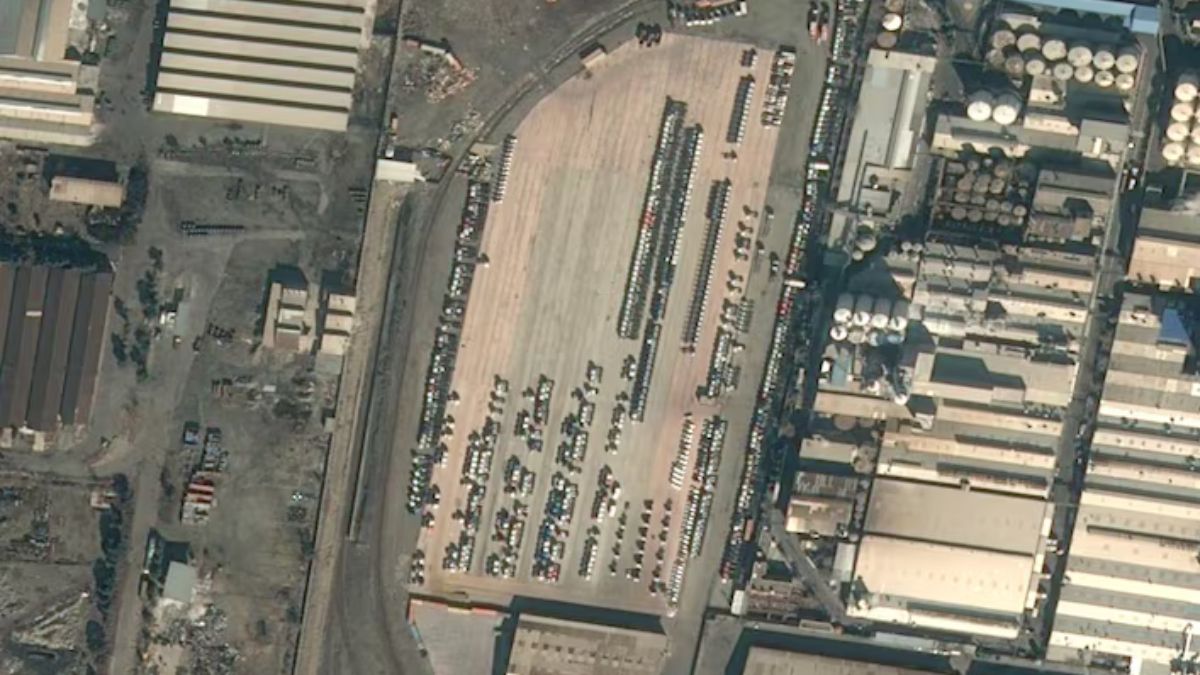
Infographic generated using AI Between January 2025 and June 2026, MOD 346428 imported another 435 Iveco trucks. Reuters used satellite images, social media videos and vehicle identification numbers to trace some of them to a customs yard outside Tehran. A separate vehicle appeared in footage released by US Central Command in March 2026. The footage showed what the US military described as a disguised Iranian mobile missile launcher being hit during an attack.
Reuters could not establish whether that truck came from MOD 346428's imports. However, analysts at UK-based defence intelligence company Janes identified it as an Iveco model of a type imported by Iran. Iveco told Reuters that its official distributors must ensure their products are not used for military, chemical, biological or nuclear purposes. The company said it had contractual safeguards to prevent sales to prohibited destinations, entities and individuals.
What role did overseas suppliers and transit routes play? The investigation also traced goods recorded as originating in the UAE. Since the war began, Iranian military purchases included $27 million worth of goods listed as coming from the Emirates, nearly all of which arrived by sea. The most recent shipment identified in the data was listed as electronics and arrived on June 27. The UAE government rejected the allegations after publication.
It told Reuters that it "categorically rejects and refutes these baseless allegations". The statement said the claims misrepresented the country's policies and actions and added that the UAE was committed to preventing the misuse of its territory for illegal activities. China's Foreign Ministry told Reuters it was "unaware of the situation you describe". It also said, "We firmly oppose attempts to maliciously link regional hostilities to China or smear China's reputation."
However, Russia's Defence Ministry, the White House and US Central Command have not issued any statement yet regarding the claims. The investigation found that goods recorded as originating in Germany and other countries also entered Iran through the procurement network. However, the records do not establish that the governments or manufacturers in those countries knowingly supported Iran's military purchases.
The findings also require a distinction between military and dual-use goods. Chemicals, industrial machinery, electronic components and vehicles can have civilian applications, and Reuters said it could not independently confirm the contents or declared origin of every shipment. Nevertheless, the records reviewed by Reuters, along with assessments from weapons and sanctions experts, show how Iran has continued to acquire materials that could support its military production despite sanctions and attacks on its weapons facilities.