Make in India, import inside: How much of India’s defence orders are truly indigenous?
The numbers point to a gradual reduction in India’s dependence on imported finished military platforms. But they do not necessarily capture the foreign-origin components embedded in equipment manufactured or assembled domestically.
India’s defence procurement is increasingly shifting towards domestic manufacturers, with a growing share of capital acquisition spending reserved for Indian industry and more military platforms being designed and assembled within the country. But as the government pushes its self-reliance agenda, a more complicated question is emerging: how much of the equipment supplied under domestic defence contracts is actually made in India?
The distinction matters because an Indian company winning a defence order does not necessarily mean that every critical component in the platform is domestically manufactured. Engines, radar systems, seekers, sensors, electronic components and other specialised equipment can continue to come from overseas suppliers, even when the final platform is designed, assembled or integrated by an Indian manufacturer.
This is the gap between the growing value of domestic defence orders and the depth of India’s manufacturing independence. It also raises questions about how indigenous content is calculated, whether the current procurement framework adequately captures imported components and how dependence on foreign suppliers affects production schedules, costs and profitability. The scale of the challenge is reflected in the latest data from the Stockholm International Peace Research Institute (SIPRI).
In its March 2026 report on international arms transfers, India remained the world’s second-largest recipient of major arms during 2021-25, accounting for 8.2% of global imports. Its arms imports declined 4% compared with 2016-20, a reduction SIPRI partly attributed to India’s growing ability to design and produce its own weapons. However, the institute also flagged substantial delays in domestic production.
The supplier mix has changed, too. Russia accounted for 40% of India’s major arms imports in 2021-25, down from 51% in 2016-20 and 70% in 2011-15. France accounted for 29%, while Israel contributed 15%, according to SIPRI. The numbers point to a gradual reduction in India’s dependence on imported finished military platforms. But they do not necessarily capture the foreign-origin components embedded in equipment manufactured or assembled domestically.
That distinction is central to understanding the actual depth of India’s defence indigenisation. The Defence Acquisition Procedure (DAP) 2020 provides the framework for determining indigenous content in defence procurement. Under the Buy (Indian-IDDM) category, which stands for Indigenously Designed, Developed and Manufactured, the minimum indigenous content requirement is 50% of the base contract price.
The base contract price is calculated after excluding taxes and duties. The framework also provides indigenous-content thresholds for other procurement categories, including Buy (Indian) and Buy and Make (Indian). The objective is to give preference to equipment that is designed and manufactured in India, while encouraging domestic sourcing of materials and components. However, the percentage-based calculation also makes it important to understand what is being counted as indigenous and how foreign-origin inputs are treated in the overall cost of a platform.
A system may be designed and integrated by an Indian manufacturer, with domestic production covering several subsystems, while still relying on imported components for some of its most technologically sensitive functions. The final indigenous-content percentage therefore needs to be read alongside the origin of critical components. This is particularly relevant for complex defence platforms, where a small number of imported systems can determine performance, delivery schedules and the ability to scale up production.
The government has proposed changes through the draft DAP 2026, released in February this year. Among the proposed changes is an increase in the minimum indigenous-content requirement under Buy (Indian-IDDM) from 50% to 60%. The draft also seeks to strengthen the definition and verification of indigenous content. The Ministry of Defence has invited comments on the draft, which is intended to replace DAP 2020 once approved.
Until it is notified, the 2020 procedure remains the operative framework. The proposed changes could make it more important for manufacturers to demonstrate the domestic value added in their products rather than rely only on broad declarations of indigenous content. The aircraft is an important part of India’s effort to build its own combat aviation ecosystem. Its design, development and production involve domestic institutions and manufacturers, and the government has highlighted a substantial indigenous-content component in the programme.
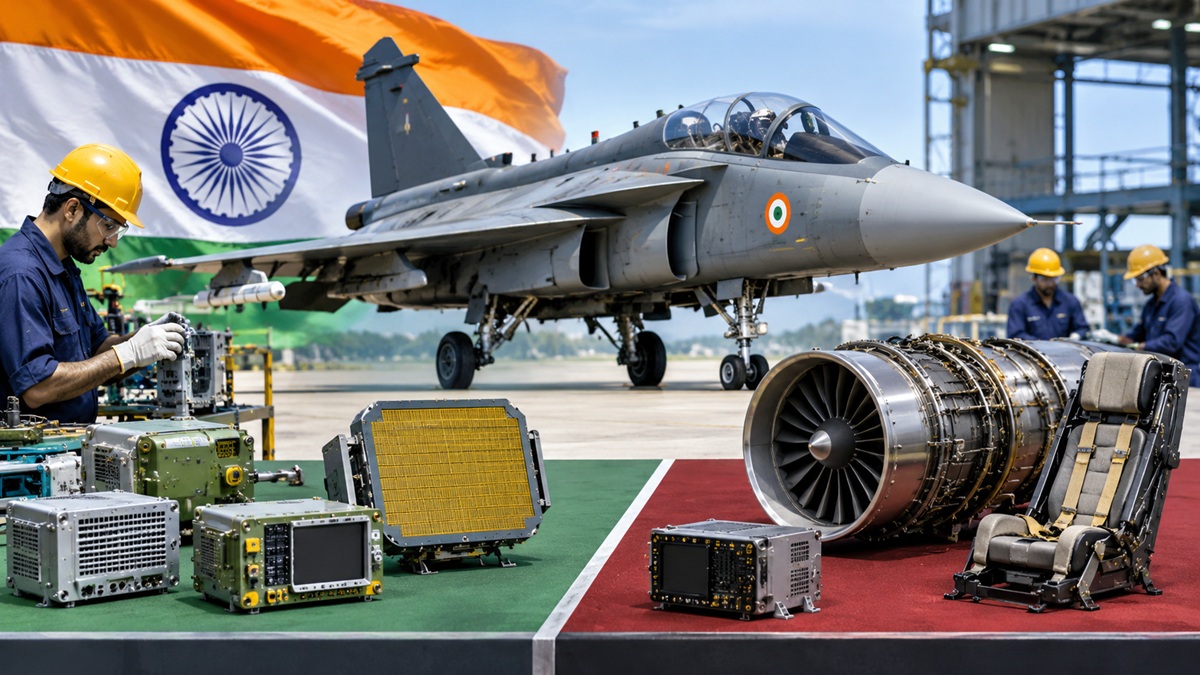
The Ministry of Defence has stated that the order for 97 additional Tejas Mk1A aircraft carries indigenous content of over 64%. The order includes domestically developed systems such as the UTTAM AESA radar, Swayam Raksha Kavach and indigenous control-surface actuators. However, the aircraft continues to depend on foreign-origin components. The GE Aerospace F404-IN20 engine remains a key imported system.
Other foreign-origin equipment and components have also featured in the aircraft’s supply chain, including ejection seats and specialised systems. The dependence is not merely a question of accounting. Engine availability has been a major factor in the production and delivery schedule of the Tejas Mk1A programme. A domestically manufactured aircraft cannot be completed and handed over without the engines required to power it.
The case illustrates why an indigenous-content percentage alone may not provide a complete picture of supply-chain independence. A platform can meet the prescribed domestic-content threshold and still depend on overseas suppliers for components that are difficult to substitute. It also highlights the difference between manufacturing a platform in India and having control over the technologies and supply chains that determine its production.
Imported components can affect margins and delivery schedules The dependence on foreign-origin components has implications beyond procurement policy. It can affect the financial performance of defence manufacturers, particularly when companies are required to meet delivery schedules amid constraints in sourcing specialised equipment. For manufacturers such as Bharat Dynamics Ltd (BDL), bought-out components and imported subsystems form an important part of the production chain.
Research commentary on the company has flagged the possibility of margin pressure from a higher share of bought-out components and the need to import certain items to avoid further production delays. The availability of specialised components such as radars and seekers can also influence the pace at which missile systems and other defence equipment are manufactured and delivered. When a critical imported component is delayed, the domestic manufacturer may be unable to complete the final system, even if the rest of the platform is ready.
This creates a difficult trade-off. Companies may have to continue sourcing from overseas to meet contractual commitments, while domestic alternatives are still being developed, tested or qualified. For defence electronics manufacturers such as Bharat Electronics Ltd (BEL), the cost and availability of raw materials and bought-out components can influence operating margins. Higher input costs can offset some of the benefits of rising order books and increased production.
Hindustan Aeronautics Ltd (HAL) faces a similar challenge in complex aerospace programmes, where imported engines and other specialised systems can affect production schedules and costs. The issue is also relevant to the unmanned aerial systems segment. Pankaj Akula, Founder and Managing Director of AKSI Aerospace Group, told The Financial Express that an Indian-made airframe can still carry significant strategic dependencies if its critical electronic and propulsion systems are sourced from abroad.
“An indigenous airframe with a foreign-controlled electronic nervous system is not necessarily an indigenous strategic capability,” Akula said. He said dependence on overseas suppliers for flight controllers, propulsion electronics, communications, sensors, batteries and navigation systems could expose domestic manufacturers to supply-chain and technology restrictions. AKSI is seeking to develop capabilities across autopilots and flight-control systems, batteries, motors and propulsion, composite airframes, cameras and payload electronics.
The company’s approach is to progressively build domestic capability in the systems that determine an unmanned aircraft’s ability to fly, navigate, communicate and complete its mission. Akula said the company’s strategy was not to pursue complete indigenisation immediately, but to increase domestic control over critical technologies while continuing to source certain specialised components from trusted global supply chains where local production was not yet commercially viable.
The longer-term argument for indigenisation is that a deeper domestic component ecosystem could reduce these vulnerabilities. Greater local sourcing may improve supply-chain visibility, reduce exposure to overseas procurement delays and provide manufacturers with better control over production costs. However, the transition requires investment in research and development, manufacturing capacity, testing facilities and technology partnerships.
Developing a domestic substitute for a specialised engine, radar or seeker is not simply a matter of replacing an imported part with a locally manufactured one. It requires extensive testing, certification and validation before the armed forces can induct it. The government’s procurement targets provide another measure of the shift towards domestic defence manufacturing. For FY27, the Union Budget has earmarked Rs 1.39 lakh crore for procurement from domestic defence industries, equivalent to around 75% of the capital acquisition budget.
The allocation is intended to provide greater visibility to Indian manufacturers and encourage investment in domestic production capacity. It also creates opportunities for private-sector companies, defence public sector undertakings and smaller component suppliers. However, the domestic procurement reservation and the indigenous-content requirement measure different things. The former determines the procurement preference given to domestic industry, while the latter seeks to establish how much of the equipment’s value is indigenous under the applicable procurement category.
An order placed with an Indian vendor should therefore not automatically be interpreted as a fully domestic supply chain. This distinction is important when assessing the impact of the government’s defence spending targets. A higher share of procurement from Indian companies can strengthen domestic manufacturing and assembly, but the extent to which it reduces foreign dependence depends on the origin of the components used in the final product.
The Ministry of Defence’s procurement framework and the Budget allocation should consequently be assessed alongside company-level disclosures on imported raw materials, bought-out components and foreign technology dependencies.