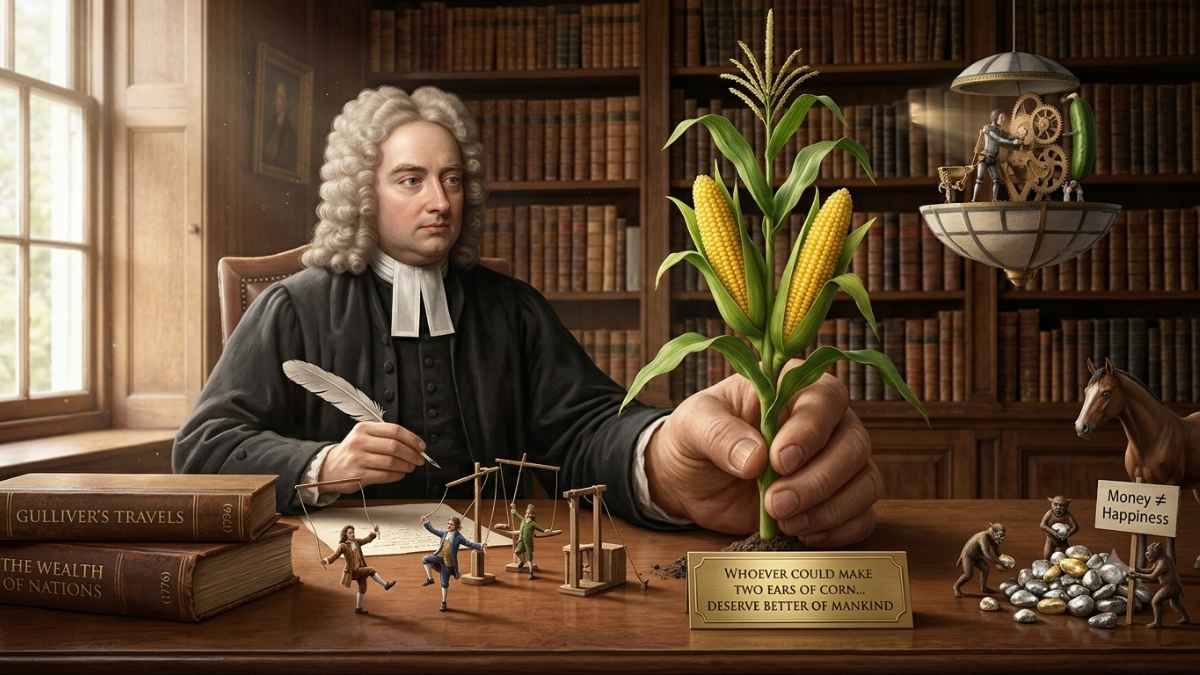
Before Adam Smith, Jonathan Swift's 300-yr-old novel asked: What is an economy for?
Economics, the subject, was creeping when Jonathan Swift published Gulliver’s Travels in 1726. That’s exactly 300 years ago. Adam Smith would come up with his The Wealth of Nations exactly 50 years later, in 1776. However, important economic issues like trade, taxes, national debts, and prosperity were under discussion long before that. Swift was an Anglo-Irish cleric, writer, and satirist. He paid distinct attention to the drawbacks of society and politics of his time through his writings.
And he clearly raised distinct economic questions that are relevant even today. Adam Smith’s admiration for Swift is well documented. In fact, both of them shared themes and insights about human nature. Smith praised Swift as “the plainist as well as the most proper and precise of all the English writers” (in his Lectures on Rhetoric and Belles Lettres, an elective lecture course in Edinburgh during 1746-48).
Smith understood that Swift’s satire makes us see human vanity, political ambition, and cruelty through unfamiliar eyes. Court positions there are filled by those who are best at rope dancing. In the war against the neighbouring Blefuscu, Gulliver was used as a giant war machine. Here comes the question of opportunity cost, too. What kind of welfare for the common Lilliputians could be done using Gulliver instead?
The next episode takes place in Brobdingnag, which is inhabited by a race of giants. Here, Swift clearly questions the nature of European civilisation of his time. Gulliver proudly describes the military strengths, political intrigues, and financial arrangements of the European civilisation to the king of Brobdingnag. However, instead of admiration, the king gets appalled. “Whoever could make two ears of corn, or two blades of grass, to grow upon a spot of ground where only one grew before, would deserve better of mankind, and do more essential service to his country, than the whole race of politicians put together,” the king says.
Later, in The Wealth of Nations, Smith would investigate how the division of labour, productivity, and exchange create national wealth. He gives an insight into how wealth can be made, whereas half a century before that, Swift questions the purpose of that wealth through the giant king. Today, every economic statistic might face the same question. Gulliver’s third voyage is to Laputa and Balnibarbi, and maybe to an intellectual vanity, if we rightly call it.
A grand project in the Grand Academy of Lagado is about extracting sunbeams from cucumbers, whereas the state of agriculture there remains poor. Here Swift mocks that the experts lack contact with reality. Certainly, Swift is not attacking science as a whole. But, disillusioned by the nature of some scientific research in England at that time, he ridicules the ingenuity detached from reality. In the last voyage, Gulliver meets the Houyhnhnms and Yahoos.
Houyhnhnms have no wars, bribes, or desire for possessions. The Yahoos, however, even quarrel over shining stones, which are essentially useless to them. Modern economics increasingly focuses on the fact that money and consumption are not enough for human well-being and happiness. We need something beyond that, perhaps, such as good healthcare, relationships, safety, and a healthy environment. Swift, certainly, didn’t introduce the modern-day theory of human-centred economics.
Even though Smith is mostly associated with market economics, his earlier foundational work was about the necessity of public institutions since market systems alone couldn’t support society. Subsequently, Marshall turned the direction to humanity, declaring that economics was the “study of mankind in the ordinary business of life”. Developments made by contemporary researchers such as Richard Samans are furthering the tradition of this school, bringing the main macroeconomic issues closer to the level of median living standards and social equality.
Jonathan Swift’s Yahoos, portrayed much before that, however, nudge us to think that material possession is not the same as happiness. Yet Swift remained confused between the two extremes—Houyhnhnm and Yahoo. The Houyhnhnm society exhibited an almost exaggerated level of rationality. They certainly don’t have the human-like emotions, which are the hallmark of a human. Gulliver was so much moved by that society that even after returning home, he thinks the human beings around him are like the Yahoos.
Certainly, it was Gulliver’s mistake to classify all humans into a single group. However, in a nutshell, Gulliver’s Travels often depicts something similar to the modern human-centred economic ideas. Lilliput has politics devoid of wisdom; Lagado illustrated that ingenuity can be detached from reality. Yahoos, as we have already argued, had possessions but no satisfaction. The Brobdingnag episode represents a more modest economic outlook, though.
We can remember Adam Smith in this connection, too. Smith begins his The Theory of Moral Sentiments (1759) as “How selfish soever man may be supposed, there are evidently some principles in his nature, which interest him in the fortune of others”, he asks us to look beyond ourselves. Smith calls this sympathy. Gulliver’s voyages may thus have a shared insight that understanding humanity requires both moral imagination and a close look at human folly.
About 33 years before Smith’s The Theory of Moral Sentiments, Jonathan Swift raised a modern question regarding the worth of wealth if it doesn’t benefit its owners. He described the fairytales of the giants, tiny politicians, and impossible inventions. But he remembers the ordinary human being, who doesn’t care about another grand theory or impressive statistics. All he wants is a better life.