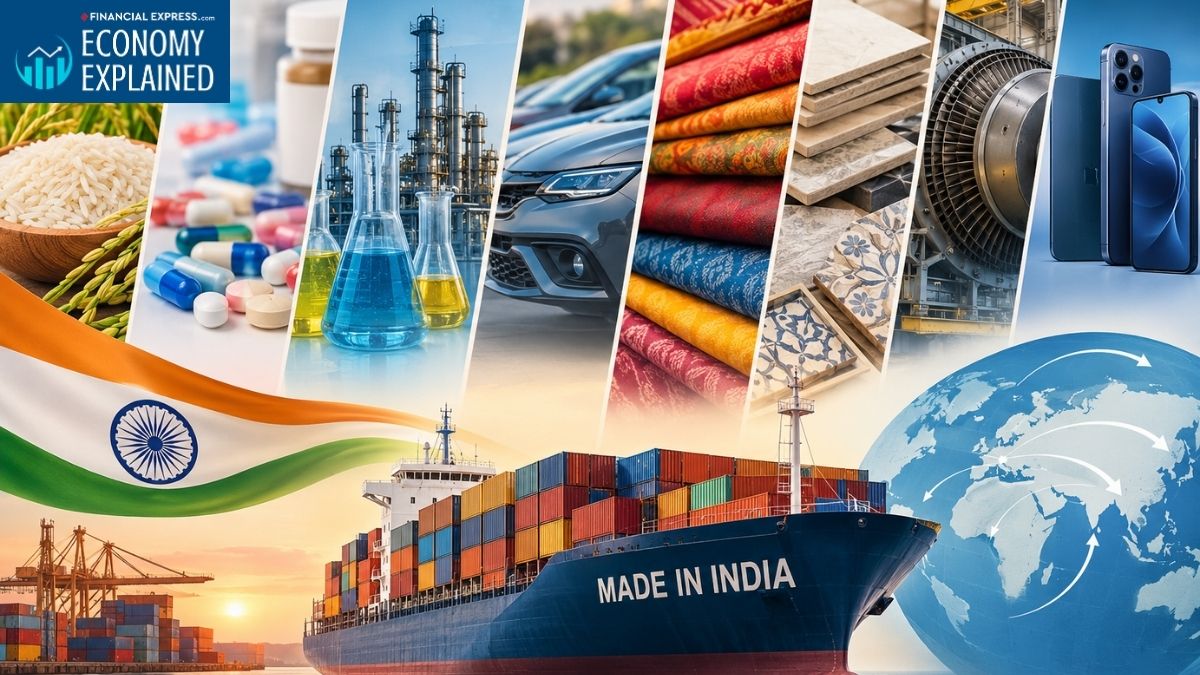
From rice to turbines: How ‘made in India’ is gaining ground on the world stage
Discover India's evolving export strengths through Revealed Comparative Advantage, highlighting sectors like agriculture, automobiles, textiles, and ceramics with shifting competitive edges from 2011 to 2025.
Imagine Rahul scores 85 in Maths and 80 in English. It looks like Rahul is better at Maths than English. But there's a catch. The class average in Maths is 90, while that in English is 70. That means he scored below average in Maths but well above average in English. So what is his real strength? Maths, his highest score, or English, where he outperformed his friends? Think about the subject his friends would ask him doubts about more often.
That's his comparative advantage. Some products make up a large share of India's exports. But that alone does not mean India is especially good at exporting them. The real question is: does India export more of that product than the rest of the world does on average? That's what Revealed Comparative Advantage, or RCA, measures. If rice accounts for 5% of India's exports but only 1% of global exports, India is more specialised in rice than the average country.
In that case, India's RCA in rice is above 1. The higher the RCA, the stronger India's export advantage in that product. So, let’s see the trajectory of the relative strength of India’s exports. What is Revealed Comparative Advantage? We can analyse the data in two ways. First, which products have crossed the benchmark of 1. That shows India gained comparative advantage. Second, the trajectory to see if the relative advantage has fallen or risen over time, even if the products are above 1.
Across 255 product categories based on the UNCTAD database, India had a comparative advantage (average RCA above 1) in 87 products during 2011-15. By 2021-25, that number had risen to 102. Most of India's export strengths endured: 73 of the 86 products remained above the threshold. Another 29 products joined the list over the decade, while 14 dropped out. Here, I compare the five-year averages to remove unwanted noise in the dataset.
The data shows that India has retained its traditional expertise in rice, spices, synthetic dyes, precious stones and seafood. At the same time, it has gained ground in industrial inputs, chemicals, engineering equipment, and selected manufacturing niches. Smartphone production has been a major success story over the past decade, but that success has not yet translated into a broader comparative advantage in electronics.
On the other hand, India appears to have lost some of its relative specialisation in gems and jewellery, leather, and garments. Food & Agriculture: Getting more specialised India may be known today for its IT services and growing manufacturing sector, but agriculture remains one of its strongest export engines. The country continues to enjoy a strong competitive advantage in products such as rice, spices and seafood, with several of these categories becoming even more competitive over the past decade.
Agriculture is also changing. Some traditional strengths, including tea, cotton and bovine meat, are no longer as dominant as they once were. Cotton is a good example. Higher yields helped India in the 2000s, but that advantage has narrowed (RCA: 2007 = 12, 2025 = 4.6). At the same time, India is specialising in preserved fruit, prepared vegetables, and processed fish. These are higher-value food exports.
It’s a good sign that it is looking beyond commodity exports. Automobiles: Still stuck with two wheels India's automotive export story is a tale of two industries. It has strong positions in two-wheelers and tractors with RCA above 2 in both segments. A huge domestic market allowed companies to build scale and capabilities over decades. Their ability to produce at lower costs than many competitors then helped them win market share across developing countries.
On the other hand, passenger cars remain a weak spot. India's RCA has remained around 0.4 for more than a decade. Although sales within India have been strong, exports need a different strategy. Countries like Germany, Japan, South Korea and China dominate the market. India needs to do a lot to make a mark in this market. But there is some good news. Auto components have become more competitive. Its RCA rose from 0.6 in 2011-15 to 0.9 in 2021-25.
The number is low, and the progress is also slow. But it shows where it could reach in the next few years. That would also mean the Indian auto ancillary industry may integrate into global supply chains much faster than carmakers. Textiles: Losing specialisation The textiles and clothing sector, India’s bellwether, is changing too. But the signs are a bit worrying. Overall RCA in the sector has slipped, and a gap has opened up between textiles and garments.
Apparel, clothing accessories and leather products are losing some of their competitive edge. Woven cotton fabrics, jute products, yarn and floor coverings have remained strong or improved. India remains competitive in many textile inputs, home textiles and fabrics. But when it comes to garments, countries such as Bangladesh and Vietnam have pulled ahead. According to ICRIER, Bangladesh's share of global apparel exports rose from around 2% in 2000 to 10% in 2024, while Vietnam's climbed from 1% to 6%.
But India's share has been around 3% for decades. Put simply, India is still much better at exporting textile inputs than turning them into finished garments. Closing that gap could mean more exports, higher profits and value addition, and many more jobs in garment manufacturing. Ceramics: Vitrifying its way to the top One would never have thought that tiles would make the list. But here it is. The RCA for clay construction and refractory materials jumped from 0.9 in 2011-15 to 4.3 in 2021-25.
Ceramic tiles are one part of this broader export category. A lot of this success can be traced to Morbi in Gujarat. Over the years, the city helped India become one of the largest tile manufacturing hubs. The correct number is obviously 10% India was already the world’s third-largest ceramic tile producer in 2015, making around 850 million square metres of tiles. By 2024, output had nearly tripled to 2.4 billion square metres.
Much of this growth came from Morbi, Gujarat. According to Centrum Research, rising demand from housing construction, advanced production techniques, changing flooring preferences, replacement purchases, commercial real estate and a construction boom in the Gulf region supported India's tile industry. Power & Engineering: Charging up for something bigger One of the more surprising changes in India's export basket has come from power and engineering equipment.
A decade ago, only one of the 12 select product categories had an RCA above 1. By 2021-25, that number had risen to 10. The list includes products such as steam turbines, generators, transmission shafts, bearings, textile machinery and civil engineering equipment. These exports did not emerge out of nowhere. Many of them build on capabilities that India has developed over decades in metals, casting, forging, machining and vehicles.
It shows how capabilities can spill over to other sectors over time. In other words, today's export strengths often grow out of yesterday's industrial successes. Electronics: A narrow success story Now let's talk electronics. We have all heard about Apple, Samsung and other companies making phones in India. And the data shows that something has changed. The RCA for telecom equipment, which includes mobile phones, rose from 0.4 in 2011-15 to 1.1 in 2021-25.
Office machines also crossed the RCA threshold of 1. Higher import duties, the phased manufacturing programme, and the production-linked incentive scheme have boosted smartphone production and exports. Exports have jumped from about $5.5 billion in FY22 to nearly $29 billion in FY26. But there is an important caveat. These gains are concentrated in smartphones, led by Apple, rather than electronics as a whole.
Much of it is assembly-based work. Now we need to create ecosystems to move beyond that. Schemes such as the Electronics Component Manufacturing Scheme and Semicon 2.0 could help in this transition. Chemicals: Getting to the right formula Chemicals tell a very different story from electronics. This is not a new industry that emerged over the past decade. India has built capabilities for decades and is now reaping the benefits.
The average RCA for ten chemical-related product categories rose from 2.6 in 2011-15 to 3.6 in 2021-25. The global chemicals industry was also changing. Rising trade tensions and China+1 alternatives created opportunity for India, as Crisil reported. It also noted that companies were investing more to make key inputs themselves and rely less on imports. When China closed many chemical plants in its environmental crackdown, Indian firms stepped in and benefited.
Moreover, they also exported around 1,000 tonnes of vinyl sulphone to China in 2016, a chemical they had traditionally imported from there. That was a major achievement. Pharmaceuticals: A bitter pill to swallow Pharmaceuticals highlight an interesting gap in India's capabilities. India is very strong in making finished medicines, but much weaker in producing the ingredients that go into them. The RCA for finished medicines rose from 1.9 in 2011-15 to 2.1 in 2021-25.
In contrast, the RCA for pharmaceutical ingredients fell from 0.7 to 0.5. Part of the reason is economic. China built huge chemical manufacturing clusters that can produce many ingredients at very low cost. Indian drugmakers found it cheaper to focus on finished medicines, especially generics, and import the ingredients from China. This helped India become a pharmaceutical powerhouse, but it also created a weakness – dependence on China.
Government schemes and bulk-drug parks are now trying to rebuild domestic production. But the challenge will be around how cheaply the Indian chemical industry can produce these raw materials. That is where scale, efficiency and strong chemical manufacturing clusters matter. Conclusion Looking across these industries, common themes emerge. The sectors where India is strong today have often spent years, sometimes decades, building capabilities, supply chains and customer relationships.
A large domestic market can help firms grow, but it does not guarantee export success. Clusters such as Morbi show how suppliers, skilled workers, machinery makers and logistics networks can strengthen an entire industry. Therefore, we need to think about developing such clusters in other sectors too. But the story should not end with exports. The bigger challenge is to move into higher-value parts of the production chain and use existing capabilities to develop newer, related industries.
As mentioned earlier, the skills, know-how and supplier networks built in one sector can create opportunities in another. Many of tomorrow's export strengths may well emerge from the foundations laid by today's successes. Disclaimer The views expressed are the author’s own and do not reflect the official policy or position of Financial Express. Swapnil Karkare likes bridging economics and storytelling. A Chartered Accountant and economist by profession — he analyses finance and policy through research, writing, and podcasts.