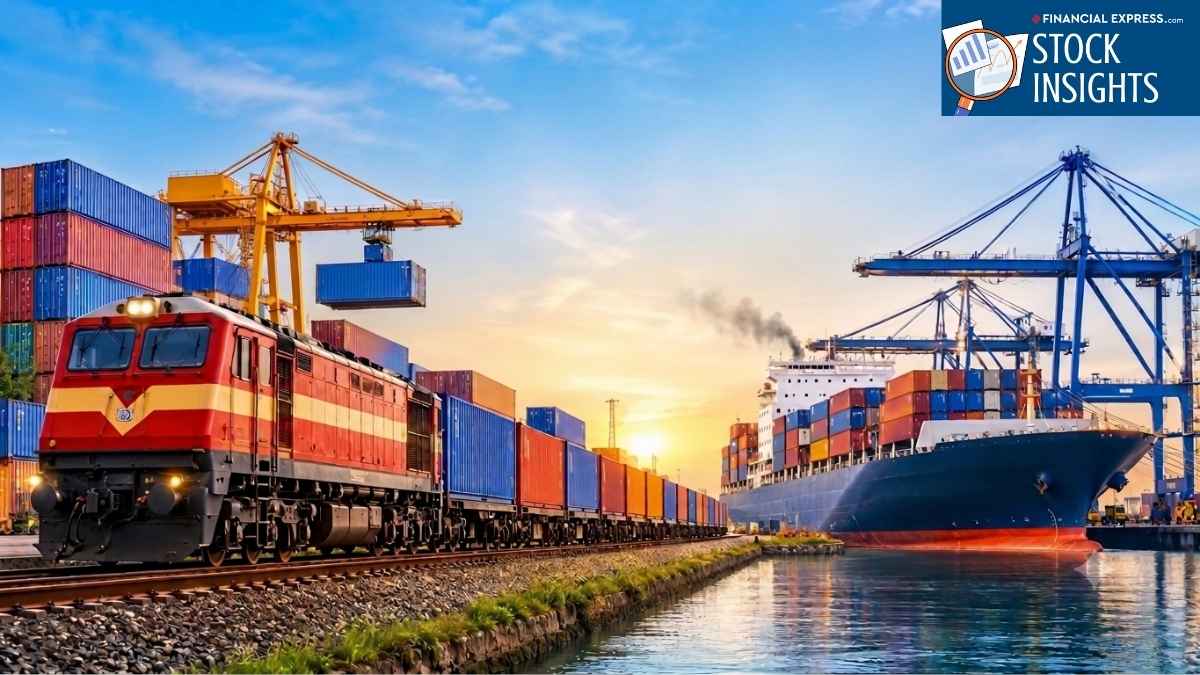
From inland depots to global ports: 2 stocks chasing a bigger share of India’s trade
India’s container market could grow from $361.6 million in FY25 to $881.5 million by FY34. Which businesses stand to benefit from this expansion?
India’s container opportunity is more than just making shipping boxes. The country is developing a connected ecosystem of container production, rail transport, ports and shipping. Indian Shipping Container Market is expected to reach $361.6 million in FY25 and is projected to grow to $881.5 million by FY34 at a CAGR of 10.4%. Meanwhile, the major ports handled 915.17 million tons of cargo in FY26, Indian Railways transported 1,670 million tons of freight and global container-port throughput exceeded an estimated 1 billion twenty-foot equivalent units (TEUs) in 2025.
For readers: Two companies that offer different entry points into this developing ecosystem are CONCOR and Adani Ports. #1 CONCOR: The Rail-Linked Logistics Network Connecting India's Factories With Its Ports Container Corporation of India (CONCOR) is a Navratna Central Public Sector Enterprise under the Ministry of Railways, primarily engaged in transporting containers by rail and providing integrated logistics services.
Its business covers inland container depots (ICDs), container freight stations, multimodal logistics parks, warehousing, port connectivity and first-mile and last-mile transportation. This makes CONCOR an important link between India's manufacturing centres and maritime gateways. Unlike a conventional freight operator, it combines transportation infrastructure with container-handling assets, allowing it to participate in several stages of an export-import (EXIM) shipment.
The Inland Network Is CONCOR's Biggest Competitive Asset CONCOR has 68 terminals, including logistics parks, more than 15 logistics parks and 422 wagons. Its network connects inland industrial centres such as Dadri, Ludhiana, Kanpur and Tughlakabad with important western and eastern ports, including Mundra, Mumbai, Chennai and Kolkata. FE Stock Insights on WhatsApPGet instant alerts on high-conviction investment themes and fundamental deep dives—direct from Financial Express.Join now CONCOR's container procurement programme also connects it with India's domestic manufacturing ambitions.
Under the Make in India initiative, the company had placed orders for 21,620 indigenously manufactured containers. The company currently has a fleet of 56,008 containers. The distinction between container procurement and container manufacturing is important. CONCOR purchases containers to support its logistics operations; it is not itself the principal manufacturer in this segment. Its returns therefore depend on how efficiently the additional equipment is deployed.
Specialised Cargo Opens Another Route To Revenue CONCOR is also widening the range of goods that can be transported through its network. In its Q1 FY26, CONCOR introduced specialised tank containers for transporting bulk cement and customer-owned tank containers for bulk liquids. It also reported the movement of industrial chemicals in tank containers from Paradip Port to Dadri and Khatuwas. Customer-owned equipment can be particularly useful because CONCOR may provide transportation and network access without financing every specialised container itself.
Another important development is rail connectivity for the Gati Shakti Multi-Modal Cargo Terminal at Varnama, linked to the Western Dedicated Freight Corridor (WDFC) through New Makarpura Yard. Two Wagon Orders Strengthen The Transportation Backbone In October, CONCOR placed an ₹87.15 crore order with Southern Railway for 12 rakes of BLSS wagons. A few days later, it placed another order worth ₹485.93 crore with Braithwaite & Co.
Ltd. for 24 rakes of BLSS wagons with Brake Van Type BVCM. The delivery deadline for the latter order is 20 June 2028. More rakes can handle more transportation capacity. They can also help CONCOR run more routes, given sufficient cargo demand and railway access. Bharat Container Shipping Line Could Extend CONCOR's Reach To The Sea Another development concerning the integrated container-chain theme is the proposed Bharat Container Shipping Line (BCSL).
The Shipping Corporation of India, CONCOR, Jawaharlal Nehru Port Authority, V.O. Chidambaranar Port Authority, Chennai Port Authority and Sagarmala Finance Corporation Limited signed a Memorandum of Understanding in February 2026 to establish BCSL. The proposed initiative is to connect the major ports of India with the inland markets through development of a domestic container shipping ecosystem. It is intended to strengthen end-to-end logistics, improve freight-cost stability and reduce dependence on foreign shipping operators.
Q1 FY27: The Revenue Engine Holds, But Growth Remains on Track Two CONCOR reported a largely stable consolidated revenue performance in Q1 FY27, with growth in EXIM logistics offset by a decline in domestic logistics. The results matter to the integrated container-chain investment theme because they show whether rising freight volumes are translating into higher revenue and profit. ParticularsQ1 FY27Year-on-year changeRevenue from operations₹2,159.76 crore0.28%Total income₹2,245.26 crore(0.16%)Total expenses₹1,885.15 crore(0.77%)Profit before tax₹360.11 crore3.17%Profit after tax before share of joint ventures₹272.46 crore5.14%Consolidated profit for the period₹268.90 crore0.61% Revenue grew only marginally, but lower total expenses helped improve profit before tax.
EXIM growth offsets domestic weakness: SegmentQ1 FY27 revenueChangeEXIM logistics₹1,433.65 crore2.33%Domestic logistics₹726.11 crore(3.53%) EXIM logistics generated approximately 66.4% of consolidated operating revenue, while domestic logistics contributed 33.6%. This mix makes CONCOR's performance sensitive to international trade flows, port evacuation and export-import demand. The decline in domestic revenue also shows that the benefits of network expansion were not uniform across its business segments.
Mukul Agrawal just bought into one CONCOR Stock Performance: A Falling Share Price Raises The Earnings Bar Source: Screener.in CONCOR closed at ₹413.85 on 30 October 2026. Its share price declined 19% over six months and 25.70% over one year. The stock traded at approximately 25.8 times earnings and offered a dividend yield of around 2.08%. JP Morgan maintained a Hold rating and a ₹500 price target on 6 October 2026.
Based on the closing price of 30 October 2026, JP Morgan’s price target indicates an implied upside potential of approximately 20.82%. The rating needs to be viewed alongside the stock's weak recent performance and the company's relatively modest FY26 revenue growth. #2 Adani Ports: The Port-To-Door Network Bringing Terminals, Rail, Trucks And Marine Services Together Adani Ports and Special Economic Zone Limited (APSEZ) operates ports, container terminals, logistics parks and marine services.
The company is also into providing rail transportation, warehousing, trucking and international freight services. Its integrated business model aims to manage cargo from its point of origin to the customer's destination rather than earning exclusively from port handling. As of October 2026, its network included 16 Indian ports and terminals, four international ports, 12 multimodal logistics parks, 3.1 million square feet of warehousing space and 138 marine vessels.
Its trucking platform also connects customers with more than 40,000 trucks. The Competitive Edge Lies In Owning More Of The Cargo Journey APSEZ operates on the western, eastern and southern coasts of India. Its international assets extend to Australia, Sri Lanka, Tanzania, and Israel. The domestic port capacity stood at 671 million tonnes per annum (MTPA) in Q2 FY27. It reported an all-India cargo market share of 27.3% and a container market share of 44.4% during the quarter.
The latter was lower than 45.9% in the corresponding quarter of the previous year, making market-share retention an important indicator to monitor. Paradip Adds Another Gateway To The Eastern Cargo Corridor In September 2026, APSEZ emerged as the highest bidder for Paradip Port's CQ-I and CQ-II dry bulk berths and received the Letter of Award. The project involves a 30-year concession and will add 18 MMT of mechanised dry bulk capacity to the domestic portfolio of the company.
After this addition, APSEZ's total capacity will increase from 653 MMT to 671 MMT. The project will provide access to mineral-rich hinterlands of eastern and central India and is complementary to its existing eastern port network. Paradip's additional capacity relates to dry bulk cargo, not container handling. Colombo Doubles Its Capacity As Transhipment Ambitions Grow On 30 September 2026, Phase II of Colombo West International Terminal (CWIT) was inaugurated following a total investment of US$750 million.
The expansion doubled the terminal's annual handling capacity from 1.6 million TEUs to 3.2 million TEUs. Developed by APSEZ, John Keells Holdings and the Sri Lanka Ports Authority under a 35-year build-operate-transfer concession, CWIT handled 2 million TEUs within its first 18 months of operations. This investment is strategically important. Colombo is a major transhipment gateway for international container traffic.
The expanded facility will be able to accommodate three ultra-large container vessels simultaneously and will enhance APSEZ’s ability to service shipping lines on major international routes. Vizhinjam Joins MSC in APSEZ Growth Story In June 2026, APSEZ and the terminal arm of Mediterranean Shipping Company (MSC), Terminal Investment Limited (TiL), entered into a definitive agreement under which TiL would acquire a 49% interest in Adani Vizhinjam Port Private Limited.
The proposed transaction values the project at US$2.85 billion, with TiL investing US$1.397 billion for its proportionate interest. Vizhinjam has a current capacity of 1.6 million TEUs. The company plans to expand it to 5.7 million TEUs, 3.5 times the current capacity, by December 2028. APSEZ also started EXIM operations at the port during Q2 FY27. The strategic importance is more than just the cash injection.
MSC is a leading global shipping and logistics group and the participation of its terminal subsidiary could boost cargo visibility and help in the growth of Vizhinjam as a transhipment hub. However, the proposed transaction remains subject to customary approvals. Mundra Moves Beyond Loaded Containers On 3 September 2026, APSEZ announced plans to commence dedicated empty-container yard operations at Mundra Port and Special Economic Zone (SEZ).
Mundra handles approximately 1.6 million empty TEUs annually and accounts for nearly 35% of India's container trade, according to the company. The proposed facility will offer storage, maintenance, inspection and movement services for empty containers, helping shipping lines position equipment closer to exporters and importers. APSEZ also plans to add more than 6 million TEUs of container-handling capacity across its network over five years.
The opportunity is to earn additional service revenue while reducing unnecessary container movements and improving turnaround times. Marine Contracts Extend The Business Beyond Container Terminals In June 2026, its subsidiary Adani Harbour International FZCO, through a consortium with Argentina's Meridian Group, secured a 10-year marine-services contract linked to Argentina's first liquefied natural gas (LNG) export project.
The consortium's estimated investment commitment is US$70 million, with commercial operations expected to commence in September 2027. The first phase of the LNG project is expected to produce 2.45 million tonnes annually. Separately, marine subsidiary Astro Offshore entered into a contract with Oceaneering International in May 2026 to support European subsea expansion. These developments expand APSEZ's addressable marine-services market, but should be treated as adjacent opportunities rather than direct container-shipping contracts.
The 2025 Acquisitions And Partnerships That Built The Foundation Two developments during 2025 strengthened APSEZ's wider logistics network. NQXT Australia acquisition: APSEZ completed the acquisition of a 100% interest in North Queensland Export Terminal in December 2025. The Australian deep-water terminal has a nameplate capacity of 50 MTPA and operates under long-term take-or-pay customer contracts.
Its FY25 contracted capacity stood at 40 million tonnes, while pro forma EBITDA was A$228 million. The acquisition adds an international cash-generating asset, although its contribution is primarily related to bulk exports rather than container traffic. Dighi automobile export facility: In December 2025, Dighi Port Limited, an APSEZ subsidiary, partnered with Samvardhana Motherson Hamakyorex Engineered Logistics Limited to establish a dedicated automobile export facility.
Designed to handle 200,000 vehicles annually, the facility targets automobile exporters in the Mumbai-Pune industrial belt. This adds specialised cargo-handling capability and diversifies the port's customer base. Q2 FY27: The Integrated Model Begins To Show Its Earnings Potential In Q2 FY27, APSEZ reported a consolidated revenue of ₹11,340 crore, up 24% on a year-on-year (YoY) basis. Net profit for the period stood at ₹3,682 crore, up 18% compared to the same quarter of the previous financial year.
Domestic ports generated revenue of ₹7,177 crore in Q2 FY27, up 13% YoY. EBITDA increased 11% to ₹5,201 crore, while the EBITDA margin stood at 72.5%. Cargo volumes reached 118 MMT against 114 MMT in Q2 FY26. The segment continues to provide scale and cash generation, although EBITDA growth trailing revenue growth indicates that higher cargo activity did not translate into equivalent operating-profit growth.
8 lakh cr data centre boom: 2 stocks powering AI without making a single chip International ports generated revenue of ₹1,839 crore in Q2 FY27, against ₹1,077 crore in the corresponding quarter last year, representing 71% growth. EBITDA rose to ₹878 crore from ₹261 crore, up about 236%. The segment's EBITDA margin reached 47.7%, up from about 24.2% a year earlier. International port cargo volumes increased to 24 MMT from 10 MMT.
Logistics: Revenue Is Growing Faster Than Operating Earnings The logistics segment reported Q2 FY27 revenue of ₹1,273 crore, up 21% year-on-year. EBITDA increased only 8% to ₹237 crore. Its operating indicators included: Logistics TEU volumes of 167,453 in Q2 FY27, against 145,310 in Q1 FY27, an increase of approximately 15% quarter-on-quarter. Trucking revenue grew by 28%. International Freight Network (IFN) revenue was ₹289 crore, more than double the year-earlier level.
Marine revenue increased 57% year-on-year to ₹1,007 crore, while EBITDA rose 32% to ₹447 crore. The fleet expanded to 138 vessels from 127 a year earlier. Higher offshore-services contribution and the entry into subsea services supported marine segment performance. APSEZ Stock Performance: Growth Expectations Are Already Reflected In The Valuation Source: Screener.in APSEZ closed at ₹1,850 on 30 October 2026.
The stock delivered a six-month return of 12.12% and a one-year return of 26.89%. Its trailing price-to-earnings (P/E) ratio stood at approximately 31.2, while its dividend yield was around 0.41%. The share price performed considerably better than CONCOR's over the same one-year period. However, the valuation also reflects expectations of continued earnings growth and successful execution of its expansion programme.
On 18 September 2026, Jefferies gave Adani Ports a Buy rating with a target price of ₹2,160. At the 30 October closing price, this indicates an upside potential of approximately 17.84%. The brokerage's positive outlook was supported by the company's ambition to handle 1 billion tonnes of cargo by 2030, growth in domestic and international ports, and expansion of its logistics operations. The Road Ahead Could Be Blocked By More Than Just Infrastructure Delays First-mile and last-mile connectivity remains one of the biggest challenges.
A port may have sufficient berth capacity, but cargo movement can still be restricted if container freight stations (CFSs), inland depots, railway sidings and road networks cannot evacuate containers efficiently. Shortages of trailer drivers, congestion around terminals and delays in customs clearance can increase turnaround times. These bottlenecks can reduce the benefits of investments made in port and rail infrastructure, particularly when containers remain idle instead of moving through the network.
Capacity additions could also outpace actual cargo demand. Infrastructure creates value only when it attracts sufficient commercial activity. If cargo volumes fail to keep pace with capacity, utilisation could remain weak and depreciation, maintenance and other operating costs could weigh on returns. This is particularly important for long-gestation projects such as Vizhinjam and Colombo. Indian port operators compete with domestic and international transhipment hubs, while logistics companies compete on freight rates, delivery times and service quality.
Shipping routes can also be disrupted by geopolitical tensions, changes in trade policies and fluctuations in global freight demand. A decline in international trade or a shift in shipping routes could affect container throughput, terminal utilisation and the economics of maritime operations. The Container Race: What Readers Must Track Before Placing Their Next Bet For readers, the next step is to look beyond capacity announcements and track how effectively companies convert infrastructure into cash flows.
CONCOR deserves monitoring for a recovery in domestic logistics revenue, better utilisation of its expanding wagon fleet and tangible progress on the proposed BCSL. APSEZ, meanwhile, offers broader exposure to ports, logistics and marine services, but readers should track the Vizhinjam transaction, Colombo's utilisation, container market-share trends and the pace of EBITDA growth against revenue. Compare incremental capital expenditure with cargo growth, asset utilisation, operating margins and debt levels in upcoming results.
It may be a good idea to add these stocks to your watchlist and keep track to see how they perform in time to come. Disclaimer: Note: We have relied on data from www.Screener.in throughout this article. Only in cases where the data was not available, have we used an alternate, but widely used and accepted source of information. The purpose of this article is only to share interesting charts, data points and thought-provoking opinions.
It is NOT a recommendation. If you wish to consider an investment, you are strongly advised to consult your advisor. This article is strictly for educative purposes only. Rishabh Sinha is a seasoned financial content creator with over 10 years of experience in BFSI domain. His portfolio spans over 20 of India’s most trusted financial brands. Rishabh brings depth, structure, and a reader-first approach to every piece he crafts.
Disclosure: The writer and his dependents do not hold the stocks discussed in this article. The website managers, its employee(s), and contributors/writers/authors of articles have or may have an outstanding buy or sell position or holding in the securities, options on securities or other related investments of issuers and/or companies discussed therein. The content of the articles and the interpretation of data are solely the personal views of the contributors/ writers Investors must make their own investment decisions based on their specific objectives, resources and only after consulting such independent advisors as may be necessary.