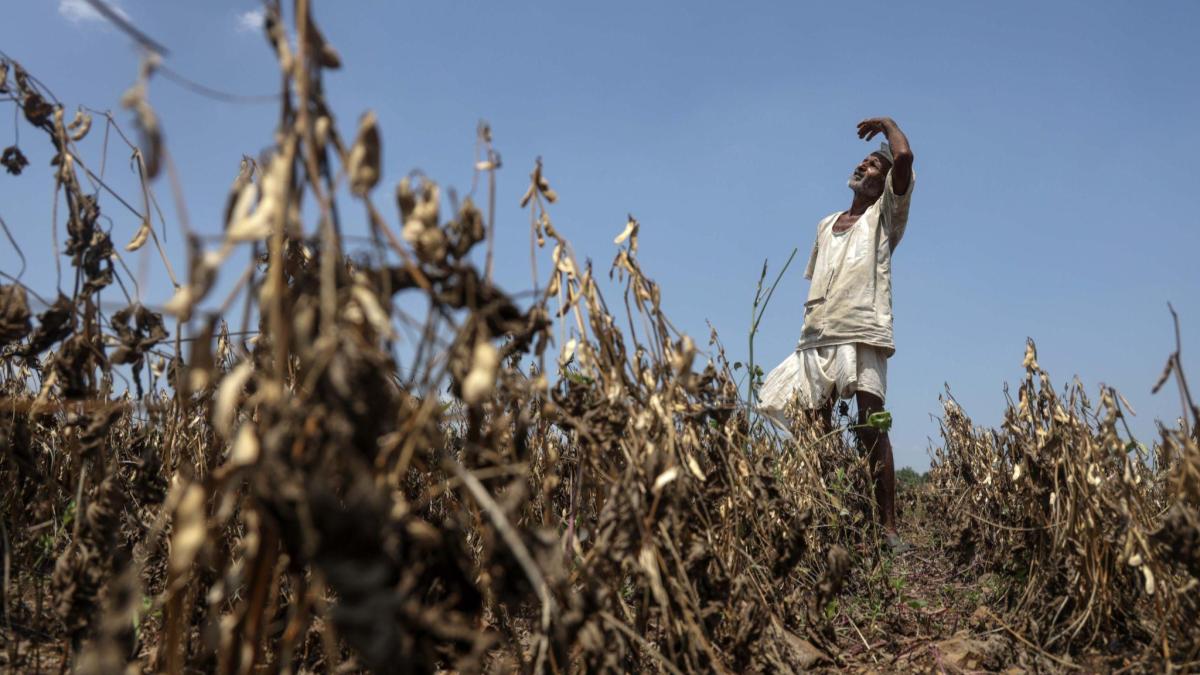
Drought across three states: What farmers have lost and what aid is coming
Farmers in drought-hit states face severe crop losses, cash shortages, and delayed government aid, threatening winter sowing and livelihoods as water scarcity worsens across regions.
Farmers in drought-hit states are confronting losses on their monsoon crops just as they need money for winter sowing. Governments have announced cash assistance and employment support, but recent reports show that some payments remain pending while families sell livestock or leave villages in search of work. The next season is already under pressure. In its October 23 bulletin, the India Meteorological Department advised farmers in North Interior Karnataka to sow only when adequate soil moisture becomes available and to prefer short-duration, drought-tolerant crops.
Maharashtra: Losses reach the household The damage is visible across Vidarbha and Marathwada. In Yavatmal, farmer Chitaman Vitthal Bhoyar told Indian Express that cultivation expenditure had reached about Rs 2.75 lakh, while expected crop income was only Rs 90,000. He expected soybean output of five quintals against 25 in a good year. Fodder shortages had also forced him to sell bullocks bought for Rs 70,000 for about Rs 40,000, IE reported on October 6.
Such sales reduce immediate expenses but also strip households of productive assets. In Beed, cotton farmer Mangesh Karpe told Down To Earth he had spent Rs 2.5 lakh cultivating 10 acres but expected no harvest. The September 28 DTE report quoted Ambesavali’s deputy sarpanch estimating that nearly half the village’s residents had migrated for work. These accounts show how drought spreads beyond crop earnings: farm labour disappears, debts remain unpaid and education expenses become harder to meet.
That was an early assessment, rather than a final statewide damage estimate. The state announced an input subsidy of Rs 2,500 per affected farmer, with Rs 1,250 crore proposed for the first phase, while seeking central assistance. Karnataka government’s September 10 memorandum requested Rs 3,705.30 crore for immediate relief, including crop-loss assistance, drinking water and livestock protection, according to IE.
Weather remains a constraint. The IMD’s October 23 bulletin forecasts dry conditions across North Interior Karnataka from October 25-27, following limited rainfall in some districts. Its advice to conserve moisture and irrigate groundnut and horticultural crops illustrates the competing demands on scarce water. Andhra Pradesh: Widespread crop stress Andhra Pradesh’s October 1 government order declared 388 mandals across 21 districts drought-affected, including 283 severely affected mandals.
The order reported a 53.4% rainfall deficit during June-August. In Rayalaseema, the pressure extends to orchards. The IE reported claims by opposition YSRCP leaders that mango and citrus plantations were withering and farmers were depending on tanker water to save them. For orchard growers, keeping trees alive involves spending even when returns are uncertain. The distinction matters economically as prolonged water shortages can threaten productive trees as well as a single season’s harvest.
Separately, the state agriculture department’s rabi seed dashboard recorded distribution to 45,259 farmers by October 15, involving Rs 19.63 crore in subsidies under its regular winter-crop programme. What assistance is reaching families? Maharashtra expanded its drought declaration to 305 of 358 tehsils and announced Rs 5,000 per farmer before Diwali. According to an Indian Express report, officials estimated the measure could cost Rs 6,000-7,000 crore, although eligibility and beneficiary numbers were not finalised.
The payment was announced as an advance against expected central assistance. But on October 19, the IE reported that guidelines were still pending. It also found two instalments of the separate NaMo Shetkari income-support scheme, worth Rs 4,000 per eligible farmer, remained unpaid. Employment support is another response. Maharashtra earmarked Rs 6,728 crore for rural employment and livelihoods. Citing state rural-development figures, DTE reported that households seeking employment-guarantee work increased from 4.02 lakh in July to 4.93 lakh in September.
An allocation, however, does not establish how many households have received work or wages. Some assistance has moved beyond announcements. As many as 2,40,365 students across 26 Maharashtra universities had used an examination-fee waiver for drought-affected areas. Mumbai University had also begun refunds. The winter crop test The immediate economic risk is that a failed monsoon harvest leaves farmers short of both cash and water for the next crop.
Cash advances can help meet urgent expenses; employment programmes can support households whose farm wages have disappeared. The government response will therefore be tested by delivery: when compensation reaches bank accounts, whether rural work produces timely wages and whether farmers have enough moisture to sow. Across 178 monitored reservoirs, storage rose from 129.870 billion cubic metres (BCM) to 130.980 BCM between September 3 and October 8.
Yet the shortfall against the corresponding ten-year average widened from 3.25 per cent to 12.92 per cent. In other words, water reserves increased slightly but did not build up as much as they normally would over that period. Storage also fell by 1.754 BCM between October 1 and October 8. On October 8, these reservoirs were 70.89 per cent full, compared with a ten-year norm of 81.41 per cent and 90.06 per cent a year earlier.
The south moved in the opposite direction to the modest national gain. Its storage fell from 31.718 BCM to 26.384 BCM over five weeks, leaving it 38.59 per cent below its ten-year norm. Eastern and central regional storage, meanwhile, remained above their corresponding averages.