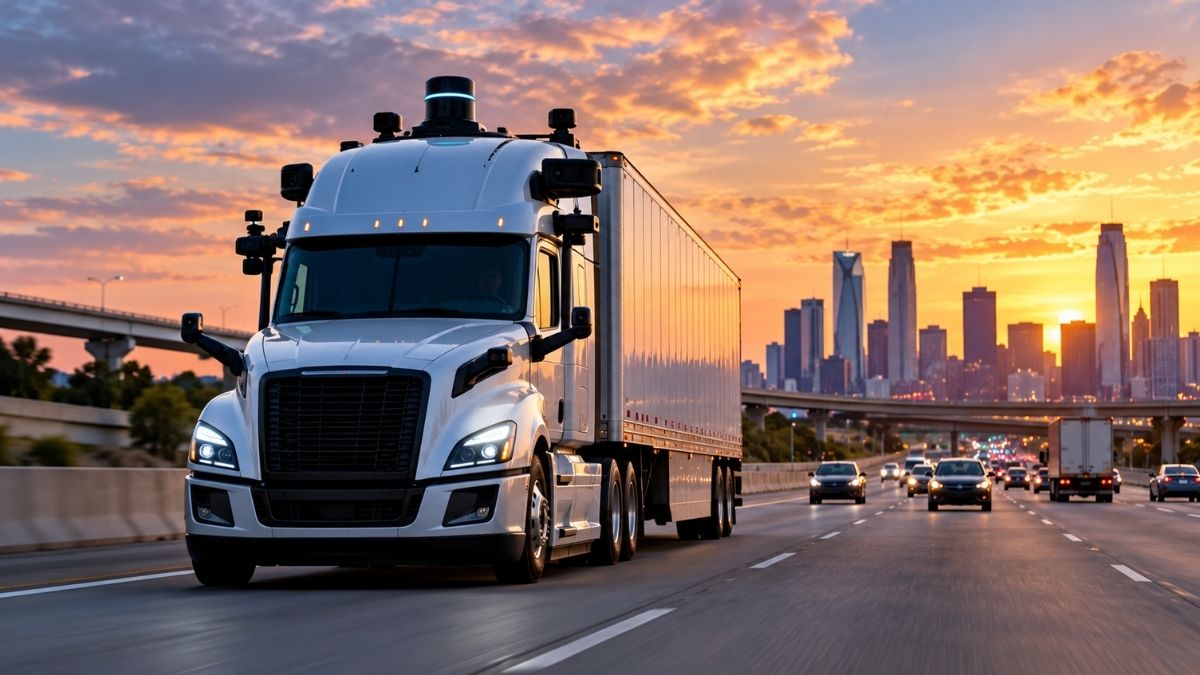
Driverless 18-wheelers are hitting US roads. Are they ready for every emergency?
Driverless trucks from companies such as Aurora Innovation are hauling freight on selected US highways. But expanding autonomous trucking will depend on safety, emergency-response procedures, regulatory requirements, operating costs and the potential impact on truck-driving jobs.
Driverless trucks have moved beyond testing on American highways, with companies such as Aurora Innovation hauling freight on public roads without a human driver behind the wheel. The next challenge is proving that the technology can operate safely, reliably and at a competitive cost across enough routes to transform the US trucking industry. Autonomous 18-wheelers are operating along major freight corridors in Texas, including Interstate 45 between Dallas and Houston, reported Wall Street Journal.
In one example, a driverless truck allowed cars to merge, while another changed lanes to give a truck stopped on the shoulder more room. The trucks did not honk because they cannot sound their horns autonomously. The vehicles use cameras, sensors and onboard computing systems to identify other road users, interpret traffic conditions and respond to hazards. But replacing a human driver requires more than keeping a truck in its lane.
The technology must also handle unexpected events, mechanical failures and emergencies while complying with safety regulations. How far have driverless trucks come in US? Aurora Innovation is among the companies working to bring autonomous trucking into commercial use. Its Aurora Driver automated driving system is designed to control trucks without a human driver inside the vehicle during driverless operations.
In an October 8, newsroom post titled “Driving the Inflection”, Aurora said it had completed more than 500,000 driverless miles since its commercial launch. The company also aims to have more than 30,000 Aurora Driver-powered trucks on the road by 2030. We're operating one, hauling freight for customers on public roads every day.” The statement shows the company’s position that autonomous trucking has progressed from development to commercial operations.
However, the mileage figure and 2030 fleet target are company-reported figures, and the expansion goal is not a guaranteed outcome. The Wall Street Journal reported that Aurora planned to increase its fleet from 30 trucks to 200 by the end of 2026. It also reported that companies including Volvo Autonomous Solutions and Waabi were testing or deploying autonomous heavy trucks in Texas, Oklahoma and other southern states.
For now, operations are concentrated on defined routes and freight corridors. Interstate 45, which connects Dallas and Houston, is one such route. Operating on established corridors allows companies to gain experience with real freight movements, road conditions and customer requirements. Infographic generated using AI Aurora’s technology uses a perception system to identify vehicles and potential hazards.
The Wall Street Journal reported that the system can respond to changing conditions around the truck and anticipate potential dangers rather than relying solely on sudden braking. These capabilities are important because fully loaded trucks are large and heavy, with longer stopping distances than passenger cars. Their automated systems must detect hazards early, maintain sufficient space and account for other vehicles entering or leaving the highway.
Autonomous trucks could offer freight companies several operational benefits. Vehicles that operate without a driver inside may spend more time moving freight and less time waiting for a driver to rest. Companies also expect the technology to reduce some driver-related costs and make deliveries more predictable. Companies expect autonomous trucks to become cost-competitive with conventional trucking by 2028, reported Wall Street Journal.
This remains an industry expectation rather than a confirmed outcome. The economics will depend on technology costs, fleet utilisation, maintenance, insurance, freight demand and the expense of supporting driverless operations. Autonomous trucks could also help freight companies address driver shortages. However, the extent of that benefit will depend on how quickly the technology expands beyond selected routes and operating conditions.
What are the limits of replacing human truck drivers? Completing a route without a driver is an important technological milestone, but it does not establish that a truck can operate on every highway, in all weather conditions or during every emergency. Human drivers can interpret instructions from police officers, communicate with other motorists, inspect vehicles and respond to unusual situations.
Autonomous systems must be designed and tested to manage these tasks within their approved operating conditions. When an event falls outside those conditions, the vehicle needs a safe way to respond. The operating environment also matters. A system that performs well on a mapped freight corridor may face different challenges on unfamiliar roads, at complex construction sites or amid changing traffic patterns.
The information cited about Aurora does not establish that its trucks can handle every road and weather condition across the United States. Breakdowns present another challenge. If a driverless truck stops on a highway shoulder, other motorists and emergency responders need to know how to approach it. A human driver can place warning devices around a stopped vehicle, but an autonomous truck needs an alternative procedure for situations in which no driver is present.
In a notice published in October 2026, the agency granted a limited five-year exemption, effective from October 7, 2026, through October 7, 2031. The exemption allows Aurora and other motor carriers operating Level 4 automated-driving-system-equipped commercial vehicles, after notifying FMCSA, to use warning beacons mounted on the truck cab instead of certain traditional warning devices. It covers specified requirements relating to warning-device placement, steady-burning lamps and the types and number of warning devices.
FMCSA said it determined that the exemption would likely achieve a level of safety equivalent to or greater than that provided by existing rules. However, the decision applies only to the specified warning-device requirements. It is not a blanket exemption from trucking safety rules or a general federal endorsement of all aspects of autonomous truck operations. The exemption illustrates how regulations may need to adapt to vehicles without a human driver to perform traditional tasks.
It also highlights the practical challenges of autonomous trucking: vehicles must not only navigate highways but also respond safely when they stop or encounter problems. Texas has its own legal framework for autonomous vehicles. Under the state’s rules, companies transporting goods commercially on public roads without a human driver must obtain the required authorisation and provide an emergency-response plan.
The plan must explain how police, firefighters, ambulance crews and other emergency responders can contact the vehicle’s support team, remove it safely from the road and arrange towing. The rules also require autonomous vehicles to meet applicable legal and safety requirements and reach a minimal-risk condition if a system failure prevents them from performing their driving task. These provisions address what happens when an automated system cannot continue operating as intended.
Will driverless trucks affect jobs? Employment is another concern as autonomous trucking expands. Companies argue that the technology could lower operating costs and improve freight efficiency, while truck drivers and their representatives have raised concerns about job losses and the pace of deployment. The Wall Street Journal reported concerns from the Teamsters union and the Owner-Operator Independent Drivers Association about potential employment losses and regulatory oversight.
The scale of any impact will depend on how quickly driverless trucks expand, which routes they can serve and how trucking companies adapt their operations. Infographic generated using AI The technology could also change the types of jobs required across freight transport. Even without a driver in the cab, companies need people to maintain vehicles, manage fleets, coordinate deliveries and support operations.
However, the available sources do not establish how many conventional driving jobs autonomous trucks will replace or how many new jobs they may create. Safety remains central to whether the technology can expand. Aurora chief executive Chris Urmson told the Wall Street Journal: “It's our job to continue to operate safely and build trust.” Building that trust will require more than successfully completing planned journeys.
Customers, regulators and the public will want evidence that autonomous trucks can handle hazards, respond to failures and operate safely around human drivers. Clear rules on responsibility when an incident occurs will also matter. For now, driverless trucks have begun commercial freight operations on selected US routes, but the available evidence does not show that they can replace human drivers across the entire highway network.
Aurora’s reported mileage demonstrates progress, while its 2030 fleet target indicates the scale it hopes to achieve. Neither establishes that the technology has resolved every operational, safety, regulatory or employment challenge. The more likely path is gradual expansion rather than an immediate shift to driverless trucks across the country. Whether autonomous vehicles become a major part of US freight transport will depend on their ability to demonstrate safety, handle difficult situations, meet regulatory requirements and deliver reliable service at a competitive cost.