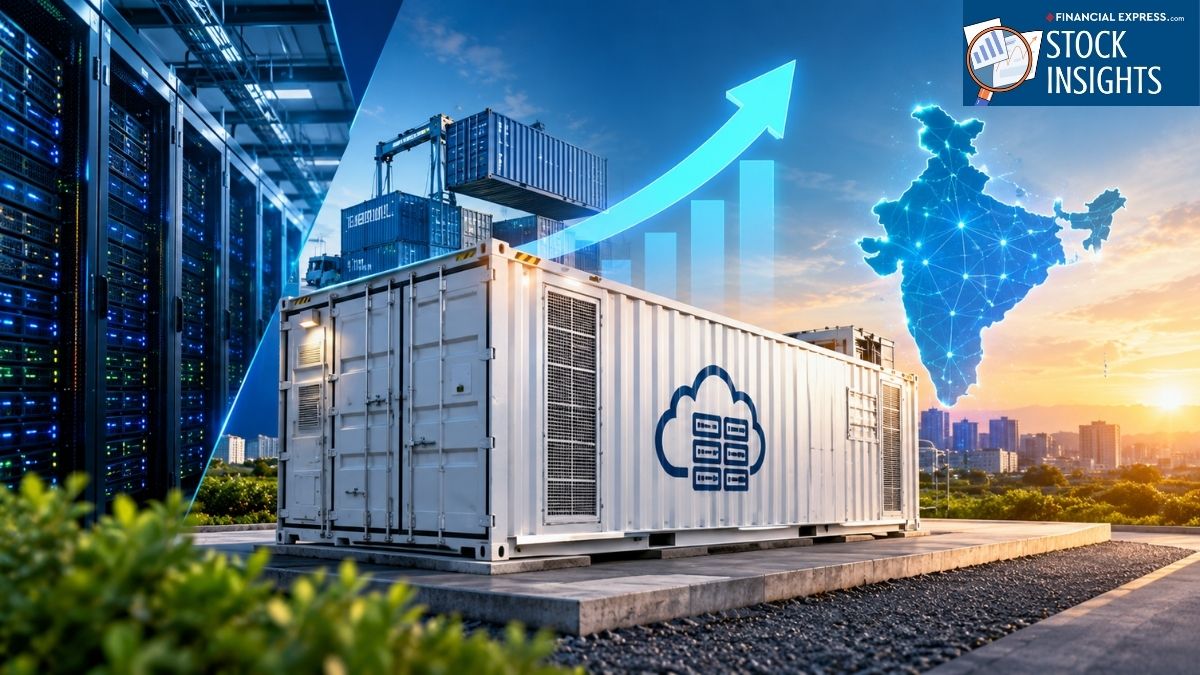
‘Data centre in a container’: The multibillion-dollar opportunity and 2 stocks to watch
India’s modular data centre market could grow from US$1.22 billion in 2025 to US$3.71 billion by 2034, but can emerging players turn this opportunity into measurable earnings?
A containerised data centre is a portable computing facility built inside a standard or customised steel container, with servers, power distribution, cooling systems and network equipment integrated into a ready-to-deploy unit. They enable companies to increase computing capacity at a much faster pace than traditional facilities that require major on-site construction, particularly in remote locations, industrial sites, telecom networks and areas with limited infrastructure.
The opportunity is expanding alongside digital infrastructure requirements of India. According to IMARC Group estimates, the broader modular data centre market in India was US$1.22 billion in 2025, with a projected value of US$3.71 billion by 2034, representing a compound annual growth rate (CAGR) of 12.74% during 2026–2034. The global containerised data centre market is estimated at US$18.3 billion in 2026, with Grand View Research forecasting growth to US$62.4 billion by 2033, at a CAGR of 19.2%.
Forty-foot containers accounted for 49.4% of global market revenue in 2025, reflecting demand for larger, integrated computing modules. FE Stock Insights on WhatsApPGet instant alerts on high-conviction investment themes and fundamental deep dives—direct from Financial Express.Join now As India's data centre capacity expands, the key question is which listed businesses can convert demand for prefabricated infrastructure into actual orders and revenue.
This brings Belding India and Dynacons Systems & Solutions into focus. #1 Belding India: Building Modular Data Centres Beyond Conventional Construction Belding India Ltd, formerly Synthiko Foils Ltd, is expanding beyond its legacy manufacturing business into engineering, manufacturing, energy storage and digital infrastructure. Its wholly owned subsidiary, DC&T Global Private Limited, lists prefabricated modular data centres, turnkey data centre engineering, procurement and construction (EPC), edge infrastructure, industrial EPC and battery energy storage systems (BESS) among its offerings.
Unlike conventional facilities built predominantly on-site, physical modular data centres can integrate server space, electrical systems, cooling and related infrastructure into prefabricated units. The North American Partnership: A Route to Market, Not Yet a Revenue Guarantee On 19 September 2026, Belding announced a strategic partnership with a United States-based technology distribution and original equipment manufacturer (OEM) supply partner covering the US, Canada and Mexico.
Under the announced arrangement, the partner is expected to market, distribute, integrate and support Belding's modular data centre systems. The portfolio includes complete modular solutions, controls, components, spare parts and accessories, potentially supplied under Belding's own brand or through OEM and original design manufacturer (ODM) arrangements. The arrangement could give Belding access to overseas customers without requiring it to establish an entirely new distribution network.
The Defence Demonstration That Still Needs A Commercial Follow-Through DC&T Global has also showcased a containerised, modular and vehicle-mounted edge data centre at its facility in Khed, near Pune, to a delegation from the Armed Forces. The proposed use case is secure, low-latency data processing in locations where permanent computing infrastructure may be difficult to establish. A mobile unit could support mission-sensitive applications by bringing computing closer to where information is generated, rather than depending entirely on a distant central facility.
The demonstration establishes that the company has presented a product for a potential defence use case. The 4 MW Project: Capacity Is Not the Same as Completed Business DC&T Global also highlights a project involving the conversion of a leased shell into a carrier-neutral, 4 MW, Tier-ready data centre facility. A carrier-neutral facility is designed to support connectivity from multiple telecommunications providers.
In contrast, a Tier-ready description represents a design standard to be achieved, but not necessarily a certification or operational performance. 87 lakh and standalone net loss was ₹18.21 lakh. Standalone loss narrowed to ₹25.72 lakh in Q4 FY26; a decline of around 29.2% quarter-on-quarter. However, the consolidated net loss was equivalent to about 153.4% of consolidated total income. The comparison with earlier periods is also affected by the discontinuation of the legacy foils manufacturing operations.
These figures provide a broad financial baseline, but they do not isolate the performance of the modular data centre business. The Stock Market's Verdict Source: Screener.in Belding's share price closed at ₹951.30 on 16 October 2026. The stock was down approximately 45.15% year-to-date and 30.98% over six months on the Bombay Stock Exchange (BSE). It began trading on the National Stock Exchange (NSE) on 12 October 2026.
For readers assessing its data centre opportunity, the key consideration is the gap between Belding's expansion plans and its reported financial performance. The North American partnership, defence demonstration and 4 MW data centre project provide evidence of its intended business direction, but the financial figures do not yet establish how much revenue or profit these activities contribute. Until the company reports measurable commercial progress, it is difficult to assess the financial value of these initiatives #2 Dynacons Systems & Solutions: The Data Centre Infrastructure Play Dynacons Systems & Solutions Ltd is an information technology (IT) systems integrator that supplies and supports enterprise computing infrastructure.
It covers data centre solutions, system integration, networking, project execution and managed services. The company's data centre exposure includes servers, storage, private-cloud infrastructure, software, implementation and ongoing technical support. RBI's ₹750.82 Crore Contract: A Major Infrastructure Assignment On 4 May 2026, Dynacons disclosed an order worth ₹750.82 crore from the Reserve Bank of India (RBI) for private-cloud infrastructure at RBI data centres.
The five-year project covers servers, unified storage, storage-area-network switches, physical racks, software licences, integration, maintenance and facilities-management services. The infrastructure is intended to support RBI's next-generation data centre in Bhubaneswar, Odisha. However, the project should not be described as a physical containerised data centre contract. The disclosed scope concerns private-cloud infrastructure and related equipment and services.
Central Bank Of India: Where The Word Containerisation Can Mislead On 8 June 2026, Dynacons announced a ₹125.88 crore contract from Central Bank of India for private-cloud expansion, an on-premises containerisation platform and servers based on NVIDIA H200 Blackwell graphics processing units (GPUs). The five-year project includes GPU-enabled computing, application deployment, integration, maintenance and lifecycle support.
Here, containerisation refers to packaging software applications so they can run consistently across computing environments. It is different from placing servers, electrical distribution and cooling equipment inside a physical transportable container. NPCI's ₹267.58 Crore Order: Equipment Supply With A Long Service Tail On 28 July 2026, Dynacons disclosed a ₹267.58 crore contract from the National Payments Corporation of India (NPCI) for data centre augmentation using enterprise server infrastructure.
The scope includes installation, testing, commissioning, round-the-clock support and a seven-year warranty and support commitment. The service component matters because the contract extends beyond the initial supply and installation of equipment. However, the full contract value should not be treated as immediate revenue or profit. Execution schedules, delivery milestones, support obligations and revenue-recognition terms determine when the economic benefit appears in the accounts.
Order Book Growth Versus Debt And Delivery Requirements Dynacons reported an order book of ₹2,964 crore as of 30 May 2026, compared with ₹2,230 crore at the end of March 2026. That represents an increase of approximately 32.9%. The expanding order book provides a measure of contracted work, but it should not be confused with revenue already earned, cash collected or profit generated. Hardware procurement, installation and multi-year support can create different cash-flow patterns across individual projects.
Net debt rose from ₹17 crore by 31 March 2025 to ₹68 crore by 31 March 2026, an increase of ₹51 crore, or 300%. Its reported net debt-to-equity ratio was 0.2 times. Management linked the higher debt to investments in infrastructure and delivery capabilities, including property, plant and equipment. The company also has device-as-a-service and core-banking-as-a-service arrangements involving right-of-use assets and corresponding lease liabilities.
These obligations matter when assessing its wider financial commitments. Dynacons' revenue from operations declined 22.05% quarter-on-quarter and 4.61% year-on-year to ₹313.69 crore. Net profit increased to ₹19.80 crore, up 4.24% Qo-Q and 0.77% YoY. Big Contracts, Modest Stock Returns: What Is the Market Pricing In? Source: Screener.in The stock closed at ₹1,032.85 on the NSE on 16 October 2026. In terms of price performance, the stock fell about 3% over the last six months.
Its one-year return stood at 9.45%, with a price-to-earnings (P/E) ratio of 15.2. For readers evaluating Dynacons’ exposure to India’s data centre expansion, the key question is whether its growing order book can be converted into consistent topline, sustainable bottomline and cash generation. The stock's future performance will depend not simply on the value of contracts won, but on how effectively the company executes them.
Wood Mackenzie’s July 2026 outlook said that one of the key constraints on the expansion of data centres in India is reliable and cost-competitive electricity. Its forecast predicts data centre electricity demand will increase to 191 terawatt hours by 2040 from 10 terawatt hours in 2025. Specialised servers, power-management equipment, cooling systems and control components may involve overseas suppliers.
Dependence on these parts can expose projects to longer lead times, currency movements and replacement-part availability. Delays can affect installation schedules and the timing of customer payments, while unplanned procurement costs can put pressure on project economics. The Real Test Begins After the Announcement For investors, the most important distinction is between a promising business opportunity and a business that can consistently convert it into earnings.
Belding India has a more direct link to physical modular data centres, but its overseas partnership, defence demonstration and project descriptions still need to translate into measurable commercial activity. Dynacons offers a different investment case. Its disclosed contracts provide evidence of demand for enterprise computing infrastructure, but investors should track execution, cash collection, working-capital requirements and debt alongside order-book growth.
Large contracts can strengthen revenue visibility without guaranteeing strong margins or immediate cash inflows. The key question is not which company has the bigger data centre story, but which can deliver profitable growth without stretching its balance sheet. Until disclosures establish the financial contribution of these opportunities, investors should distinguish business potential from proven performance.
It may be a good idea to add these stocks to your watchlist and keep track to see how they perform in time to come. Disclaimer Note: We have relied on data from www.Screener.in throughout this article. Only in cases where the data was not available, have we used an alternate, but widely used and accepted source of information. The purpose of this article is only to share interesting charts, data points and thought-provoking opinions.
It is NOT a recommendation. If you wish to consider an investment, you are strongly advised to consult your advisor. This article is strictly for educative purposes only. Rishabh Sinha is a seasoned financial content creator with over 10 years of experience in BFSI domain. His portfolio spans over 20 of India’s most trusted financial brands. Rishabh brings depth, structure, and a reader-first approach to every piece he crafts.
Disclosure: The writer and his dependents do not hold the stocks discussed in this article. The website managers, its employee(s), and contributors/writers/authors of articles have or may have an outstanding buy or sell position or holding in the securities, options on securities or other related investments of issuers and/or companies discussed therein. The content of the articles and the interpretation of data are solely the personal views of the contributors/ writers Investors must make their own investment decisions based on their specific objectives, resources and only after consulting such independent advisors as may be necessary.