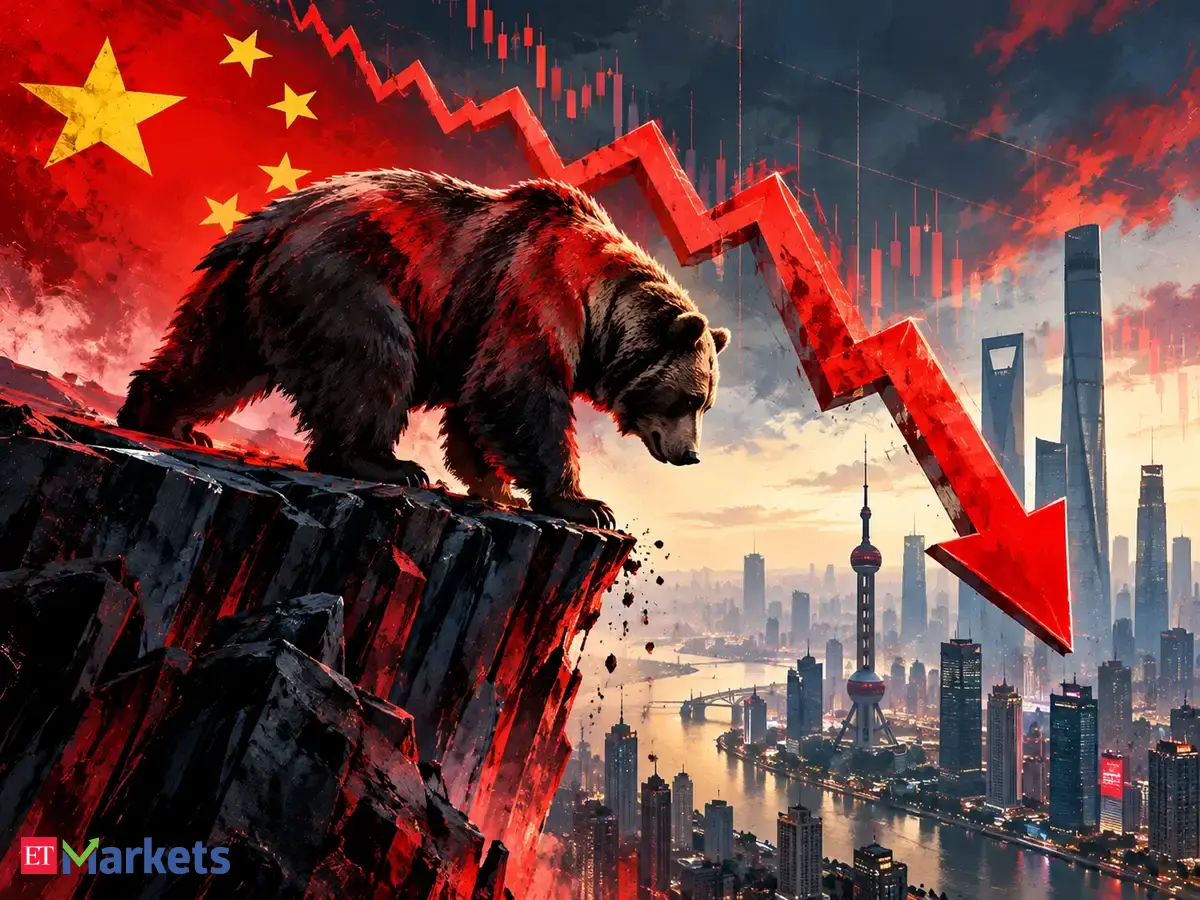
Chinese stock market enters bear territory! CSI 300 index crashes 20% from June peak
Chinas CSI 300 index entered bear market territory on Thursday, falling 20% from its June peak amid concerns over taxation policies, slowing economic growth and weak corporate earnings. Geopolitical uncertainty and fears of an artificial intelligence bubble have added to investor anxiety, though some analysts expect a potential rebound in 2027.
China’s mainland-listed shares entered the infamous, technical 'bear' market on Thursday, as the country’s benchmark CSI 300 index dropped 20% from its June peak.The index tracks the 300 largest stocks listed on China’s Shanghai and Shenzhen exchanges. It has declined for 10 consecutive weeks, losing nearly 3% so far this week. On Thursday, the index fell more than 1%.US MarketsPowered ByAs on 22 Oct 2026, 01:30 AM ISTS&P 500 Top GainersSuper Micro Computer35.57(9.55%)Charles River344.87(9.33%)Datadog273.09(6.50%)Dell Technologies485.88(5.27%)Gainers»S&P 500 Top LosersCoterra Energy32.56(-8.62%)AT&T21.91(-6.45%)DexCom80.26(-6.39%)Netflix65.04(-5.31%)Losers»Why is China's stock market crashing?Beijing set October 22 as the deadline for wealthy individuals to declare and pay offshore trust income, which may have prompted some to offload stocks to collect cash, Reuters reported earlier.
"Rather than seeking to boost near-term growth, the government's focus remains on technological advancement, industrial upgrading and greater self-sufficiency," Reuters cited Sophie Altermatt, an economist at Julius Baer, as saying.Additionally, more restrictive taxation policies have also put pressure on stocks in the near-term, the report cited market participants as saying. Meanwhile, the world’s second-largest economy posted its slowest growth in over three years in the second quarter, pressured by a multiyear slowdown in the property sector and extended weakness in consumer demand, further dampening sentiment on the market.
Slow earnings growth is also spooking investors. He further said that the country’s large base of retail investors could also exacerbate market volatility.Can Chinese stock market rebound?However, Rein noted the sell-off has been excessive, pointing to resilient exports and signs of a recovery in property prices in China’s largest cities. “It is a crisis of confidence right now, not a crisis in the economy,” the analyst told CNBC, predicting a strong rebound in Chinese equities in 2027.AI bubble worries have been spooking investors not only on China but Korea’s Kospi as well, which has already visited the bear market multiple times this year.
Michael Burry, popularly known as the ‘Big Short’ investor and famous for correctly predicting the 2008 housing bubble, suggested the bubble around artificial intelligence frenzy bubble could pop even before what he previously expected.Michael Burry cited recent research from Ares Management that said it would take only a season in which AI revenue disappoints the massive capital expenditure that hyperscalers are putting behind it.
“In that scenario, a handful of boards, predisposed to redeploy capital toward the highest-conviction bet, would simply need to conclude that the highest-conviction bet has shifted,” the report said. Michael Burry believes it would take only one season of revenue disappointmentThis comes after Burry said in August that the AI crash could begin from 2028. However, his latest comments imply that he expects this to happen sooner.
Recently, he said the President Donald Trump-led US administration cannot afford to let the AI boom fail. He explained that AI infrastructure buildout has become a critical support for the US economy, keeping very little room for the Trump administration to let the ongoing AI boom weaken, Stockwits reported. Notably, Burry has been shorting AI-linked stocks and warning investors of a sharp selloff ahead.Disclaimer: This article has been written by Debaroti Adhikary, who is not a SEBI-registered Research Analyst or an Investment Adviser.
Debaroti Adhikary and his/her ‘relative(s)’ (as defined under Section 2(77) of the Companies Act, 2013) do not hold any financial interest in the companies mentioned in this article as of the date of publication. The views/recommendations mentioned in this article, wherever applicable, are those of the respective SEBI-registered Research Analyst/brokerage and have been reproduced/reported with due attribution.
They should not be construed as the views or recommendations of The Economic Times Digital or the journalist. Readers are advised to consider the original research report and make their investment decisions based on their own assessment. Brokerage disclaimers here.(You can now subscribe to our ETMarkets WhatsApp channel)