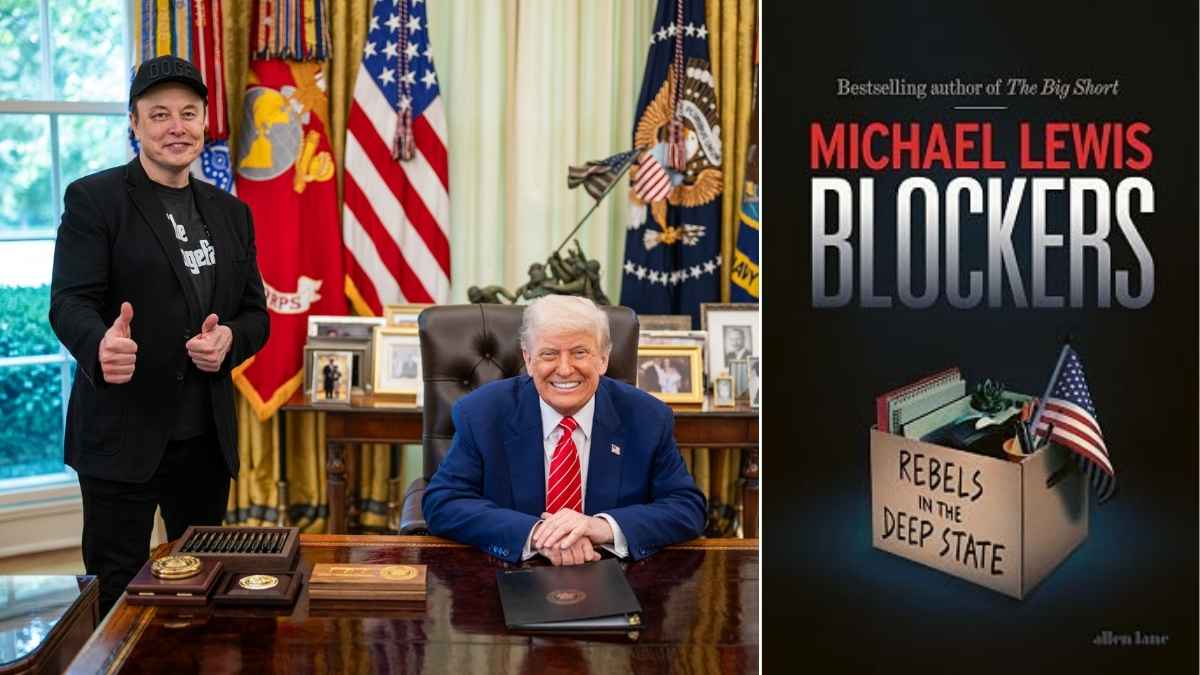
The myth of the difficult public servant: Michael Lewis takes on DOGE in his new book, revealing the human cost of ideological demolition
Kathleen Walters had spent two decades at the US internal revenue service doing work that rarely attracts public attention. As a privacy officer, she understood the obligations attached to confidential taxpayer information. Then came Gavin Kliger, a young operative associated with Elon Musk’s Department of Government Efficiency (DOGE), demanding access to information Walters believed could not lawfully be handed over.
Her refusal earned her a new designation — a ‘blocker’, someone standing in the way of progress. In Washington under Donald Trump, a professional obligation had become an act of defiance. This is the sort of encounter Michael Lewis knows how to turn into a story. In Blockers: Rebels in the Deep State, he follows the public servants who found themselves on the wrong side of an administration determined to remake the American state.
Lewis has built a formidable reputation by making complicated subjects accessible without stripping them of their complexity. In Moneyball, he transformed baseball statistics into a story about institutional resistance. In The Big Short, he made the arcane machinery of financial markets compelling. The distinction between the two books is significant. The earlier concern was indifference to the state.
This time, Lewis describes a more purposeful effort to dismantle parts of it, conducted in the name of eliminating waste, fraud and abuse. Musk promised to cut $2 trillion in federal spending, an ambition rooted in a legitimate question about government efficiency. The trouble, as Lewis portrays it, was how that ambition unfolded. Staffed largely by young tech enthusiasts with limited experience of public administration, DOGE’s operatives arrived with extraordinary confidence in their methods and little patience for institutional caution.
What began as a potentially necessary exercise in reform increasingly acquired the character of a power play, with cowboy tactics and technological bravado substituting for institutional understanding. In Lewis’s account, DOGE’s defining failure was to mistake public service for obstruction, risking the destruction of expertise that made the government work in the first place. One episode captures the problem with uncomfortable clarity.
At the US Institute of Peace, DOGE highlighted a $675,000 payment for private aviation services as evidence of waste. The expenditure was, in fact, for an emergency charter flight that evacuated more than 200 Afghan staff members and their families as Kabul fell to the Taliban in 2021. Another payment, of $132,000, was associated with a former Taliban member. The individual had become a valuable source of intelligence for the United States.
Publicising the payment exposed the connection, putting his relatives in Afghanistan at risk. Expenditure that looked indefensible in a spreadsheet had a very different meaning when its purpose was understood. The episode raises a question that runs through the book: What happens when those empowered to judge government spending do not understand what the government does? Lewis’s answer emerges through the people caught in the upheaval.
Alexander Maranghides, a fire protection engineer at the National Institute of Standards and Technology, represents the accumulated expertise behind public safety research. Walters represents the legal and ethical safeguards that protect sensitive information. Others worked in agencies whose functions were invisible to most citizens until a crisis made them indispensable. Their stories give the book its emotional force because the stakes are rarely confined to a job or a department.
The people being removed carry knowledge, relationships and experience that cannot be recreated simply by appointing someone younger, cheaper or more enthusiastic. The most revealing character may be Sahil Lavingia, a software entrepreneur who joined DOGE expecting to find easy opportunities to improve government. At the Department of Veterans Affairs, he encountered employees who were committed to serving former soldiers, often with limited resources.
When he publicly acknowledged that the government worked better than he had expected, his observation proved incompatible with DOGE’s governing narrative. He was dismissed. Later, he returned to work on improving the IRS’s technology systems, suggesting that the ambition to make government more effective need not be incompatible with respect for its employees. To call someone a blocker is to prejudge the value of the resistance.
The person asking for evidence becomes an obstacle, the official protecting confidential data becomes a defender of bureaucracy, and the expert warning of consequences becomes an enemy of innovation. This vocabulary makes it easier to bypass questions that any serious reform programme should welcome. It also allows those in power to present compliance as competence and speed as proof of achievement.
Governments do accumulate waste, outdated technology, cumbersome procedures and employees who have ceased to perform effectively. Public institutions must be open to scrutiny, and career officials cannot claim immunity simply because they possess experience. A reformer who questions established practice may be doing the public a service. The difficulty lies in distinguishing that challenge from an ideological determination to weaken the institution itself.
Lewis is an exceptional reporter of individuals, and his civil servants in this book emerge with greater texture than the people seeking to displace them. The motivations of the latter, whether ideological conviction, opportunism, technological hubris or simple careerism, deserve equally sustained examination. Genuine reformers have legitimate reasons to challenge government complacency. By making the case against DOGE so forcefully, Lewis risks leaving insufficient room to distinguish the necessary challenge to bureaucracy from the destructive impulse to discredit expertise altogether.
Musk may have brought the spectacle, but Russell Vought, the architect behind much of Project 2025, represents the more consequential force, quietly and systematically, reshaping the state while staying out of the spotlight. Lewis’s account of Francis Collins, the scientist who helped advance a life-extending treatment for cystic fibrosis, is particularly telling. Collins was eventually forced out of the National Institutes of Health amid the administration’s changes.
The irony is striking: Vought’s own daughter has cystic fibrosis. Lewis leaves us confronting an uncomfortable truth about ideology and power: even personal proximity to human suffering may not temper the determination to pursue an ideological mission. When those responsible for reform begin treating every constraint as obstruction, who remains to warn them that they are destroying something worth preserving?
Lewis could have gone deeper into the DOGE tribe itself, whose motivations range from Musk’s socially awkward young coders and opportunistic bureaucrats to more eccentric figures in Trump’s administration. Their personal journeys, convictions and contradictions deserves greater understanding. What drives people to participate in an exercise that can dismantle institutions they barely understand remains an intriguing, underexplored question.
Probably that might be his next book. Srinath Sridharan is an author & corporate adviser Blockers: Rebels in the Deep State Michael Lewis Penguin Random House Pp 256, Rs 1,499