Ashish Kacholia’s Rs 51 cr IPO stake, Sunil Singhania’s Rs 250 cr auto play: Latest moves
Ashish Kacholia bought into a heart-stent maker before it listed and is already sitting on a 35% gain over the IPO price. Sunil Singhania's fund has been quietly buying a truck-brake maker that now trades 31% below its 52-week high. Two fresh names, two opposite moods, and very different questions for anyone tempted to follow them in.
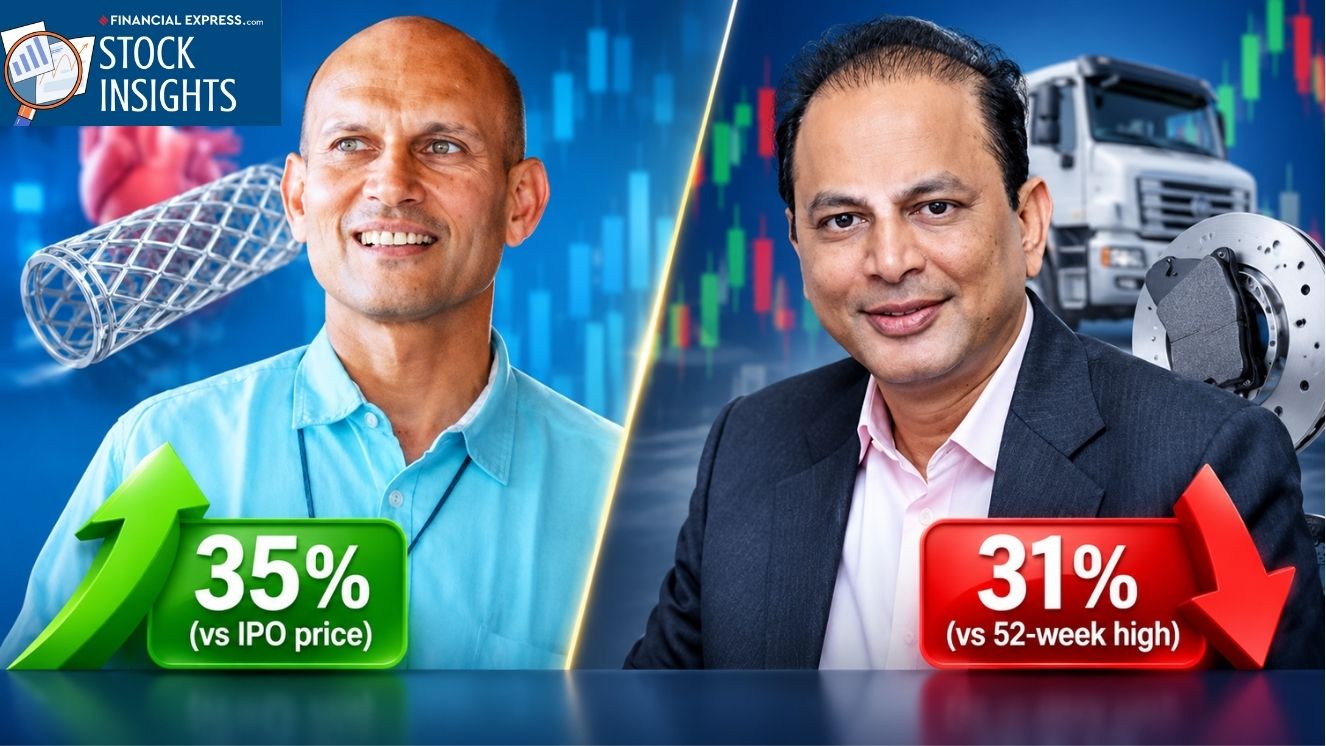
One Hot IPO, One Cold Auto Stock The latest shareholding filings reveal two distinct additions for anyone who tracks India's super investors. Ashish Kacholia shows up with a 1.08% stake in a Medical Technologies company, Sunil Singhania's Abakkus Small Cap Fund shows up with 1.05% in a company that is into Commercial Vehicle Control Systems India. Neither stake was bought the way most people picture it.
Kacholia came in before the former’s IPO and his name surfaced only because the stock listed on 23rd October 2026. Singhania's fund has owned the latter since its very first portfolio and simply crossed the 1% disclosure line in the September quarter. They now sit at opposite ends of the mood scale. The former is 35% above its IPO price in its first week. The second trades 31% below its 52-week high and barely 3% above its low.
One makes devices that keep blocked arteries open. The other makes the brakes that stop loaded trucks. #1 Sahajanand Medical Technologies (SMT): Kacholia's Pre-IPO Heart Stent Bet Is Up 35% Incorporated in 2001 in Gujarat by the Kotadia family, Sahajanand Medical Technologies makes devices for the heart. Its core product is the drug-coated stent, the tiny mesh tube pushed into a clogged artery. It also makes heart valves and occluders, and its products were sold in 77 countries in FY26.
Its market cap is Rs 4,703 cr. FE Stock Insights on WhatsApPGet instant alerts on high-conviction investment themes and fundamental deep dives—direct from Financial Express.Join now A Five-Year Wait and a Valuation That Barely Moved SMT filed for a Rs 1,500 cr IPO in 2021 and shelved it. In October 2024, Cipla and Alkem were reported to be eyeing a controlling stake at Rs 3,500 cr to Rs 4,000 cr. That never happened either.
The IPO that finally came was smaller. It was a Rs 475 cr offer for sale priced at Rs 327 to Rs 344, valuing SMT at roughly Rs 3,500 cr. Not a single rupee went to the company. It went to the sellers, led by private equity investor Samara Capital, which sold close to 65 lakh shares. Institutions bid 34.7 times the shares reserved for them. Retail investors bid just 3 times. Kacholia joined a pre-IPO round at about the same valuation.
The offer document shows he held 10,95,890 shares and was not a seller. At the closing price of Rs 463 on 30th October 2026, that stake is worth around Rs 51 cr. On listing day, Invesco Mutual Fund bought about 36 lakh shares in bulk deals at Rs 371 to Rs 375 each. International Sales and The Fundamental Growth Disconnect SMT is an Indian stent maker that earns most of its money outside India. As per its red herring prospectus, nearly three-fourths of FY26 revenue came from overseas, with Europe as its largest market.
The likely reason is price control. Drug-eluting stents in India sell under a government price ceiling. That cap does not apply to what it sells overseas. Let us look at the financials closely. Financial YearFY21FY22FY23FY24FY25FY265Y CAGRSales (Rs cr)589690NA9021,0251,21015%EBITDA (Rs cr)4948NA11012917128%Net Profit (Rs cr)-72-49NA-72569NM Source: Screener.in NA: FY23 is not part of the consolidated series.
NM: not meaningful. A profit growth rate means little here, since the company lost money in three of the five years shown. The real change is in margins, up from 8% in FY21 to 14% in FY26. Sales grew 18% in FY26 to Rs 1,210 cr, and net profit rose to Rs 69 cr from Rs 25 cr. In the June 2026 quarter, sales were Rs 352 cr and net profit was Rs 15 cr. Valuation: 72x Earnings for a Week-Old Stock The share price of Sahajanand Medical Technologies closed its first day on the NSE at Rs 377.65.
Within a week it touched Rs 566, 65% above the IPO price. As of closing on 30th October 2026, it was Rs 463. That is still 35% above the issue price, but 18% below the peak. The stock trades at a PE of about 72x, double the current industry median of 36x. Its 10-year median PE is also 72x, but that covers just six trading sessions. The industry median for the same period is 35x. The GST Summons That Arrived on Listing Day On 23rd October 2026, the very day the stock listed, SMT received summons from the GST intelligence wing in Mumbai, as per its filing with BSE.
Officers want to check its books and clinical trial reimbursements. A summons is not a penalty, but nobody wanted it in week one. Inventory days stood at 384 in FY26, so stock sits on the shelf for over a year. Borrowings were Rs 306 cr in March 2026, and return on equity has averaged just 4% over three years. The first test comes on 5th November 2026, when the board meets to approve SMT's first results as a listed company. #2 ZF Commercial Vehicle Control Systems: Why Singhania Kept Buying a Falling Auto Stock Incorporated in 2004, ZF Commercial Vehicle Control Systems India took over the brakes business of the TVS group's Sundaram-Clayton.
WABCO took control in 2009, and Germany's ZF inherited it when it bought WABCO worldwide in 2020. The Chennai company makes air brakes, electronic braking systems and compressors for trucks, buses, off-road and defence vehicles. It has a market cap of Rs 23,916 cr. A Top Holding Since Day One of Abakkus Small Cap Fund The Abakkus Small Cap Fund put out its first portfolio in April 2026, and ZF was already its third-largest holding.
The stock has slid since. The fund kept adding, enough to cross 1% of the company. The September 2026 filing lists it with 11,90,413 shares, worth about Rs 250 cr at the current price. In December 2024, ZF's own promoter entity sold a 4.3% stake for about Rs 1,022 cr, at an average of Rs 12,465 a share. Adjusted for the 5:1 bonus issue of June 2026, that is roughly Rs 2,078 a share. As of closing on 30th October 2026, the stock was at Rs 2,102.
Two years on, the price is back where the parent sold. The Bonus Issue That Pulled In 23,568 New Shareholders The promoter stake has fallen from 75% in March 2024 to 60%, through a string of sales by the parent. Then came the bonus issue, with a record date of 24th June 2026. Small investors rushed in. The number of shareholders jumped from 31,657 in March 2026 to 55,225 in September 2026, up 74% in two quarters.
Foreign investors did the opposite, cutting their holding from 5.93% to 5.07% in the September quarter. 5-Year Financials for ZF Commercial Vehicle Control Systems Financial YearFY21FY22FY23FY24FY25FY265Y CAGRSales (Rs cr)1,8642,5433,4453,7843,8044,05517%EBITDA (Rs cr)20625347056362663925%Net Profit (Rs cr)10414231840545950737% Source: Screener.in EBITDA here refers to operating profit before other income.
Read these growth rates with care. FY21 was the bottom of a deep slump in truck sales, so the five-year numbers start from a low base. Back in FY19, the company had already earned an operating profit of Rs 411 cr. Over ten years, from FY16 to FY26, sales and operating profit grew about 8% a year and net profit about 10%. Other income does real work too. At Rs 176 cr, it made up about 26% of FY26 profit before tax.
In the June 2026 quarter, net profit fell 17.5% from a year ago to Rs 99 cr, though operating profit held at Rs 130 cr. The company blamed lower currency gains and one-time income in the base quarter. The October 2027 Truck Safety Rule That Could Matter More Than Any Quarter From 1st October 2027, new trucks in India will need electronic stability control. The system brakes single wheels to stop a vehicle from skidding or tipping over.
In July 2026, ZF said three major truck makers had picked its ESCsmart system ahead of the deadline. Supply starts in 2027, from units assembled in India. It sits 31% below its 52-week high of Rs 3,044. The stock trades at a PE of about 50x against the current industry median of 28x. The 10-year median PE for the company is 62x while the industry median for the same period is 26x. So ZF is cheaper than its own past, but far pricier than its peers.
The balance sheet is clean. Borrowings were just Rs 55 cr in FY26, and free cash flow of Rs 669 cr beat net profit. Return on capital employed is 19%. The worries lie elsewhere. The parent sold 15% of the company in about two years. The dividend payout fell to 2% of profit in FY26. A GST show-cause notice from August 2026 proposes a demand of about Rs 28 cr. And as FY21 showed, truck demand can fall off a cliff.
Kacholia vs Singhania: What These 2 New Portfolio Stocks Tell Retail Investors Kacholia entered SMT at the price the private market had already agreed on, then let the listing frenzy do the rest. Singhania's fund held ZF from day one and added as the price fell, while foreign funds trimmed and the parent sold. Neither is cheap. SMT trades at 72 times earnings with a tax probe and heavy inventory. ZF, though below its own 10-year median, trades at 49 times earnings for profits that grew about 10% a year over a decade.
What both share is a product that is hard to skip, whether it is a stent for a blocked artery or stability control on a new truck. Circle two dates. SMT reports its first listed numbers on 5th November 2026. ZF's real test begins when the safety rule kicks in on 1st October 2027. Until then, a sensible move would be to add these stocks to a watchlist and track both stories closely. Disclaimer Note: We have relied on data from www.Screener.in and www.trendlyne.com throughout this article.
Only in cases where the data was not available, have we used an alternate, but widely used and accepted source of information, including filings made available on the BSE website. The purpose of this article is only to share interesting charts, data points and thought-provoking opinions. It is NOT a recommendation. If you wish to consider an investment, you are strongly advised to consult your advisor.
This article is strictly for educative purposes only. Suhel Khan has been a passionate follower of the markets for over a decade. During this period, He was an integral part of a leading Equity Research organisation based in Mumbai as the Head of Sales & Marketing. Presently, he is spending most of his time dissecting the investments and strategies of the Super Investors of India. Disclosure: The writer and his dependents do not hold the stocks discussed in this article.
The website managers, its employee(s), and contributors/writers/authors of articles have or may have an outstanding buy or sell position or holding in the securities, options on securities or other related investments of issuers and/or companies discussed therein. The content of the articles and the interpretation of data are solely the personal views of the contributors/ writers
Financial Express
Related Articles

Gold ETF inflows slow to ₹3,300 crore in October as AMCs suspend FoFs
Gold ETFs attracted an estimated ₹3,300 crore in October, down from ₹4,450 crore in September, as fund houses suspended…

Foreign investors pump over $2 billion into Indian equities in 10 days
Foreign portfolio investors have invested $2.28 billion in Indian equities over the past 10 days, with Jio Platforms' re…