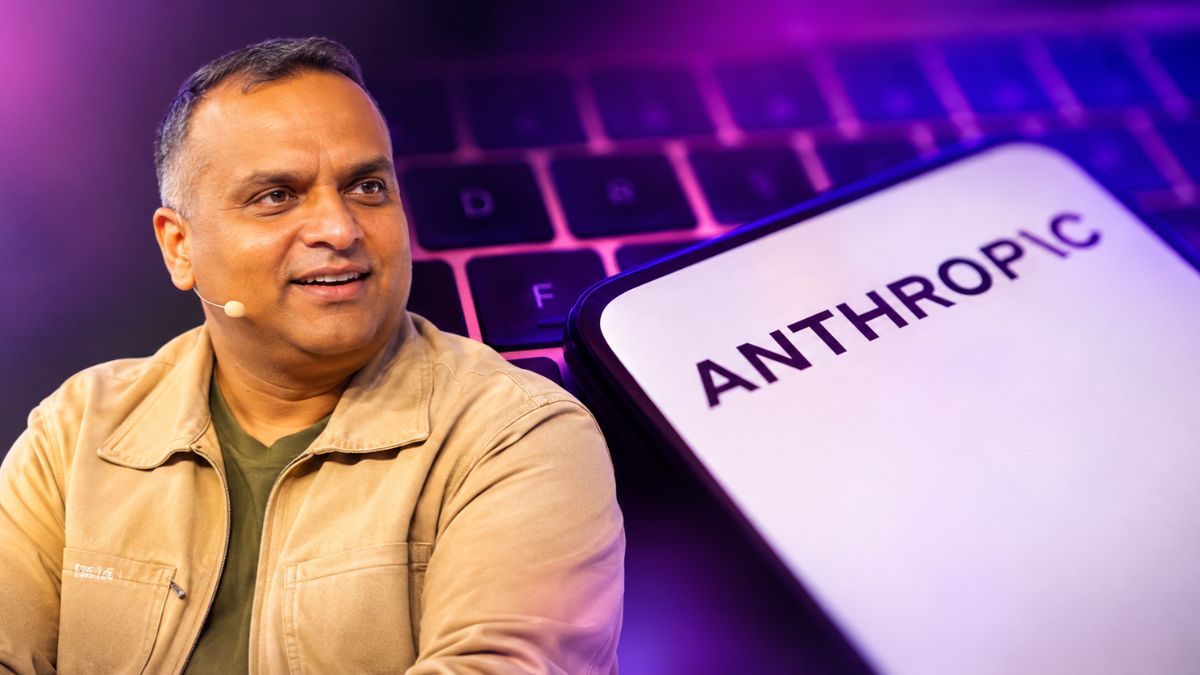
Anthropic IPO: How Indian-Origin Rahul Patil is steering its AI ambitions
Anthropic readies a Nasdaq IPO as CTO Rahul Patil focuses on resilient Claude infrastructure and enterprise AI growth. Read how.
Anthropic is getting ready for its Wall Street debut. On June 1, 2026, Anthropic confirmed that it had confidentially submitted a draft registration statement to the US Securities and Exchange Commission (SEC) under Rule 135 for an initial public offering (IPO). The filing followed a landmark $65 billion Series H funding round in May, which valued the San Francisco-based AI company at $965 billion.
The company took another major step on October 26, 2026, when it made its Form S-1 registration statement public on the SEC's EDGAR system. Anthropic has applied to list its common stock on the Nasdaq Global Select Market under the ticker symbol ANT. Goldman Sachs and Morgan Stanley are leading the underwriting syndicate, although the price range and final number of shares are yet to be determined.
For Anthropic, the IPO is more than a financial milestone. It is a new phase in which investors will scrutinise not just revenue and growth but also the reliability of the technology powering its business. Anthropic reported revenue of $16.29 billion for the six months ended June 30, 2026, compared with $1.16 billion in the same period a year earlier ( Image: Shutterstock ) Hundreds of thousands of enterprise customers depend on Anthropic's Claude models for software development, legal analysis and critical business operations.
A system outage can mean lost revenue, delayed projects and compliance complications. In a world where businesses increasingly depend on AI, even a brief disruption can have serious consequences. The person responsible for ensuring that these systems keep running is Rahul Patil, Anthropic's Indian-origin chief technology officer (CTO). He earned a bachelor's degree in computer science from PES University, formerly known as PES Institute of Technology (PESIT), in 2002.
He later moved to the US, where he completed a master's degree in computer science at Arizona State University and an MBA from the University of Washington. He is currently based in Seattle. Over the next two decades, Patil built his career around a challenge that most users rarely think about: keeping massive technology systems running without interruption. According to Fortune India, at Amazon Web Services (AWS), he played a key role in engineering AWS Kinesis, a platform that handles real-time data streaming at a global scale.
He subsequently held senior positions at Microsoft before joining Oracle as senior vice-president of cloud infrastructure. However, one of his most important career stops was Stripe, where he served as chief technology officer for more than five years. At Stripe, Patil oversaw engineering teams responsible for a global payments infrastructure processing more than $1 trillion in annual transactions.
The stakes were enormous. A few seconds of downtime could disrupt payments, affect merchants and interrupt millions of transactions. It was an environment where reliability was not a technical luxury. It was the foundation of the business. It helped shape the philosophy that would later define his role at Anthropic. Every system will fail Most technology companies sell the promise of uninterrupted services.
Patil approaches the problem differently. He believes that systems must be built with the expectation that something will eventually go wrong. During his time at Stripe, he told Fortune India, "A key to preventing user impact is accepting that failures are inevitable. So, it's important to design for failure from the ground up. Every system fails. It's not if, but how." It is a simple idea with enormous consequences.
Instead of assuming that servers, networks and software will always work, engineers must prepare for their failure. The objective is to ensure that when one component breaks, the entire system does not collapse with it. For Anthropic, the IPO is more than a financial milestone (LinkedIn/Anthropic) Think of it as an electrical circuit breaker. When one part of a system fails, the architecture should automatically isolate the problem, protect other operations and restore normal functioning.
This approach is particularly important for AI companies. Running advanced AI models requires enormous computing power, complex infrastructure and interconnected systems. A failure in one part can affect thousands of users if it is not contained quickly. Anthropic brought Patil on board as CTO in October 2025 to strengthen precisely this aspect of its business. His responsibilities span core product engineering, computing infrastructure, model inference, data science, cloud operations and cybersecurity.
His appointment also led to an organisational shift. Anthropic co-founder Sam McCandlish moved into the role of chief architect, allowing him to focus on next-generation model training. Both executives report to Anthropic President Daniela Amodei. Explaining the importance of Patil's appointment, Amodei said in a press statement that "Rahul brings a proven track record in building and scaling robust infrastructure that businesses can depend on as we work to make Claude the leading intelligence platform for enterprises," Patil, meanwhile, sees the AI revolution as an opportunity that comes with an enormous responsibility.
"AI possibilities seem endless, and it is going to be an extraordinary adventure of discoveries and effort to make these possibilities real. More importantly, it is going to require us to make a conscientious set of decisions every day to safely navigate this massive transformation and ensure that responsible AI wins,” he told Fortune India. Claude Code, enterprise customers and the business of AI Keeping AI systems running is only one part of Patil's challenge.
Anthropic must also turn its rapidly growing user base into a sustainable business. One of its biggest growth drivers is Claude Code, an AI-powered command-line tool designed to handle complex software engineering tasks with greater autonomy. Patil has described its adoption as a remarkable example of how quickly a product can gain traction when it solves a real problem. "February 4 marked the first anniversary of launching Claude Code, and its adoption trajectory has been remarkable," Patil stated regarding the product's performance in a press release.
"It represents one of the fastest-growing software platforms in enterprise history, reaching a $2.5-billion revenue run rate within its first year of operation." Anthropic is also expanding its enterprise offerings through products such as Claude Cowork, which bring AI agents into everyday workplace operations. The idea is straightforward it is that let AI handle repetitive administrative tasks so that employees can spend more time on decisions that require human judgement.
"If you talk to enterprise teams using Cowork and specialized integrations, the feedback is consistent: professionals are finally delegating repetitive administrative overhead and focusing on higher-level strategic output," Patil emphasised in an interaction with Fortune India. "Making real work better is the primary metric of AI usefulness." However, Anthropic is also taking a different approach to making money from AI.
Unlike many consumer internet platforms that depend on advertising, the company has maintained its opposition to introducing advertisements into conversational AI experiences. "We maintain a sustainable, viable enterprise business model based on subscription and API usage," Patil explained regarding monetization strategy. "If you consult a trusted professional for advice, you would not expect them to open the conversation with an advertisement.
AI assistants must preserve that same objective trust." For Patil, this also means making AI infrastructure more efficient. Training and running advanced models requires expensive computing resources, particularly powerful GPU clusters. Improving processing speeds, reducing computing costs and making better use of available hardware will be essential to maintaining profitability. Why India matters to Anthropic's global ambitions Patil's Indian roots also connect him to one of Anthropic's important growth markets.
India is currently Claude's second-largest market by user volume. Its expanding developer community and growing adoption of AI tools make it a significant opportunity for the company. The country's linguistic diversity, however, presents a unique challenge. With 22 officially recognised languages and more than 1,000 regional dialects, building AI systems that understand local contexts is far more complicated than simply translating words.
Patil has pointed to specialised applications such as Aadalat.ai as examples of how AI can transform public institutions. The platform is designed to support courtroom operations, legal research and judicial documentation, helping judges, lawyers and court staff manage their work more efficiently. Such applications demonstrate the potential of AI beyond coding assistants and consumer chatbots. They also highlight the challenges of introducing AI into institutions where accuracy, accountability and reliability are critical.
The real test begins on Wall Street Anthropic's potential Nasdaq debut will put the company under an entirely different kind of scrutiny. Investors will look beyond its billion valuation, product adoption and revenue growth. They will want to know whether the company can maintain reliable services as demand for its AI models increases. Can its infrastructure withstand sudden spikes in demand? Can it contain failures across geographically distributed data centres?
Can enterprise customers trust Claude to remain available when their businesses depend on it? These questions will become increasingly important as AI moves from being an experimental technology to a core part of business operations. However for Rahul Patil, the challenge is not to promise that nothing will ever break. It is to make sure that when something does, the damage does not spread. As the company prepares to take its ambitions to Wall Street, its success may depend as much on the systems users never see as on the AI models they interact with every day.