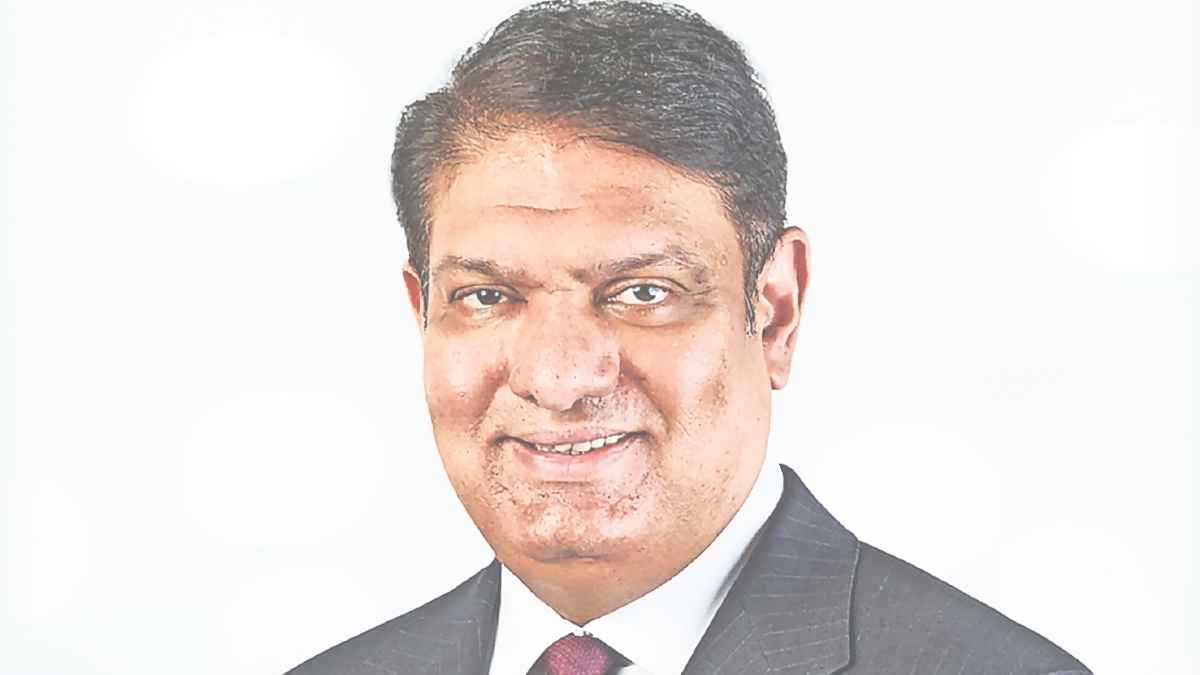
‘The biggest risk is failing to move fast enough’: Krishna Bodanapu, Executive Vice-Chairman & MD, Cyient
In an exclusive interview, Cyient MD Krishna Bodanapu details the firm's strategic expansion into semiconductors, electronics manufacturing, and AI-driven engineering services.
Krishna Bodanapu, executive vice chairman and managing director of Cyient, is steering the company beyond traditional engineering services into semiconductors, electronics manufacturing and digital technology. As engineering converges with software and AI, the Hyderabad-based firm is expanding its capabilities while drawing on its domain expertise to stand apart. In an interview with Sudhir Chowdhary, Bodanapu discusses Cyient’s growth strategy and India’s evolving role in global engineering.
Excerpts: Engineering services are expanding beyond traditional design and development into manufacturing, semiconductors and digital technology. What is driving this shift, and how do you see it evolving? The biggest change we have seen over the last decade is the convergence of engineering, technology, manufacturing and lifecycle management. Historically, these functions operated in silos. Today, products are increasingly connected, intelligent and managed across their entire lifecycle.
For us, that meant rethinking how we serve customers. We realised we needed capabilities across multiple parts of the value chain rather than operating within a narrow engineering segment. That is why we have invested in semiconductors, electronics manufacturing through Cyient DLM, and digital capabilities, including the recent acquisition of Tao Digital. As technology becomes embedded in every product and system, customers need partners who understand both the engineering domain and the digital technologies driving transformation.
How has the growing role of software and digital technology changed the nature of engineering research and development (ER&D)? The definition of ER&D has expanded significantly. If you look at something as simple as a car's fuel gauge, it has evolved from being purely mechanical to electrical, digital, connected and now intelligent. Today's products combine engineering, software, geospatial technologies, applications and increasingly, AI.
Engineering outcomes are no longer created by mechanical and electrical disciplines alone. What gives us confidence is our deep domain expertise. Technology is critical, but domain knowledge remains the differentiator. You still need people who understand how products operate in the real world, how systems behave and what trade-offs need to be made. As AI and software-defined products gain ground, how will the balance between technology and engineering expertise change?
We recognised this convergence several years ago and made a conscious decision to build capabilities around it. Technology will continue to play an increasingly important role, but our core strength remains domain expertise. Engineering is fundamentally about judgment and trade-offs. AI can provide insights and predictions, but many decisions still require deep contextual understanding. For example, predictive analytics may identify the probability of a component failure, but deciding whether to replace or continue using that component depends on engineering judgment and operational considerations.
Our belief is that the future lies in combining technology with deep engineering knowledge. That is where we see the opportunity. Where will AI have the greatest impact on engineering services over the next five years? AI will have the greatest impact wherever work is repeatable, rigorous and data-intensive. Engineering involves enormous amounts of testing, certification, documentation, compliance and validation.
These processes require consistency and precision, making them ideal candidates for AI-enabled automation. Take aerospace, for example. Documentation associated with a system can be as extensive as the engineering itself, and much of that work can increasingly be automated. Similarly, areas such as spare-parts management, predictive maintenance and operational optimisation will become far more intelligent.
Over the next few years, many of these activities will move from basic automation to AI-driven decision-making. That said, judgment remains critical. AI will become a powerful tool, but human intelligence and engineering judgment will continue to play an essential role. Are they ready for every emergency? Global companies are rethinking supply chains and manufacturing locations. What opportunities does this create for Indian engineering and electronics companies?
One of the biggest shifts we are seeing is the localisation of critical supply chains, particularly in semiconductors and manufacturing. India imports a large volume of electronics, and there is a growing realisation that critical technologies and supply chains need greater domestic capability. What I appreciate is that the Indian government's approach is practical. The objective is not to leap immediately to the most advanced technologies but to build capabilities step by step.
That creates significant opportunities. We have a partnership with a company called Azimuth that is developing a smart power metering chip, and we are also collaborating with ecosystem partners to support India's electronics ambitions. At the same time, it is important to recognise that complete localisation is neither practical nor desirable. Global supply chains have delivered scale and innovation.
The challenge is finding the right balance between resilience and efficiency. With businesses across services, manufacturing and semiconductors having different growth prospects and capital needs, how do you decide where to invest? Strategy is as much about deciding what not to do as deciding what to do. We constantly evaluate our portfolio and ask a simple question: where do we have a genuine right to win?
If another company can create more value from a business than we can, we should be pragmatic about that. On the other hand, where we have distinctive strengths, be it in semiconductors, engineering or manufacturing, we should invest aggressively. We also recognise that different businesses attract different types of investors. Services, manufacturing and semiconductor businesses operate on different economic models, which is one reason we have built separate verticals such as Cyient DLM and Cyient Semiconductors.
It allows us to attract the right investors and provide each business with the capital it needs to grow. India is increasingly taking on innovation-driven work rather than serving mainly as a cost-efficient engineering base. What advantages does the country offer today? India's greatest advantage is scale. We have a STEM talent base that very few countries can match. Beyond talent, we now have ecosystems.
If you look at sectors such as aerospace, you see global leaders, Indian companies, suppliers, talent and research capabilities all coming together. These ecosystems enable more sophisticated work and create the environment for long-term innovation. Global capability centres are also playing an important role. They are increasingly undertaking front-office and innovation-driven work rather than just support functions.
That enhances the ecosystem's overall capabilities and creates opportunities for India to move further up the value chain. Which industries are likely to offer the strongest growth opportunities as technology transforms products and operations? We deliberately maintain a diversified portfolio because industries move through cycles at different times. During the pandemic, aerospace slowed dramatically while telecom accelerated because networks needed rapid expansion.
More recently, aerospace has rebounded strongly. The key is not to over-index on any single industry. Every sector we serve is undergoing transformation, whether it is aerospace, telecom, rail, energy or healthcare. Our role is to stay close to those shifts and invest in the right opportunities at the right time. Looking ahead over the next three to five years, what will be the biggest risks and opportunities for the engineering services industry?
The biggest risk is not moving fast enough to capitalise on opportunities. The world is changing rapidly. It is easy to talk about AI, digital transformation and new technologies. The real challenge is identifying where to invest and how to deploy capital effectively. What gives me confidence is that we have strong domain expertise, long-standing customer relationships and a reputation built on trust.
Customers know we are honest about what we can and cannot do, and that trust creates opportunities for us to grow into new areas. Over the years, we have also shown a willingness to take calculated risks, whether in manufacturing, semiconductors or new technology capabilities. That willingness to evolve has been central to our growth. Ultimately, our opportunity lies in combining engineering expertise, customer trust and the courage to make the right investments at the right time. That is what will define success for us over the next few years.