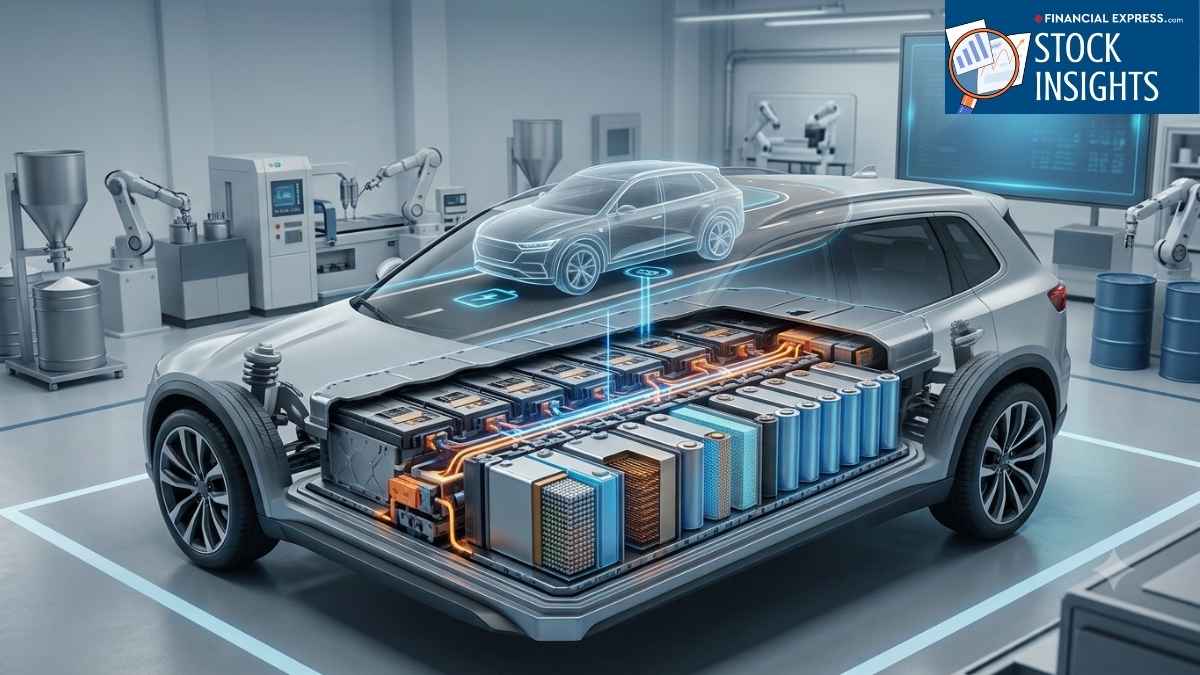
5X demand by 2030: 2 chemical stocks targeting what goes inside the EV battery
India's lithium-ion battery demand is projected to grow 5X by 2030. Can two Indian specialty chemical companies turn their battery materials investments into revenue? Their Q2FY27 results reveal the progress.
The growth of electric vehicles and battery energy storage systems is creating demand for more than just battery cells. It is also creating opportunities for companies that manufacture the specialised chemicals and materials used inside them. Global battery consumption is projected to rise from around 1,600 gigawatt-hours (GWh) in 2025 to nearly 5.7 terawatt-hours (TWh) by 2035, according to McKinsey.
India is part of this expansion, with lithium-ion battery demand expected to increase by 5X from 40 GWh in 2025 to 210 GWh by 2030. This could create opportunities across the battery supply chain, including electrolyte additives, cathode active materials and advanced anodes. However, entering this market needs substantial investment in technology, manufacturing capabilities and customer validation.
Companies must demonstrate that their products meet battery manufacturers' specifications while staying cost-competitive at commercial scale. One company is developing electrolyte additives for lithium-ion batteries using in-house technology. These additives are used in small quantities to improve battery performance, stability and lifespan. FE Stock Insights on WhatsApPGet instant alerts on high-conviction investment themes and fundamental deep dives—direct from Financial Express.Join now The company has begun commercial shipments, marking an initial step towards establishing its battery chemicals business.
The other is entering the lithium iron phosphate cathode active materials market. LFP batteries are also widely used in electric vehicles and energy storage systems. This firm is developing domestic manufacturing capabilities for LFP cathode materials, with trials planned for its new material. The move could expand its presence in the battery materials value chain and provide another avenue for growth as demand for lithium-ion batteries increases.
This matters because China still dominates 98% of global LFP production. In our previous story, we examined two stocks setting up battery material manufacturing facilities to tap into this opportunity. This story builds on that theme with two other leading chemical players tapping the battery materials opportunity. Their latest financial results (Q2FY27) offer an opportunity to assess how these investments are progressing and what lies ahead. #1 Acutaas Chemicals: Commercialising High-Purity Additives with 40% EBITDA Margins Acutaas Chemicals serves pharmaceutical originators, battery component makers and semiconductor manufacturers worldwide.
Lithium-ion batteries contain a liquid called an electrolyte. This liquid allows electrical charges to flow between the battery's positive and negative terminals. EV Supply Chain Entry: Commercialising High-Purity Additives Across 4 Product Lines Acutaas Chemicals manufactures high-purity electrolyte additives. These are specialised liquid ingredients added in small quantities to the main electrolyte solution.
They help make batteries safer, improve energy retention and extend battery lifespan. Acutaas is introducing four primary battery additive products:- Vinylene Carbonate (VC) & Fluoroethylene Carbonate (FC): These are the company's first two commercial additives. Commercial manufacturing and customer shipments are underway. Third Product: Initial commercial shipments of a third battery additive were dispatched during Q2FY27.
Sales volumes will increase in upcoming quarters. Fourth Product: The company delivered pilot-scale test batches of a fourth battery chemical to customers for evaluation and validation. Market demand in the battery chemicals sector is strong and significantly exceeds current supply. The company has a large backlog of customer orders, which will help sustain production levels in the coming quarters.
Battery additives belong to the company's Specialty Chemicals division. The company is scaling back production of these legacy products and gradually phasing them out. Revenue from the specialty chemicals in H1FY27 declined by 15.6% year-on-year to ₹71.8 crore, accounting for 9.4% of the total revenue, down from 35.9% in FY26. Replacing low-margin products with higher-margin additives boosts factory output and improves long-term profitability.
The company does not sell its chemicals on the spot market, as it is highly volatile. Instead, Acutaas enters into long-term supply contracts with major clients globally. Contractual De-Risking & Operating Leverage: How Q2 EBITDA Surged 84.6% to ₹176 Crore Notably, these contracts include 'cost pass-through' provisions for fluctuations in raw material prices and foreign exchange rates. Furthermore, Q2FY27 marked the first quarter in which Acutaas generated commercial revenue from battery chemicals.
Capacity utilisation is currently low. Sales volumes and revenue are expected to scale up over the next two to three quarters. As production volumes scale, operating leverage is expected to strengthen overall Speciality Chemicals profitability. Acutaas delivered a strong financial performance in Q2FY27. Revenue from operations grew by 42.7% year-on-year to ₹436.9 crore. EBITDA (earnings before interest, taxes, depreciation, and amortisation) surged by 84.6% to ₹176 crore, while the margin expanded by 914 bps to 40.3%.
Net profit rose by 71.4% to ₹123.1 crore. Management expects FY27 revenue to grow by 30% (compared to 25% previously), with 38-40% margins. Acutaas Chemicals Share Price #2 Himadri Speciality Chemical: Expanding from Coal Tar into Deep-Tech Battery Anodes Himadri Speciality Chemical Ltd (HSCL) manufactures carbon-based materials and chemical products. It is transitioning from traditional coal tar processing into an advanced battery materials and green energy solutions provider.
Himadri's battery materials business focuses on cathode active materials, anode active materials, and conductive additives. Beyond Coal Tar: Inside HSCL's Push to Build a 200,000 MTPA Non-China LFP Cathode Hub Himadri is building a 2,000 MTPA demonstration facility for Lithium Iron Phosphate cathode (LFP) material. Trial production is beginning in Q3FY27. The company plans to distribute samples from its commercial plant to battery manufacturers in Q4FY27.
The project aims to establish a commercial LFP cathode active material plant outside of China. In the first phase, the company plans a 40,000 MTPA commercial expansion, with an overall target capacity of 200,000 MTPA. HSCL established a 200 MTPA anode facility in West Bengal. The facility handles the full value chain from raw material processing to finished anode products. Operations began in April 2026.
Anodes, Silicon & CNTs: Securing Deep-Tech IP via IBC, Advano, and Sicona Partnerships In addition to synthetic graphite, Himadri is also improving the silicon-carbon anode material. The silicon-carbon anode delivers electrical capacities exceeding 4,000 mAh/g, compared to standard synthetic graphite anodes that deliver 360 mAh Himadri is also building India's first commercial carbon nanotube (CNT) manufacturing facility of 200 MTPA.
The plant is scheduled to be completed by Q4FY27. CNTs offer 100 times the strength of steel and the electrical conductivity of copper. They serve as conductive additives in lithium-ion battery electrodes. To establish its battery business, Himadri has entered into several partnerships. It holds a 19.44% stake in International Battery Company. The company operates a 50 MWh cell manufacturing facility in Silicon Valley and plans to set up a gigafactory in India.
It has acquired a 100% stake in the US-based firm 'Advano' to gain access to its silicon anode technology, research capabilities, and cell-testing assets. It also holds a 40% stake in 'Invati Creations' to develop electrode formulations. It also has a licensing partnership with Sicona Battery for producing silicon-carbon anode materials in India. Importantly, Himadri has signed NDAs with domestic and international customers for battery materials, CNTs, and specialty carbon black.
It already has initial commercial orders for battery applications. Management targets capacity utilisation above 50% in the first year of operation and increase it to 90%+ in the second year. Himadri reported strong growth in Q2FY27, driven by volume growth, an improved product mix and higher contribution from value-added speciality products. Q2 Financial Check: Revenue Surges 57.9% to ₹1,691 Cr as EBITDA Margins Contract to 17.9% Net revenue from operations surged 57.9% year-on-year to ₹1,691.4 crore.
EBITDA rose 27.5% to ₹303.2 crore, but margins fell to 17.9% from 22.2% in Q2FY26. However, net profit rose 31.33% to ₹231.3 crore. Sales volume rose 11%, and selling prices increased due to raw material price movements and a focus on value-added products, supporting revenue. HSCL Share Price Valuation Divergence: 38x P/E Spread Meets Contrasting Capital Return Ratios Acutaas Chemicals reports stronger return ratios than Himadri Speciality Chemical, with a return on capital employed (ROCE) of 31.6% and return on equity (ROE) of 24%.
This compares with HSCL's 22.1% and 17.8%, respectively. This indicates better returns on capital employed by Acutaas, as the company has grown earnings faster amid margin expansion. The valuation gap is equally notable. Acutaas trades at 69.8 times earnings, above its five-year median of 60.8 times and the industry multiple of 34.4 times. Valuation Comparison (X)ParticularsPrice-to-Earnings MultipleReturn RatiosCompanyIndustry5Y MedianROCE (%)ROE (%)HSCL31.637.239.222.117.8Acutaas69.834.460.831.624.0Source: Screener.in (Data as of October 28, 2026) For Acutaas, the focus will be on scaling battery additive production.
HSCL trades at 31.6x, below its five-year median of 39.2x and the industry multiple of 37.2x. Himadri's valuation will depend on its ability to commercialise new battery materials projects and improve capacity utilisation. Disclaimer: Note: Throughout this article, we have relied on data from and the company's investor presentation. We used an alternative, widely accepted and widely used source of information only when the data were unavailable.
This article is meant only to share interesting charts, data points, and thought-provoking opinions. It is NOT a recommendation. If you wish to consider an investment, you are strongly advised to consult your advisor. This article is strictly for educational purposes only. About the Author: Madhvendra has been deeply immersed in the equity markets for over seven years, combining his passion for investing with his expertise in financial writing.
He simplifies complex concepts and shares honest perspectives on startups, listed Indian companies, and macroeconomic trends. A dedicated reader and storyteller, Madhvendra thrives on uncovering insights that inspire his audience to deepen their understanding of the financial world. Disclosure: The writer and his dependents do not hold the stocks discussed in this article. The website managers, its employee(s), and contributors/writers/authors of articles have or may have an outstanding buy or sell position or holding in the securities, options on securities, or other related investments of issuers and/or companies discussed therein.
The articles' content and data interpretation are solely the personal views of the contributors/ writers Investors must make their own investment decisions based on their specific objectives, resources, and only after consulting such independent advisors as may be necessary.