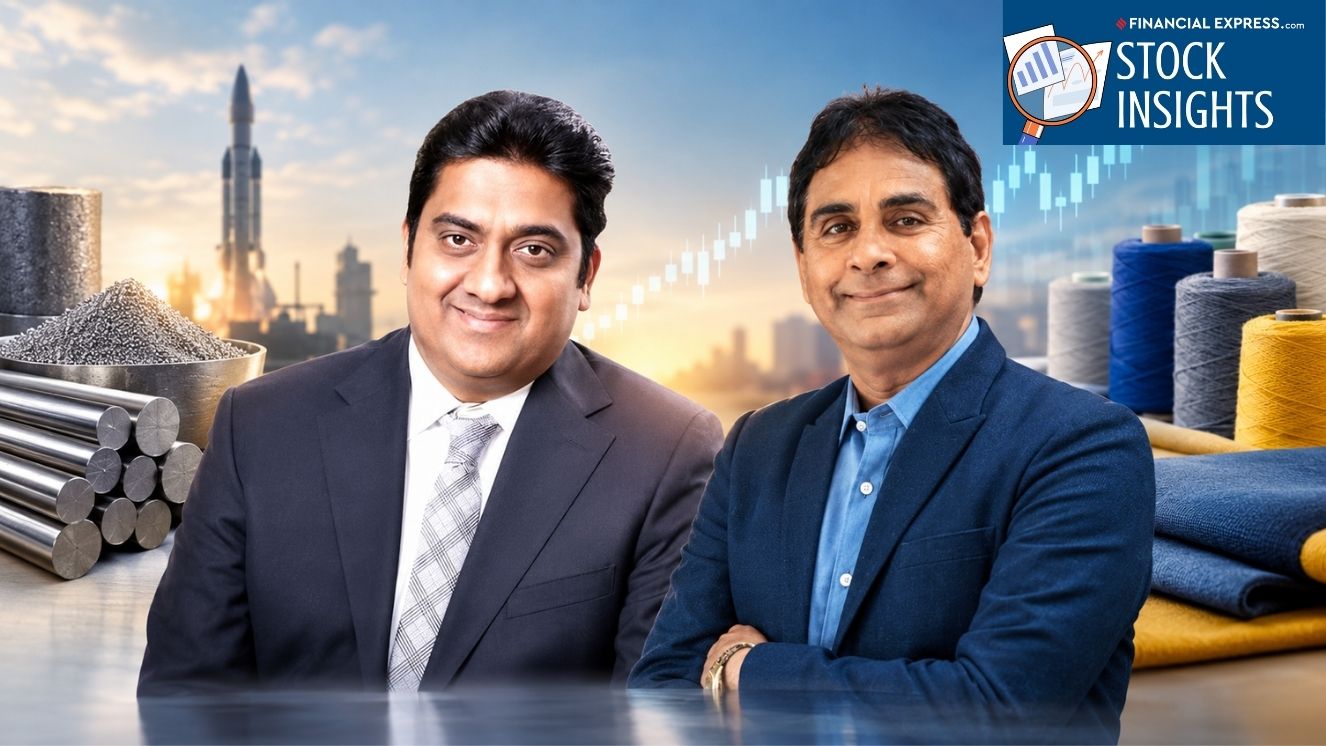
2 ‘underdog’ stocks Mukul Agrawal and Vijay Kedia just added to their portfolios
Mukul Agrawal has just paid Rs 210 apiece for warrants in a small tungsten maker that sold shares to other investors at Rs 131 barely ten weeks earlier. Vijay Kedia took a quieter road into a technical textile maker, and was on its register before the IPO even opened. Two fresh SME bets, two very different entry tickets.
Mukul Agrawal and Vijay Kedia portfolio: 2 new stocks in the September 2026 filings The September 2026 shareholding filings have thrown up two names few investors knew a quarter ago. Both are small. Both trade on NSE Emerge, the exchange's platform for small and medium enterprises (SMEs). And both now carry the name of a market veteran on their register. Mukul Agrawal, who runs Param Capital, has taken a position in a Hyderabad maker of metal powders and tungsten parts that end up in rockets.
Vijay Kedia, known for his SMILE approach to small companies, shows up in a Gujarat maker of technical yarns that listed only in September. The more telling detail is not what they bought. It is the price each paid to get in. One word of caution before the numbers. SME stocks follow lighter disclosure rules, trade in fixed lots rather than single shares, and can be hard to exit when buyers dry up.
Read every figure below with that in mind. FE Stock Insights on WhatsApPGet instant alerts on high-conviction investment themes and fundamental deep dives—direct from Financial Express.Join now #1 Innomet Advanced Materials: Mukul Agrawal's Rs 25 crore tungsten defence bet Incorporated in 1984, Innomet Advanced Materials moved from diamond tools into metal powders in 2004 and now runs two divisions.
One makes copper, bronze and nickel powders for auto parts and welding. The other, called Innotung, makes tungsten heavy alloys, an extremely dense metal used in defence, aerospace and radiation shielding. On its June 2026 earnings call, filed with NSE, the management said the company is qualified to supply pre-fragments for Pinaka rockets. It counts HAL and BDL among its tungsten customers. It also said China's curbs on tungsten exports have pushed buyers to look at India as an alternative.
That is the hook for defence stock watchers. As per the September 2026 shareholding filing, Mukul Agrawal holds 2,26,200 shares, or about 1.7% of the company, worth roughly Rs 6.2 cr at today's price. The bigger move came next. On 23rd October 2026, the company informed NSE that it had allotted 11,92,200 warrants to him at Rs 210 each, a commitment of about Rs 25 cr. Each warrant can be converted into one share.
Here is the twist. On 18th August 2026, Innomet had issued 4.5 lakh shares to non-promoter investors and 5 lakh warrants to its promoters, all at Rs 131. Mukul Agrawal's warrants are priced 60% higher. That gap reflects timing more than generosity, because SEBI's pricing rules tie such issues to recent trading prices, and the stock ran hard in between. If every warrant is converted, his holding would rise to roughly 9.4% of the enlarged share base.
3022.1823.2924.9032.5253.8134%EBITDA (Rs cr)1.121.695.734.365.055.6038%Net Profit (Rs cr)0.200.553.222.521.871.57NM Source: Screener.in EBITDA here refers to operating profit before other income. NM: not meaningful, as the FY21 base is near zero. Sales have more than quadrupled in five years, and FY26 revenue alone jumped 66%. Profit is a different matter. Its five-year growth rate only looks dazzling because it starts from Rs 0.20 cr.
Over three years, net profit has in fact shrunk by about 21% a year, from Rs 3.22 cr in FY23 to Rs 1.57 cr in FY26. Other income of Rs 0.32 cr also made up about 13% of FY26 pre-tax profit. The second half of FY26 was the weak spot. Sales rose to Rs 30.33 cr, yet the operating margin fell to 4.5% and the company posted a small loss of Rs 0.44 cr. The management blamed a sudden spike in tungsten and copper prices.
It also wrote off Rs 1.92 cr of development costs the auditor could not validate, and reversed Rs 2.96 cr of revenue booked for a technology deal that fell through. Order book, Israel exports and the Swastik Tungsten buy The bull case rests on what comes next. Orders worth Rs 35.99 cr were booked in the first two months of FY27, the management said. That is more than half of last year's revenue, and about 77% of it is tungsten heavy alloys.
A single export order from Israel's Scope Metals was pegged at about Rs 15 cr. In February 2026, Innomet also bought 57.5% of Swastik Tungsten through the NCLT route for around Rs 1.5 cr, to secure raw material. On 13th October, it disclosed fresh orders from Federal-Mogul Goetze and a Japanese buyer. Innomet share price and PE ratio: Priced at 228x earnings Innomet came to market in September 2024 at Rs 100 a share and listed at Rs 190.
The share price of Innomet then slid to a 52-week low of Rs 63.2. A sharp rally took it to Rs 276 as of closing on 27th October 2026, more than four times that low. Shareholders have grown from 799 in September 2024 to 1,255. As for valuation, the stock trades at a PE of about 228x against a current industry median of about 20x. A 10-year median PE does not exist yet, as the stock has been listed for just over two years.
At over eight times book value, with return on equity of 3.7% and return on capital of 5.7%, the price is a bet on the order book, not the past. Promoter holding slipped to 55.02% in September 2026 from 56.72% in March, largely because new shares went to other investors. More dilution lies ahead as warrants convert. These are not yarns for shirts. They go into filters, flame-retardant workwear, PPE kits, car seat fabric and carpets.
Its IPO document, filed with NSE, shows exports made up about 39% of FY26 revenue, with China its largest export market. Kedia did not buy this one on the open market. He was already a shareholder before the IPO, with 6.57% of the pre-issue capital. The IPO, priced at Rs 92 and subscribed more than 130 times, added 61.25 lakh new shares, which diluted that stake. The September 2026 filing shows him with 10,35,000 shares, or 4.73%, worth about Rs 13.2 cr at today's price.
Singularity Equity Fund II, backed by Madhusudan Kela, also holds 1.72% through the anchor book. Ashutosh Fibre financials: Margins jump to 26% Financial YearFY22FY23FY24FY25FY264Y CAGRSales (Rs cr)89981101141177%EBITDA (Rs cr)91016183136%Net Profit (Rs cr)33791652% Source: Screener.in Only five years of data are available, so the growth rate covers four years (FY22 to FY26). EBITDA here refers to operating profit before other income.
This is a margin story, not a sales story. Revenue grew about 7% a year, and just 3% in FY26. But operating profit nearly doubled in FY26 to Rs 31 cr, lifting the margin from 16% to 26%. The IPO document shows raw material costs fell from about 62% of revenue in FY24 to 55% in FY26, helped by a richer mix of specialty yarns and kinder input prices. Return on equity stood at a strong 36.6%. Cash flow backs this up.
Operating cash flow rose to Rs 21 cr in FY26, and free cash flow was Rs 11 cr. Borrowings stood at Rs 48 cr in March 2026. Of the IPO money, Rs 20 cr is set aside to repay debt and about Rs 25.5 cr will go into new machinery. The plant ran at about 96.5% of capacity in FY26, so it needs the extra room to grow. Ashutosh Fibre share price: Above the IPO price, below listing day Ashutosh Fibre listed at Rs 140 on 7th September 2026 against an IPO price of Rs 92.
The share price of Ashutosh Fibre as of closing on 27th October 2026 was Rs 127.50. That is 39% above the issue price, but 9% below the listing price and 27% below its post-listing high of Rs 174.5. On valuation, the stock trades at a PE of about 17x, and the current industry median PE of about 19x. There is no 10-year median PE to compare, as the stock has traded for under two months. The open question is whether a 26% margin can last when key inputs track crude oil.
The Disclosure Disconnect: Understanding SME Risks Three things stand out. First, supply. Half of the anchor shares came out of lock-in in early October, and the rest come free in early December 2026. Domestic institutions had already cut their holding from 10.7% at listing to 8.9% by 30th September. Second, concentration. The top customer brought in 21.8% of FY26 revenue and the top ten close to 69%, with no long-term contracts.
Third, disclosure. On 21st October, the company told NSE that the quarterly corporate governance report does not apply to it, which is standard for SME listings. Results come every six months, and the first-half FY27 numbers are still due. What Mukul Agrawal and Vijay Kedia's SME bets tell retail investors Side by side, the lesson is about cost, not conviction. Kedia was in before the IPO, so he never had to pay a listing-day price.
Mukul Agrawal is paying a market-linked price for a story still being written, a tungsten maker whose order book is racing ahead of its profit. Ashutosh Fibre is the steadier business on paper, with real profit, strong returns and a modest PE. But its margin jump is only a year old, and more shares hit the market in December. Innomet is the bolder bet, riding defence demand and China's tungsten squeeze, priced at 228 times earnings with little profit to show so far.
Anyone buying Innomet today pays about 31% more than Mukul Agrawal's warrant price. Anyone buying Ashutosh Fibre pays 39% more than the IPO price, the last price at which the company sold shares. The next half-yearly results will show whether the margins and the orders hold up. Until then, a sensible step would be to add these stocks to a watchlist and track the filings closely. Disclaimer Note: We have relied on data from www.Screener.in and www.trendlyne.com throughout this article.
Only in cases where the data was not available, have we used an alternate, but widely used and accepted source of information, including filings made available on the BSE website. The purpose of this article is only to share interesting charts, data points and thought-provoking opinions. It is NOT a recommendation. If you wish to consider an investment, you are strongly advised to consult your advisor.
This article is strictly for educative purposes only. Suhel Khan has been a passionate follower of the markets for over a decade. During this period, He was an integral part of a leading Equity Research organisation based in Mumbai as the Head of Sales & Marketing. Presently, he is spending most of his time dissecting the investments and strategies of the Super Investors of India. Disclosure: The writer and his dependents do not hold the stocks discussed in this article.
The website managers, its employee(s), and contributors/writers/authors of articles have or may have an outstanding buy or sell position or holding in the securities, options on securities or other related investments of issuers and/or companies discussed therein. The content of the articles and the interpretation of data are solely the personal views of the contributors/ writers